The artistic trajectory of Olanrewaju Atanda is a beautiful and enthralling vicissitude in self-expression, born out of cultural immersion. Although his formal education in art did not culminate in a Fine Arts degree, Atanda’s “muse” proved persistent. His early inclinations mature over time through a self-driven quest to hone his skills by learning from master-artists, navigating the galleries and studios of Lagos and getting immersed in art through workshops organised by them. This constant search has helped him develop a style that is both personal in its candor and sophisticated in his approach to merging diverse identities.
The dual sensibilities in the artist’s oeuvre serve as a bridge between two distinct but connected cultural environments of Nigeria and the United Kingdom. The images from the cultures of the two countries dominate in his paintings and drawings. Atanda’s foundational years were shaped by the vibrant, high-octane energy of Lagos city. Although Yoruba culture and lifestyle predominates in the city, which was Nigeria’s former capital, it remains a melting pot of many Nigerian cultures with a huge representation of its 250 ethnic groups, including Hausa, Igbo, and Yoruba – the country’s three major ethnic groups. Also, Lagos business and cultural influences extend to other parts of West Africa. The city’s deep well of inspiration greatly inspired and shaped Atanda’s early predilection to the arts.
Upon migrating to the United Kingdom, Atanda encountered a boisterous and established European world metropolis known for its rich and diverse art scene. The United Kingdom’s acceptance of other cultures could be read in its galleries and museums. Rather than discard one’s heritage, it can easily fit into the established multi-template of its culture ecosystem, making his works become “cultural ambassadors,” living in the intersection between his Nigerian roots and his British present, reflecting a modern definition of citizenship: one defined not just by indigeneity, but by the movement of people through the lenses of postcolonialism, education, and international cooperation.
In his portraiture suite, Atanda pays social tribute as he demonstrates a keen interest in the human condition by making a portrait of the late Fela Anikulapo Kuti who championed the cause of the masses throughout his music career. The portrait does not only honor the Yoruba-Nigerian musical icon and social justice advocate but his portrayal reminds one of the valuable legacies of art as a tool for social justice and activism.

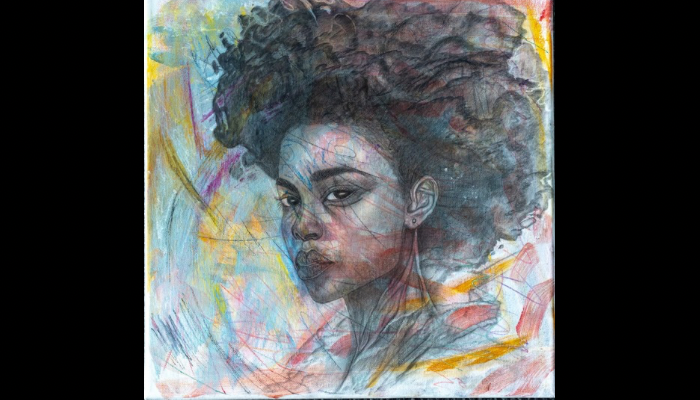
Contrasting Fela’s portrait is a graphite study (with patches of colour on its background) of a woman with an Afro hair titled ‘Beautiful Chaos’, a tribute to the ‘African Mother’. Here, Atanda’s technical skill meets emotional depth, celebrating the many sacrifices of women in the sustenance of humanity, which are sometimes not appreciated. Atanda’s exploration of the concept of womanhood and an embrace of his new environment is further highlighted in a series of studies featuring a European nude model, which he entitled ‘Seduction’. These works, rendered with a deliberate use of chiaroscuro, mark a pivotal period in his career: a conscious effort to decode the anatomy and aesthetics of his new society.
“My inspiration comes from aspects of my native culture and in recent times from European society. I allow myself to absorb influences with much intentionality,” says Atanda.
Atanda’s second suite is a foray into wildlife and sustenance of nature, which reveals his affinity for the natural world, often using animals in his paintings as both subjects and metaphors for strength and adaptation.
In his work titled ‘The Guidance of Hope’, which he made with colored pencil on black paper, Atanda painted an image of a majestic reindeer, which was featured as a standout work in the ‘All About Animals’ exhibition, which was held in Glasgow and Scotland. For Atanda, the reindeer represents a shift from a distant, mediated image (seen in documentaries and on Christmas cards in Africa) to a tangible reality in Europe. The piece captures the animal’s massive antlers and stoic gaze, symbolizing resilience, a quality that is key to living.
Also exhibited in Glasgow’s “Our Feathered Friends” show, Atanda’s lone eagle serves as a nostalgic link. While the bird is a global subject, recognized and depicted by almost every part of the world, it is closer to Atanda, as it is a central figure in the Coat of Arms of his country of origin, representing strength and dignity across borders.

Some months back, Atanda took part in a group exhibition titled “Our Heritage: The Kingship Exhibition” where he showcased drawing and paintings inspired by Nigerian heritage rooted in the Benin and Ife art heritage. The over-aching vision of the show was to honour the creativity, innovation and reach of African art within the historical contexts of global artistic achievement.
Atanda is an artist in a state of constant discovery. His work does not merely document his surroundings; it also interrogates them. By weaving together the nostalgic textures of Nigeria with the contemporary realities of the United Kingdom, he offers a vision of the world that is inclusive, diverse, and profoundly human. As he continues to explore the environments and “landscapes of life,” his portfolio remains a vital testament to the power of cultural synthesis.
Agwu Enekwachi, the writer, is an artist, art critic, culture writer and he lives in Abuja