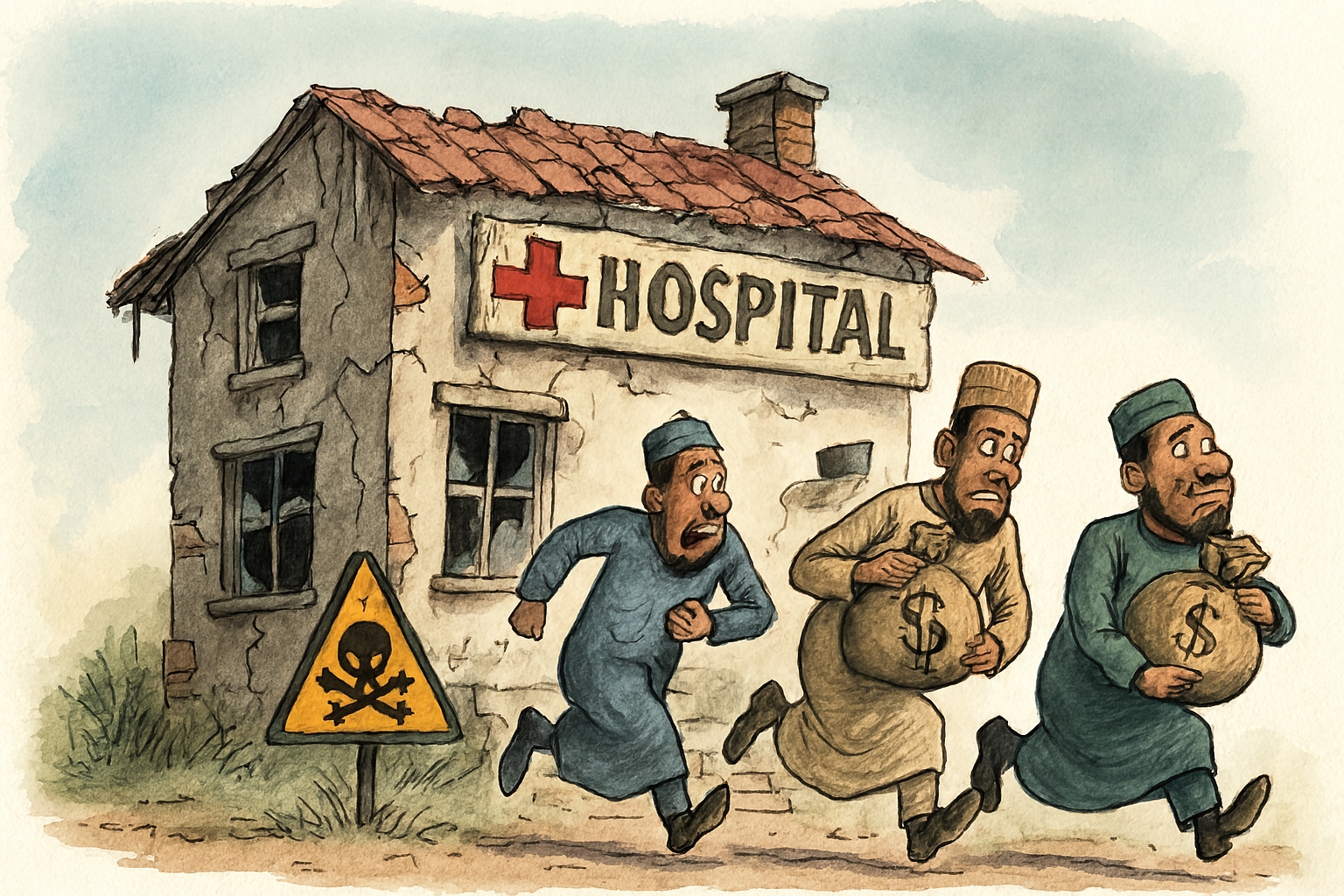
…Many seek justice, call for regulation
No matter how death comes, it is devastating to the bereaved. But death in the new year, and sadly, an avoidable one, is more devastating, as the bereaved keep blaming themselves for all that went wrong.
The above has continuously been the case of many whose loved ones and family members would have been alive today or lived longer if not for the unprofessional handling by some medical personnel, amid poor facilities that led to the avoidable and unnecessary deaths.
Call them ‘killer facilities’ or ‘killer personnel’, they deserve even the worst name tagging as the loss they cause to families of their victims is irreparable, while some hardly survive the pain.

The cases of poor handling and avoidable deaths are too many to recount as the bereaved usually bury their dead, bear the loss alone, and the killer facilities and personnel go scot-free, while waiting for the next victims.
A case in point is the recent avoidable death of Nkanu, one of the twin sons of Chimamanda Ngozi Adiche, a USA-based Nigerian writer, on January 6, 2026 in a Lagos hospital.
“We brought in a child who was unwell but stable and scheduled to travel the next day. We came to conduct basic procedures. And suddenly, our beautiful little boy was gone forever. It is like living your worst nightmare. I will never survive the loss of my child,” Adichie, a devastated mother, who was in Nigeria on a family holiday during the festive season, mourned.
She regretted that her son would have been alive today if not for an incident at Euracare Hospital on January 6, 2026.
According to the writer, her son was given too much propofol by the facility’s anesthesiologist, and he became unresponsive, and later died of cardiac arrest due to the unprofessionalism and carelessness of the doctor.

“How can you sedate a sick child and neglect to monitor him”? She asked rhetorically, while further decrying the manner in which the anesthesiologist casually switched off Nkanu’s oxygen and again decided to carry him on his shoulder to the ICU.
On October1, 2025, while the country was celebrating the independence anniversary, the Eboh family and friends were burying their patriarch who suffered severe pains for weeks after a major surgery at a Lagos hospital, where a surgical tool was left in his abdomen.
The 70-year-old man did not survive the second surgery to remove the surgical blade.
“We insisted on being in the theatre during the second surgery but the doctors said it was unprofessional, against medical procedures and would make them to lose concentration.
Read also: From Sokoto forests to Capitol Hill: How Nigeria’s insecurity is being fought in Washington
“But with all their concentration, they still couldn’t keep our father alive. We regretted going to that hospital despite the millions they charged us,” Nnenna, the spokesperson of the bereaved family, lamented.
She noted that though the hospital management admitted that a mistake was made, and offered financial assistance, their father’s death was avoidable.
In Adichie’s case, the hospital extended its deepest sympathies, but in a statement, denied any wrongdoing, stating its treatment met international standards.
Same was the case for Funmi Ajibola, a middle-aged woman, who was wrongly amputated, when her diabetes case can be controlled and save her from losing her right leg.
According to Mutiu, Funmi’s husband, a team of doctors at a government hospital at Ibadan, had serious arguments before the amputation.
“It was weeks after, when we went for the routine check that one doctor said that my wife’s right leg would have been saved if the senior doctor had listened to them.
“I confronted the doctor later, instead of apologizing, he insisted that the amputation was the last resort and that it followed international standards and procedures. I was angry and wanted to sue him, but that requires good money for a smart lawyer, which I don’t have,” Mutiu Ajibola, the husband, said, while giving up on taking a legal action.
The above has furthered the call on the government and the regulatory agencies, especially the Nigerian Medical Association (NMA) and the Ministry of Health to checkmate the negative trend by bringing perpetrators to justice, suspending licenses and shutting down such killer facilities, or a section notorious for such cases.
Adichie is also extending the call, as she sadly pointed out that the anesthesiologist was criminally negligent.
“He was fatally casual and careless with the precious life of a child. No proper protocol was followed.
“We have now heard about two previous cases of this same anesthesiologist overdosing children. Why did Euracare allow him to keep working? This must never happen to another child,” she insisted, while pushing the call to action to the authorities.
While the nation was mourning Nkanu’s unfortunate passing, another case of a woman, Aishatu Umar, a mother of five, surfaced. She died as a result of negligence as has been accepted by the authorities.
Reports had it that her death resulted from medical negligence at the Abubakar Imam Urology Centre, Kano, following a surgical procedure, prompting the Kano State Hospitals Management Board to openly admit the irreversible error.
In a statement last Tuesday, the Board’s Public Relations Officer, Samira Suleiman, said a preliminary investigation confirmed that surgical scissors were mistakenly left inside the patient’s body during surgery.
“The preliminary findings of the investigation ordered by the Executive Secretary, Dr. Mansur Mudi Nagoda, revealed clear medical negligence, as surgical scissors were left inside the patient after the procedure,” Suleiman said. Following the findings, the Board announced the immediate suspension of three hospital personnel directly involved in the surgery, pending the outcome of further investigations.
But the question remains, will the suspension of the personnel restore the life of Mrs. Umar?
Weighing in on the growing cases of negligence in hospitals, Olisa Agbakoba, SAN, senior partner, Olisa Agbakoba Legal, OAL, noted that “Patients are dying in Nigerian hospitals, not because their conditions were untreatable, but because the system meant to protect them has collapsed.”
He raised concerns about preventable deaths caused by systemic failures in Nigeria’s healthcare regulation. Referencing recent tragic cases, including the death of Nkanu Nnamdi, Agbakoba highlighted deep-rooted issues: weak oversight, compromised investigations, and the absence of an independent regulatory framework to hold practitioners and facilities accountable.
Agbakoba, who has over 20 years of experience in medical malpractice litigation, called for immediate reforms, including the establishment of an independent health regulatory authority, reinstatement of Chief Medical Officers, transparent inspections, and a clear separation between policy-making and enforcement.
According to him, “Lives are being lost to errors that should never happen. The time for silence is over. This is a governance failure. This is a regulatory failure. And it is costing Nigerian lives.”
Chijioke Umelahi, an Abuja-based lawyer, thinks that cases of avoidable deaths are rising because Nigerians hardly take legal actions against the hospitals and their personnel.
Such cases, according to him, can be treated as criminal case, with the bereaved getting due compensations for perceived wrong treatment, negligence or professional error.
But he regretted that most Nigerians are not aware of their rights to institute legal action in such cases and that once someone dies, the family is set for the burial plan without investigating the cause of the death, even when it is an avoidable death.
“The Nigerian laws provide for the prosecution of medical personnel or facilities for medical errors and negligence, especially when such leads to death. But many hardly go that route.
“They prefer to bury their dead peacefully, forgetting that a befitting burial is not the amount spent but the resolution of everything concerning the dead before his or her burial to forestall contentious issues tomorrow. Don’t be scared to sue your doctor to stop his or her excesses, it is your right and there are many lawyers out there to hire,” he said.
Nathan Asalu, a medical consultant, blamed the trend on the management of the said facilities, which prefer money to name, as competence and professionalism, according to him, are the major criteria for employing personnel in any medical facility because irreparable human lives are involved.
“We have people who own hospitals without any medical background and others who run two outlets; one for the government and the other as a private business. It boils down to business. Whatever gives good returns on investment, people go for it. But medical line, whether business or practice, should be restricted to professionals only,” he insisted.
Asalu further stated that it is time the Nigeria Medical Association (NMA) put its foot down and punish culprits in a bid to sanitise the health sector.
“It is not only the politicians and civil servants that are corrupt, there is corruption in the medial line too. We have hospitals that claim facilities and services they don’t have nor render and they are still out there.
“We have cases of doctors who managed to pass from medical schools handling cases beyond them in many hospitals as the owners have either relocated abroad or are busy in government hospitals, which is their primary place of assignment.
“The NMA should collaborate with the EFCC and others to fish out these bag eggs in the system. Sadly, the government knows them and yet allows them to thrive,” Asalu decried.
Read also: When hospitals shut, care must not: Why Nigeria’s health system needs a ‘great decoupling’
Asalu also suggested that the government should declare an emergency over the health sector, fund it, encourage local pharmaceutical production and other medical services, and tariffs on essential medical diagnostic equipment.
“You need to pay healthcare workers well enough to boost their service delivery, curb brain drain and also enforcement regulations in the sector to curb misdiagnosis. A lab professional and others who oversaw wrong diagnosis that led to the death of a patient should be tried in a law court and punished accordingly. It is not harsh because someone died for their incompetence,” he concluded.
Explaining why the case is on the rise, Felix Nzube Chukwuneke, senior lecturer, Department of Maxillofacial Surgery, College of Medicine, University of Nigeria, Nsukka, in his paper titled, “Medical incidents in developing countries: A few case studies from Nigeria”, stated that clinical negligence and medical errors are rife in most developing countries such as Nigeria because of chain reactions of events.
The events, according to the university don, include: cultural notion regarding adverse medical events; poverty and financial ineptitude to pursue legal action against perceived negligence; ignorance the rights of the individual to seek redress in court in the face of gross clinical negligence and serious harm; indifferent attitude of health care provider toward their patients’ well-being; limited options of treatment; and poor health care delivery system.
But the university don also noted that despite the rising cases, clinicians and health care providers in Nigeria and elsewhere are not infallible and a lot have been doing their job diligently in keeping the good reputation of the health care profession.
Many are also calling on the Lagos State government, which promised to investigate Adichie’s son’s death, to make public the result of the investigation and bring the culprit to justice to serve as deterrent to others.
While expecting government’s hammer on erring medical facilities and personnel, some observers have called on the government to declare an emergency over the health sector, fund it, encourage and regulate private and government participation, other medical services and tariffs on essential medical equipment that will boost efficiency.
“You need to pay healthcare workers well enough to boost their service delivery, curb brain drain and also enforcement strict regulations in the sector to curb medical errors, negligence and misdiagnosis,” one observer suggested.
“Set up a special court to try such cases and ensure justice for victims, revoke practice licenses, Certificate of Occupancy of the facilities, if need be, to ensure compliance and save lives,” another concluded.