Nigeria’s push to digitise government operations is entering a critical test as federal ministries, departments and agencies (MDAs) prepare to spend nearly N24 billion on software projects in 2026, even as regulators warn that more than half of public-sector IT projects routinely fail.
Budget details from the 2026 Appropriation Bill show that the National Identity Management Commission (NIMC) and nine other MDAs account for the largest software allocations among 115 agencies slated for IT procurement this year. The spending spans identity management, education, mining, cybersecurity, health, finance and immigration, sectors central to the government’s digital governance ambitions.
Yet the scale of the investment is reviving long-standing concerns about weak oversight, duplication of systems and value leakage, especially in a fiscal environment where public trust in government spending remains fragile.
Read also: Software testers push for digital trust as ANST holds 8th annual conference

Identity, education lead spending surge
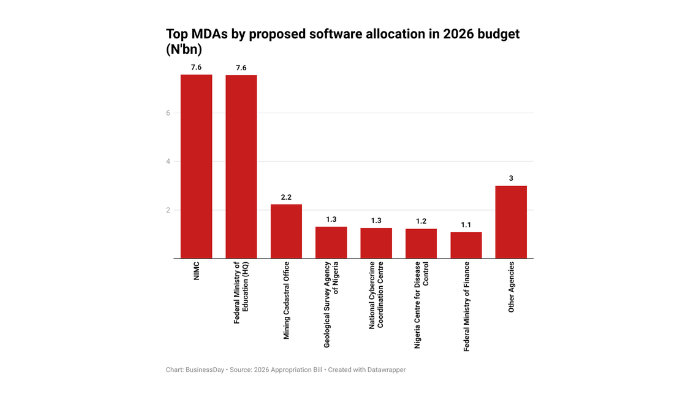
NIMC alone is expected to spend N7.58 billion on software in 2026, the single largest allocation among federal agencies. The spending underscores the strategic importance of Nigeria’s national identity infrastructure, which underpins financial inclusion, security screening and social programmes.
Close behind is the Federal Ministry of Education (Headquarters), with a proposed N7.55 billion software budget, reflecting expanded digitisation of education administration, data management and examination systems.
Other major allocations include the Mining Cadastral Office (N2.23 billion), the Geological Survey Agency of Nigeria (N1.32 billion), the National Cybercrime Coordination Centre (N1.26 billion) and the Nigeria Centre for Disease Control (N1.23 billion). The Federal Ministry of Finance is set to spend N1.09 billion, while the Nigeria Immigration Service and the Budget Office of the Federation round out the top spenders.
Together, the allocations highlight how deeply software now sits at the core of Nigeria’s administrative machinery.

A familiar problem: Spending without results
Despite the scale of investment, regulators say outcomes have consistently fallen short.
The National Information Technology Development Agency (NITDA) disclosed last year that 56 percent of IT projects executed by federal public institutions failed, largely due to poor compliance with mandatory IT Project Clearance Guidelines.
“These projects fail because they are not cleared to ensure alignment with national standards and priorities. We must stop wasting public funds on fragmented, uncoordinated IT systems that don’t deliver value,” Kashifu Inuwa, NITDA director-general said.
According to NITDA, the technical nature of software projects often shields them from rigorous scrutiny during National Assembly budget defences, creating opportunities for inflated costs, duplication and misaligned systems.
Procurement risks and abuse
The Bureau of Public Procurement (BPP) has echoed these concerns, warning that software and IT projects are increasingly used to mask inefficiencies and corruption.
“Most IT projects are intangible, and some MDAs use them as a cover to siphon public funds. We have seen projects presented without standardisation, which leads to inefficiencies and corruption,” said Adebowale Adedokun, director-general of the BPP.
The absence of shared platforms, common standards and price benchmarks has meant agencies frequently procure similar systems independently, often at vastly different costs.
Read also: Our Property NG #1 Real Estate & Property Management Software in Nigeria
Capital flight through code
Beyond governance concerns, industry experts say Nigeria’s software spending has become a missed industrial opportunity.
Jide Awe, an IT expert, said a significant share of government software budgets flows abroad due to MDAs’ preference for foreign solutions, even where local alternatives exist.
“One major problem is that the money is not being pumped into the economy. Most agencies still prefer to import software, and the funds that could support local developers end up leaving the country,” Awe told BusinessDay.
The Institute of Software Practitioners of Nigeria (ISPON) estimates that Nigeria loses about N156 billion annually to software importation, a trend it says is reinforced by government procurement practices.
Moves to rein in waste
In response, the BPP says it has introduced standard bidding documents for IT procurement and is working more closely with NITDA to reduce duplication and improve transparency.
Adedokun has also called for centralised procurement of software licences for major global vendors and the creation of a national IT price intelligence template to curb contract inflation.
“With proper coordination and standardisation, we can turn IT from a liability into a powerful asset for national development,” he said.
For now, Nigeria’s rising software budgets present a paradox: a state eager to modernise, yet still grappling with the basic discipline required to ensure that billions spent on code translate into better services, stronger institutions and real economic value.