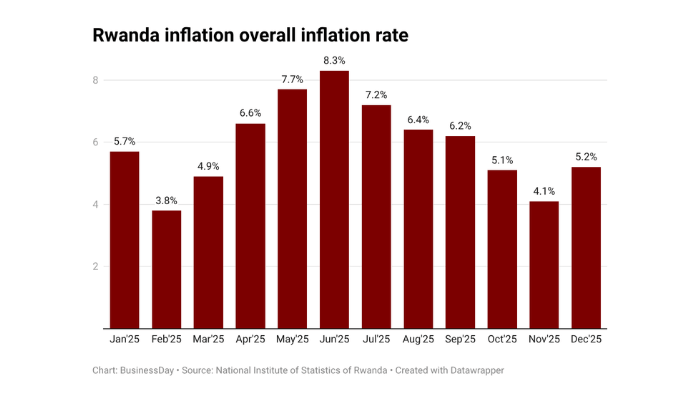
Rwanda’s inflation accelerated for the first time in six months in December 2025, rising to 5.2 percent from November’s nine-month low of 5.1 percent, driven largely by higher food and fuel prices, according to data from the National Institute of Statistics of Rwanda (NISR).
The December reading was the highest since September, marking a reversal after food prices posted their first deflation in a year.
Price pressures were broad-based. Faster inflation was recorded in alcoholic beverages and tobacco (15.1 percent from 14.4 percent), housing and utilities (4.9 percent from 4.5 percent), transport (7.8 percent from 7.6 percent), and healthcare (63.6 percent from 62.9 percent).
On a monthly basis, however, consumer prices fell by 0.6 percent in December, following a 0.1 percent decline in November, the sharpest month-on-month drop in five months.
Read also: Why Nigeria posted Africa’s biggest passport power decline in 20 years
A breakdown of the data shows that prices of food and non-alcoholic beverages rose by 3.6 percent year on year, while alcoholic beverages, tobacco and narcotics increased by 16.7 percent. Housing, water, electricity, gas and other fuels climbed 8.4 percent, transport rose 9.4 percent, restaurants and hotels increased 17.4 percent, and health surged by 70.8 percent.
Core inflation, which excludes fresh food and energy, stood at 8.9 percent year on year in December and rose by 0.3 percent compared with November, signalling persistent underlying price pressures despite the monthly decline in headline inflation.
The Consumer Price Index (CPI), which tracks average price changes for goods and services purchased by households across urban and rural Rwanda, is compiled using a modified Laspeyres formula. The index is based on a basket of 1,622 products, with more than 40,000 prices collected nationwide each month from markets, shops, hospitals, schools and other outlets.