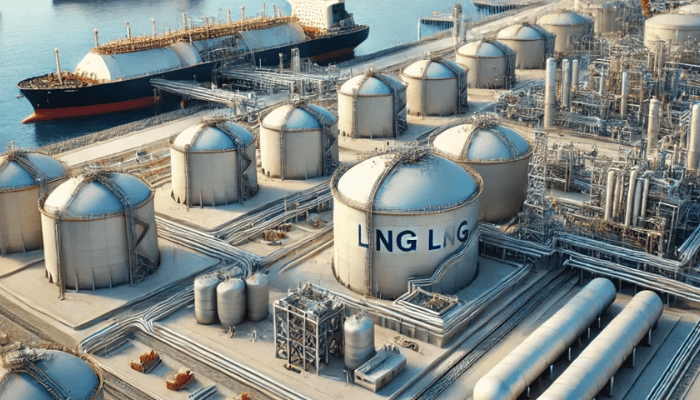
Nigeria’s liquefied natural gas exports reached a five-year high of 2.1 billion cubic meters in December 2025, marking a reversal of fortunes for Africa’s largest LNG producer as improved feed-gas availability breathes new life into facilities that have struggled with supply constraints for years.
The surge in Nigerian shipments stands in stark contrast to the performance of regional rival Algeria, whose LNG exports plummeted to a record low of 0.75 bcm during the same period as colder-than-normal December weather diverted gas supplies to meet domestic heating demand, according to Olumide Ajayi, a senior LNG specialist covering commodities at the London Stock Exchange.
Ajayi added, “On the other hand, Nigeria LNG exports rose to a five-year high of 2.1 bcm on higher feed gas availability following the takeover of onshore blocks previously owned by the local subsidiary Shell by the Indigenous consortium Renaissance.”
Read also: Canada’s LNG exports threaten Nigeria hold on Asian market

The divergent trajectories of Africa’s two largest LNG exporters underscore the critical importance of reliable feed-gas supply in determining export capacity, even as both nations operate world-class liquefaction facilities capable of pushing out significantly higher output under optimal conditions.
Shell divestment unlocks supply
Nigeria’s production resurgence follows the completion of Shell’s divestment of onshore oil blocks to the indigenous consortium Renaissance, a transaction that has already begun yielding dividends in terms of improved gas availability to Nigeria LNG’s liquefaction facilities on Bonny Island.
The handover of these previously Shell-owned assets appears to have resolved longstanding operational and maintenance issues that had constrained gas production from key fields feeding the LNG export terminals.
Industry analysts suggest that the new operators may have prioritised gas production optimisation and reduced technical downtime that plagued operations under the previous ownership structure.
The improved gas supply situation has been further bolstered by new commitments from independent producers.

Yetunde Taiwo, who oversees gas operations at First E&P, one of Nigeria’s leading independent offshore operators, described the current momentum as part of a broader transformation in the sector.
In an exclusive interview with BusinessDay, she noted that Nigeria’s gas production has surged dramatically, with current output reaching 4.8 billion cubic feet per day compared to just 1.5 BCF a decade ago.
Nigeria LNG Limited, a joint venture between the Nigerian National Petroleum Company, Shell, TotalEnergies, and Eni, operates six liquefaction trains with a combined nameplate capacity of approximately 22 million tonnes per annum.
However, the facility has rarely operated at full capacity in recent years due to persistent feed-gas shortages stemming from upstream production challenges, pipeline vandalism, and underinvestment in gas gathering infrastructure.
First E&P recently signed a 10-year gas supply agreement with NLNG that will scale from 100 million standard cubic feet per day to 500 mmscf/d by 2026, with an ultimate target of 1 BCF daily. The company has stopped routine flaring and has been re-injecting gas to maintain reservoir pressure while preparing infrastructure for commercial sales.
“At FIRST E&P, we pride ourselves on being a responsible and prudent operator,” Taiwo said. “Even before this project materialised, we had been reinjecting gas rather than flaring it. Now, the focus is on converting the gas we’ve been reinjecting into commercial value.”
The December production figures suggest monthly output reached approximately 70 percent-75 percent of nameplate capacity, a significant improvement from the 40 percent -50 percent utilisation rates that characterised much of the past three years.
Read also: Nigeria’s LNG exports fall 20% amid rising pipeline attacks
Regional competition intensifies
The performance gap between Nigeria and Algeria comes at a pivotal moment for global LNG markets, which continue to rebalance following the disruptions caused by sanctions on Russian pipeline gas to Europe and Asia’s insatiable appetite for flexible LNG supplies.
Algeria’s production struggles during the critical winter heating season highlight the vulnerability of LNG export programmes that rely on gas systems serving dual domestic and international markets. When temperatures drop, governments typically prioritise domestic energy security over export commitments, particularly in nations like Algeria, where natural gas provides the primary fuel for power generation and residential heating.
This dynamic gives Nigeria a potential competitive advantage in attracting long-term LNG offtake agreements, as the country’s tropical climate ensures minimal seasonal variation in domestic gas demand, allowing export facilities to maintain more consistent production profiles throughout the year.
European utilities and Asian importers increasingly value supply reliability following the energy crisis triggered by Russia’s invasion of Ukraine in 2022, potentially positioning Nigeria to capture additional market share if it can sustain the improved production performance demonstrated in December.
Infrastructure challenges remain
Despite the encouraging December figures, significant obstacles remain before Nigeria can claim a definitive return to LNG market leadership in Africa. The country’s gas infrastructure continues to suffer from chronic underinvestment, security challenges in the Niger Delta production region, and regulatory uncertainty that have deterred major capital commitments to upstream gas development.
The Trans-Niger Pipeline, which carries gas from eastern production fields to the Bonny Island LNG facility, remains vulnerable to sabotage and theft, contributing to supply disruptions in previous years.
While the December production figures suggest these problems may have abated temporarily, the underlying security situation remains unresolved.
Additionally, Nigeria’s ambitious plans to expand LNG export capacity through the Train 7 project, which would add approximately 8 million tonnes per annum of production, have faced repeated delays due to financing challenges and cost inflation. The $10 billion expansion, initially expected to commence operations in 2024, now has no firm completion date, raising questions about Nigeria’s ability to capitalise on growing global LNG demand in the coming decade.
However, Taiwo expressed optimism about the Train 7 project’s prospects.
“NLNG was actively pursuing their Train 7 final investment decision, so we knew the market demand was there,” she said, explaining why First E&P chose NLNG as an off-taker. “This transaction impacts Nigeria on multiple levels. Globally, it enhances NLNG’s production capacity, which generates substantial revenue for the country.”
She added that the agreement also has domestic benefits beyond export revenues. “NLNG produces the largest chunk of LPG in Nigeria, which improves social welfare by providing affordable cooking gas. So, while we’re supplying to an export market, we’re also indirectly supporting domestic energy access.”
Read also: Amongst the waves – Navigating the upcoming LNG exports surge and the perils of oversupply
Market implications
The surge in Nigerian LNG exports could provide modest relief to global gas markets, which remain tight despite increased production from the United States and Qatar. Each additional bcm of Nigerian supply helps offset declining output from mature fields in Southeast Asia and Australia, though the volumes remain insufficient to significantly impact global price benchmarks.
For Nigeria’s economy, the increased LNG exports represent a crucial source of foreign exchange (FX) revenue at a time when oil production, the country’s primary export commodity, continues to underperform due to theft, underinvestment, and aging infrastructure.
The December performance, if sustained through 2025, could add several billion dollars to Nigeria’s FX reserves and help stabilise a currency that has experienced significant depreciation pressures in recent years.
“The government’s aspiration to produce 12 BCF by 2030 is achievable, but every player needs to come to the table,” Taiwo said. “This agreement demonstrates how FIRST E&P is directly contributing to that national goal.”