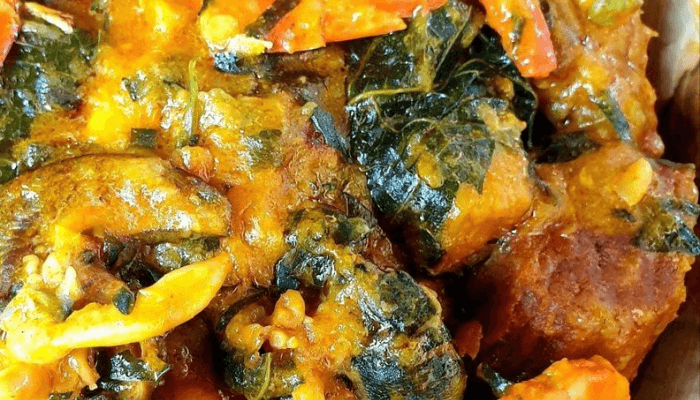
Ekpang Nkwukwo is a Nigerian delicacy that comes all the way from the South-South Akwa Ibom and Cross River States. Known mainly as Ekpang Nkukwo in Cross River and Akwa Ibom, and Ekpang in Cameroon, this hearty pottage is a culinary emblem of the Efik, Ibibio, Annang, Ejagham, and related ethnic groups.
It is a mix of grated cocoyam, water yam, cocoyam leaves, and periwinkles, as well of other delightsome traditional and cultural ingredients. This Nigerian food recipe is also native to some South-Eastern Nigeria, specifically Abia State – Abiriba. In Abiriba, the oily food is known as Oto but is prepared with mainly, water yam and plenty of fish as well as periwinkle. Southern Cameroon and some parts of Rivers State also relish this meal.
The food is usually wrapped in the traditional cocoyam leaves and garnished with periwinkle as well as some sea food like smoked fish, shrimps, prawns and lobsters. These days, the use of other vegetables apart from cocoyam leaves, has become very common with the cooking. The vegetables are also rich in the right nutrients and vitamins.
Since Ekpang Nkwukor cannot be complete without periwinkles, it is essential to note that in terms of nutritional value, periwinkles are low in fat and calories and are packed full with protein, omega-3 fatty acid and water.

This delicious Nigerian food is so special that it is reserved for many special occasions in the region. A grater can be used to grate the cocoyam and water yam. Better still, a food processor can equally do the job!
Why should the meal be added to the UNESCO ICH list?
The answers are glaring…
As global conversations intensify around safeguarding endangered cultural practices, Ekpang Nkukwo stands out as a strong candidate for inclusion on UNESCO’s Intangible Cultural Heritage List, not merely for its flavour, but for the living traditions it sustains.
In many communities, Ekpang preparation reinforces gender roles, social bonds, and intergenerational knowledge sharing, key elements that UNESCO recognises as defining intangible heritage.

At its core, Ekpang Nkukwo is a reflection of the rainforest ecology of the Cross River Basin, which includes the following key ingredients:
• Cocoyam and water yam (locally cultivated tubers)
• Cocoyam leaves or alternative green leaves
• Palm oil
• Periwinkles
• Crayfish
• Smoked fish, stockfish, or assorted meats
• Local spices and seasoning
All these ingredients tell a story of sustainable food systems, reliance on indigenous crops, and deep environmental knowledge.
The use of leaves instead of synthetic wrappers speaks to eco-friendly practices long before sustainability became a global buzzword.
Ekpang Nkukwo functions as a cultural marker. For many people from Cross River, Akwa Ibom, some part of the south east and southern Cameroon, the dish is a powerful reminder of home, especially in the diaspora. It is prepared during cultural days abroad, shared at reunions, and featured prominently in traditional food exhibitions. In this sense, Ekpang is not just eaten. it is performed, remembered, and celebrated.
Its absence from our everyday urban cooking today raises concerns about cultural erosion, making preservation efforts more urgent.
The question of why Ekpang Nkukwo belongs on UNESCO’s ICH List cannot be over emphasized. UNESCO defines Intangible Cultural Heritage as practices, expressions, knowledge, and skills that communities recognise as part of their cultural heritage. Ekpang Nkukwo meets and exceeds these criteria in several ways.
In terms of intergenerational knowledge transfer, the skills involved in Ekpang preparation are taught informally within families and communities, particularly from elders to younger women. It is a common homemade and healthy delicacy across many humid kitchens of South-South and southeastern Nigeria as well as parts of Southern Cameroon.
The cooking method which speaks volumes is a slow, deliberate ritual that has survived centuries of migration, colonial disruption, and modern fast-food culture. The cooking process itself is an act of cultural transmission. Elder women teach younger generations how to grate the tubers to the right texture, how to wrap the mixture tightly so it does not unravel. They train young ones and teach them how to layer the pot so the food cooks evenly without burning. These skills are not written in cookbooks; they are passed orally, through instruction, mentorship, coaching, observation and practice. The leaves are washed carefully while the cocoyam and water yam are grated by hand. The use of Palm oil and not any other is a glowing red story in the pot. The dish is far more than food. It is history wrapped in leaves, culture simmered in patience, and identity preserved through taste.
The food is a dish that is rooted in community and ceremony. Ekpang Nkukwo is not an everyday convenience food. Its preparation requires time, skill, and cooperation. often involving several women working together, sharing stories as they cook. Ekpang is however both labour-intensive and communal, and these qualities define its cultural significance.
Traditionally, it is a dish of honour, served to guests as a sign of respect and abundance. Ekpang is reserved for festivals, weddings, child naming ceremonies, title-taking events, funerals, and communal celebrations.
The food is rarely cooked alone. Its preparation fosters cooperation, storytelling, and collective identity and in terms of cultural representation. The dish is deeply tied to the identity of specific ethnic groups across national borders, strengthening cultural ties between Nigeria and Cameroon.
The risk of disappearance, urbanisation, fast food culture, and changing lifestyles is however threatening the continuity of traditional cooking practices like Ekpang. Adding the food to the list would preserve it, not just as a living heritage, but as a relic and a cultural celebration.
In a global food landscape increasingly dominated by homogenised tastes, Ekpang Nkukwo stands as resistance, rich, deliberate, and deeply local. Recognising it on UNESCO’s Intangible Cultural Heritage List would not only protect a dish but affirm the value of African indigenous knowledge systems, culinary artistry, and communal living.
As Nigeria and Cameroon continue to assert their cultural narratives on the global stage, Ekpang Nkukwo deserves its place among the world’s protected heritage, wrapped in leaves, simmered in history, and carried forward by the people who know its worth.
Let’s get to the kitchen…
Recipe for 6 servings:
• 2kilogramme Cocoyam [peeled, washed and grated]
• 2 sizeable water yams [peeled, washed and grated]
• Fresh Cocoyam leaves, Spinach or Pumpkin leaves [washed]
• 1 kilogram assorted smoked or freshfisj [deboned]
• Salt and seasoning to taste
• Shredded and softened stockfish
• 2 cups blended Crayfish
• 3 cups of fresh prawns or shrimps
• 10 red pepper [blended fresh]
• 3 large onions [sliced]
• 4 cooking spoons Palm Oil
• 5 cups Shelled Periwinkle
• 1 bunch scent leaf [washed and chopped] [ optional]
Method
• Season wash and boil the fish for the stock.
• Season, wash and cook the shelled periwinkle for about 5 minutes in salted water.
• Remove from heat and wash very well so there are no traces of sand or dirt.
• Use the periwinkle to form the base in the pot.
• Next you can add a cup of palm oil.
• Season the cocoyam and water yam mixture with some seasonings and salt to taste.
• Mix thoroughly with your hands or a wooden spoon.
• Wrap the cocoyam and water yam mixtures in tiny balls with either the coco yam leaves, spinach or ugu leaves starting from one tip of the leaf to the other end.
• When all the mixtures are wrapped, meticulously arrange them in the pot with the periwinkle and set on heat.
• Add about 2 cups of water to the pot of Ekpang on fire, add the water gradually, cover and steam for about five minutes.
• Add the other cooked sea food including the smoked fish and cooked stockfish.
• Allow to cook for three minutes before adding the crayfish, pepper, onions, more salt and seasoning to taste.
• Taste for salt and allow to cook for another three minutes.
• Add more stock as the need arise and allow to cook for about ten minutes on low heat.
• Simmer a bit before adding some more palm oil, as well as the scent leaf.
• Cut through with a knife and check if it’s ready.
• If not properly cooked, add more water and allow to cook further on low heat.
• Once it is set, remove from heat and serve hot.