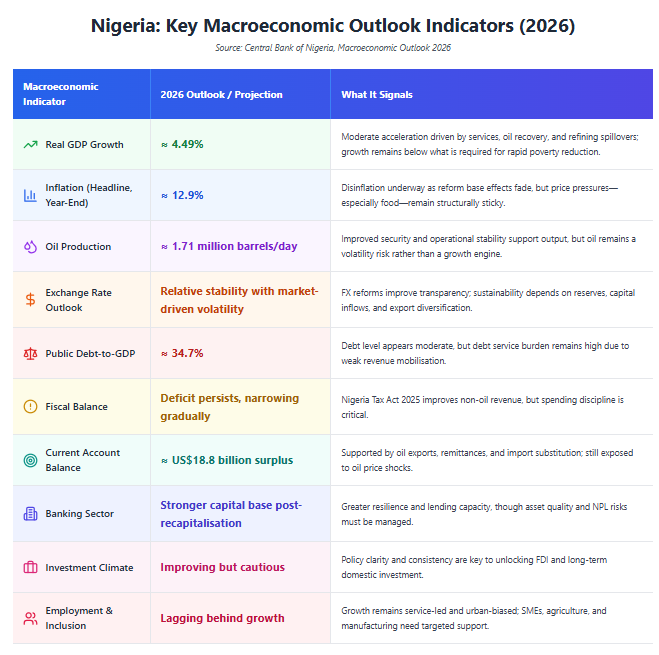
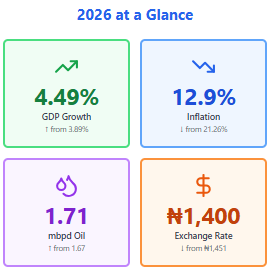
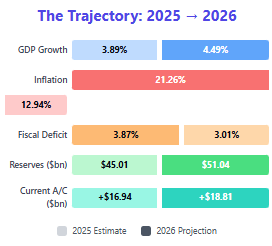
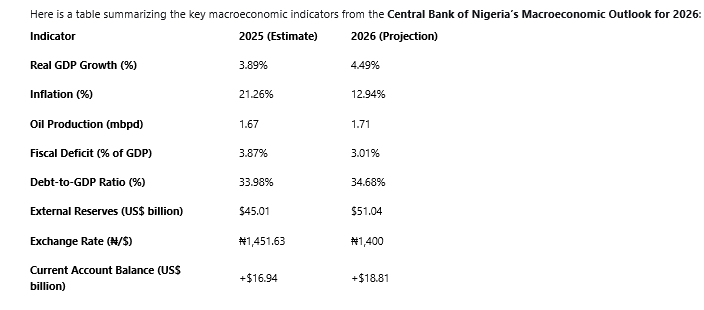
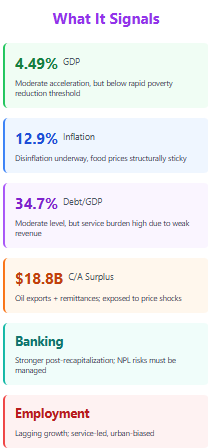
As Nigeria looks toward 2026, the economy finds itself at a defining crossroads. Recent projections from the Central Bank of Nigeria suggest growth approaching 4.5 percent, inflation easing toward the low teens, and a more stable foreign exchange environment. These numbers point to real progress, especially when set against the turbulence of the past few years. Reforms such as fuel subsidy removal, foreign exchange liberalisation, banking recapitalisation, and the Nigeria Tax Act 2025 have begun to correct long-standing distortions. Yet this emerging stability remains fragile. Structural weaknesses, exposure to global shocks, and deep inequality continue to shape everyday economic realities. For policymakers, investors, businesses, and households alike, 2026 is not a finish line but a test. The central question is whether Nigeria can turn hard-won macroeconomic stability into growth that is broad, durable, and felt across regions, sectors, and income groups.
Read also: AI could boost Africa’s economy by $1trn by 2035 AfDB
Interpretive Note

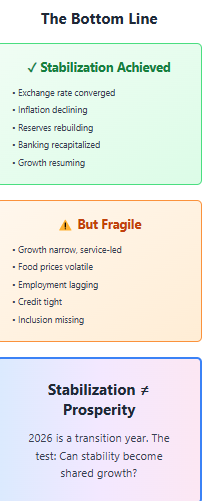
The 2026 outlook reflects macroeconomic stabilisation rather than economic comfort. Growth is real but narrow, inflation is easing but still painful, and fiscal space remains constrained. The numbers suggest Nigeria is past crisis management, but not yet in a phase of self-sustaining, inclusive expansion.
Stabilisation with Friction, Not Comfort
The past two years have been a period of economic adjustment rather than comfort. Removing subsidies, tightening monetary policy, and consolidating public finances inevitably pushed inflation higher, weakened the naira, and eroded real incomes. These outcomes were painful, but they were also the cost of addressing years of mispricing and fiscal leakage. Encouragingly, signs of order are emerging. Exchange-rate convergence has reduced arbitrage, public revenues have improved, and GDP growth has shown resilience, driven largely by services, telecommunications, finance, and selective agricultural recovery. Still, the story is incomplete. Inflation remains elevated, food prices are volatile, credit conditions are tight, and foreign direct investment has yet to return decisively. This tension defines 2026 as a transition year — one where credibility must be protected and reform fatigue carefully managed to prevent a slide back into uncertainty.
Growth Prospects and Sectoral Fault Lines

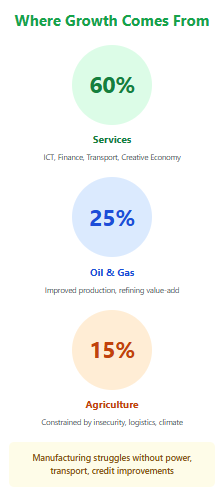
Nigeria’s growth outlook for 2026 is best described as narrow but navigable. Assuming policy consistency and no major external shocks, the economy could expand between 3 and 4 percent, enough to stabilise living standards but not enough to absorb population pressures without productivity gains. Services will remain the dominant engine, led by ICT, finance, transport, and the creative economy. Oil and gas may benefit from improved production and refining capacity, particularly through downstream value addition rather than crude exports alone. Agriculture holds immense potential but remains constrained by insecurity, climate risks, poor logistics, and post-harvest losses. Manufacturing will struggle unless power supply, transport infrastructure, and access to credit improve meaningfully. Where growth comes from will matter as much as how fast it grows, especially for jobs, incomes, and inflation dynamics.
Finance, Fiscal Choices, and the External Balance
The financial sector sits at the heart of the 2026 story. Banking recapitalisation should strengthen resilience and expand lending capacity, but rising non-performing loans and cybersecurity risks require vigilance.
Capital markets may remain buoyant, though excessive concentration in banking stocks risks crowding out other productive sectors. Fintechs and microfinance institutions must be better integrated into the formal credit system to reach SMEs and underserved communities. On the fiscal side, the Nigeria Tax Act 2025 offers a genuine opportunity to diversify revenues away from oil, but success will depend on administration, compliance, and fairness. With public debt still heavy, spending must prioritise growth-enhancing infrastructure. Externally, a projected current account surplus supported by oil exports and remittances is welcome, but vulnerability to oil price swings and capital flow reversals reinforces the need for export diversification.
What Inclusion Means for Firms, Farms, and Families
Inclusion is not a slogan; it is an economic necessity. SMEs, despite facing high energy costs, limited credit, and weak demand, remain Nigeria’s greatest employment engine. Their survival depends on technology adoption, aggregation, and stronger linkages with large firms. Agriculture remains the most inclusive value chain, employing millions, but must shift decisively from subsistence to productivity through security, storage, processing, and finance. Energy reform will shape competitiveness everywhere, as reliable power underpins manufacturing, services, and digital growth. For households, 2026 will still feel tight. Real incomes will recover slowly, making skills development, multiple income streams, and well-targeted social protection essential. Without deliberate inclusion, stabilisation risks becoming a narrow achievement that leaves too many behind.
Read also: FG cuts digital economy allocation to N84.56bn in 2026 budget despite $1trn ambition
The Policy Choices That Will Matter Most
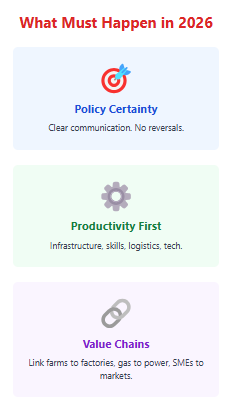
Three priorities should guide economic management in 2026. First, policy certainty and clear communication are critical. Nigerians can endure tough policies, but unpredictability undermines confidence and investment. Second, productivity must come before redistribution. Lasting inclusion flows from better infrastructure, skills, logistics, and technology, not from temporary transfers alone. Third, Nigeria must think in value chains, not silos — linking farms to factories, gas to power, skills to jobs, and SMEs to markets. Regional integration through the African Continental Free Trade Area also offers a powerful platform for export growth if non-tariff barriers and payment frictions are addressed.
Turning Stability into Shared Prosperity
Nigeria’s economic future will not be decided by a single reform or budget. It will be shaped by whether the discipline of adjustment gives way to the dividends of productivity. The outlook for 2026 is one of cautious optimism, but optimism with conditions. If policy credibility holds, if reforms deepen rather than stall, and if inclusion is treated as an economic strategy rather than a moral afterthought, Nigeria can emerge stronger, more competitive, and more equitable. If not, the risk is a relapse into volatility and stagnation. The path is narrow, but it is navigable — and the choices made now will determine whether stability finally becomes shared prosperity.