Nigeria’s economy has been projected for expansion this year, with real GDP growth expected to rise to 4.4 percent as reforms shape growth, analysts disclosed.
The projected growth has been supported by various renowned analysts, the Central Bank of Nigeria, and reputable investment houses, as the 2026 economic outlook is expected to reflect sustained gains from ongoing reforms, stronger private sector investment, and improved macroeconomic stability.
President Bola Tinubu, in his New Year’s speech, said the country closed 2025 on a strong note. Despite the policies to fight inflation, Nigeria has recorded a robust GDP growth each quarter, with annualised growth expected to exceed 4 percent for the year.
According to CBN’s 2026 Macroeconomic Outlook for Nigeria, Nigeria’s economy is projected to expand by 4.49 percent in 2026 on the implementation of well-sequenced, consistent fiscal and monetary policies.

Similarly, Muda Yusuf, chief executive officer of CPPE, in his review of the Nigerian economy in 2025 and outlook for 2026, expressed cautious optimism for 2026, projecting GDP growth of between 4.0 and 4.5 percent, supported by moderating inflation and stronger non-oil sector performance.
He said the easing inflation could create room for gradual monetary easing, stimulate private investment, and strengthen domestic demand.
However, Yusuf warned that several risks persist, including insecurity, oil price and production volatility, high energy and logistics costs, rising debt-service burdens, estimated at over N15 trillion in the 2026 appropriation, and potential pre-election fiscal pressures. Emerging resistance to tax reforms and external geopolitical headwinds were also identified as downside risks.
Yusuf added that sustaining reform momentum and addressing security and structural constraints would be critical to translating stability into inclusive growth.
Bismarck Rewane, an economist and managing director of Financial Derivatives Company (FDC), said Nigeria’s GDP growth is forecast to rise to 4.1 percent in 2026, driven by expanding business activity, infrastructure improvements, industrial-policy execution, stronger private-sector credit, better trade flows, and higher domestic value addition.

Read also: Nigeria’s tax-to-GDP ratio seen rising in 2026 as reforms kick in
He notes that consumption, which has been heavily eroded by inflation, is expected to recover gradually, while investment spending will be supported by strong government-bond issuance and public infrastructure expansion.
Rewane identifies six industries he believes will shape Nigeria’s economic direction in 2026, with agriculture and agro-processing leading with projected earnings of N104.6 trillion.
This is followed by real estate and construction with N72.41 trillion; telecommunications with N41.07 trillion; manufacturing with N38.25 trillion; the creative economy with N7.23 trillion; and technology and fintech with N2.97 trillion.
He noted that each of these sectors is undergoing its own structural transformation driven by demographic pressure, digital expansion, urbanisation, regional trade integration, and the broader macroeconomic adjustment.
Baboye Olaolu, lead economist and fixed income strategist at CardinalStone, during an interview on Channels TV, said Nigeria’s outlook from 2025 into 2026 resembles 2019, a period marked by relative macroeconomic stability.
Olaolu projects nominal GDP of about N507 trillion (roughly $362 billion) in 2026, supported by moderating inflation, improved FX stability, and recovering business profitability. He expects inflation to fall below the long-run average of 14 percent, creating room for monetary easing.
He added that improved FX liquidity, rising foreign investor confidence, and growing non-oil exports, particularly gas and refined products, will help sustain growth and support GDP expansion.
According to the 2026 Macroeconomic Outlook by CardinalStone Research, Nigeria’s real GDP is expected to rise to 4.4 percent in 2026, supported by a broad-based recovery across oil and gas, services, construction, agriculture, and the digital economy.
The report said the projected acceleration marks a clear break from the past decade, when real GDP growth averaged around 2 percent, and reflects the impact of macroeconomic reforms, improving external balances, and easing inflationary pressures.
“After nearly a decade of real GDP growth averaging about 2.0 percent, growth is likely to find a new level of 4.4 percent in 2026 and over 4.5 percent–5.0 percent in the medium term,” CardinalStone Research noted
Read also: GDP growth dropped by 0.25% in Q3 2025, Cardoso tells Senate
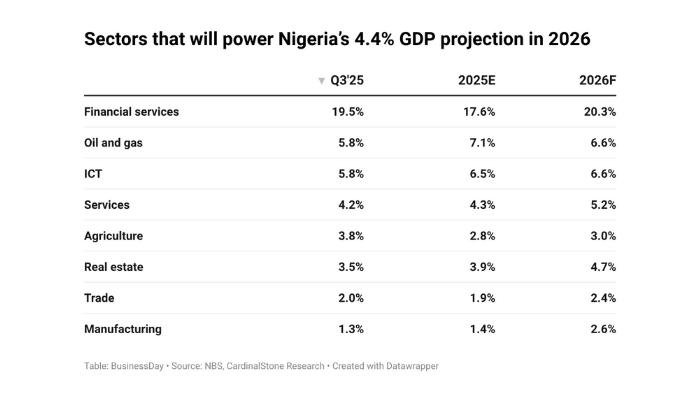
Here are the sectors that will power Nigeria’s projected growth
Services Sector
The services sector is projected to remain Nigeria’s largest growth engine in 2026, reflecting the economy’s service-driven structure.
According to CardinalStone, domestic trade, the largest contributor to services, is expected to record 2.4 percent growth, marking its strongest performance since before the COVID-19 pandemic.
“Trade margins are likely to be firmer, as recovering local consumption, normalisation of energy and logistics costs are positive for trade volumes and inventory cycles,” the report stated.
Real estate, which accounts for nearly a quarter of the services sector, is forecast to grow by 4.7 percent in 2026, up from 3.9 percent in 2025, supported by urbanisation and infrastructure spending.
The report noted that the Renewed Hope Project and increased state-level investments in roads and airports are expected to lift sectoral output.
In ICT, growth is projected at 6.6 percent, driven by higher capital expenditure by mobile network operators (MNOs) following recent tariff increases, alongside broader 4G and 5G rollouts.
CardinalStone highlighted that broader network coverage and advancement in technologies, especially in relation to essential digital ecosystem components like data centres, would support growth, although it warned that the NIN-SIM link remains a major downside to our outlook.
The strongest expansion within services is expected in financial services, with growth projected at 20.3 percent in 2026, up from 17.6 percent in 2025.
“This is expected to be driven by higher banking fees, stronger credit creation following a reduction in the monetary policy rate, and rising electronic banking fees due to aggressive digital investments by banks,” the report disclosed.
Oil and Gas
Nigeria’s oil and gas sector is expected to grow by 6.6 percent in 2026, slightly lower than the 7.1 percent expected in 2025, as base effects fade.
However, CardinalStone projects average oil production to rise to 1.75 million barrels per day, compared with 1.67 million barrels per day in 2025.
The improvement is linked to declining crude losses, which the report said are now at their lowest level since 2009, alongside annual licensing rounds focused on underdeveloped and deepwater fields.
Investment momentum remains strong, supported by executive orders issued in 2024 and 2025. According to the report, these measures culminated in $16.0 billion in new investment commitments over the last two years.
Gas development is also gaining prominence. CardinalStone noted a strong industry push toward the development of natural gas production, reduction of gas flaring, and increased gas commercialisation, with companies such as Seplat expanding into LPG and CNG projects to serve industrial and domestic users.
Agriculture
The agricultural sector is projected to grow by 3.0 percent in 2026, slightly above the 2.8 percent growth recorded in 2025, supported by improved energy availability and foreign exchange stability.
A key development is the reconstitution of the Agricultural Credit Guarantee Scheme Fund (ACGSF) board by the apex bank.
CardinalStone noted that while it is unclear whether this is a resumption of CBN’s discontinued development finances, the scheme is designed to de-risk agricultural lending and should help unlock incremental credit to the sector.
The report highlighted that agriculture has received only about 5.0 percent of total banking system credit over the past five years, underscoring the need for increased financing to raise productivity and output.
Manufacturing
Manufacturing growth is forecast to reach 2.6 percent in 2026, up from 1.4 percent expected in 2025, as easing inflation, improved FX conditions, and anticipated monetary policy easing support output.
CardinalStone observed that the sector has been slow to respond to recent reforms due to the lagged impact of the government’s policies and elevated interest rates, with firms borrowing at close to or above 30 percent in 2025.
However, the report expects a 300–400 basis point cut in the monetary policy rate to improve credit conditions. Additional support is expected from improved refining capacity, particularly as the Dangote Refinery plans to scale output from 650,000 barrels per day (bpd) to 700 bpd in 2026, with longer-term expansion targets in view.