…As 69 firms secure $10M+ rounds in 2025, up 70% from 2024
Africa’s startup ecosystem showed a clear return to growth in 2025, driven by renewed investor confidence, the emergence of new financing structures, and a sharper focus on businesses with sustainable revenue models and real-world impact, BusinessDay findings have revealed.
After funding fell sharply from about $3.5 billion in 2023 to roughly $2.2 billion in 2024, capital flows into African startups rose in 2025, signalling what investors describe as a ‘broad-based market recovery.’
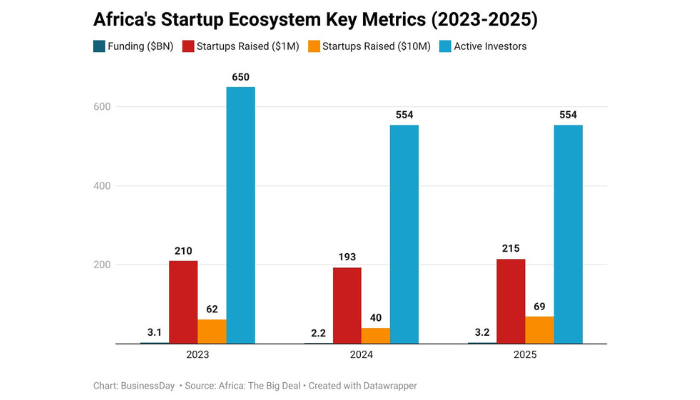
Data from Africa: The Big Deal shows that 69 African startups raised $10 million or more in 2025, a 70 percent increase from 2024, marking the second-highest year on record for large funding rounds after the global boom of 2022. Total startup funding across equity, debt and grants, excluding exits, reached $3.2 billion, representing a 40 percent year-on-year growth from $2.2 billion in 2024, and edging above 2023 levels.

Read also: Tax reforms test investor confidence in 2026
The recovery follows two years of contraction, when funding fell from about $3.5 billion in 2023 amid tighter global financial conditions.
Adedayo Amzat, chief executive officer of financial services firm Zedcrest Group, said the turnaround reflects a broad reset in investor sentiment. “Last year shows a clear return of confidence across the market,” Amzat said, pointing to improving deal quality and the re-emergence of credible exit pathways.
Mambu Sherman, chief executive officer of Calpe Partners, told BusinessDay that the recovery is being driven less by speculative capital and more by structural changes in how investors deploy funds.
“What we are seeing is investor confidence, but also different types of capital vehicles. There is growth in equity financing, but we are also seeing creative approaches like revenue-share financing and inventory-based financing. There is innovation in finance that is driving this confidence,” Sherman said.

Sector priorities are broadening alongside the rebound. While fintech remains the dominant engine, accounting for several of the largest rounds and most of the eight mega-deals above $100 million, investors are expanding into infrastructure-heavy sectors such as healthcare, agribusiness, data infrastructure, and climate technology.
Sherman said areas long described as underdeveloped are increasingly being reframed as opportunities. “Where people once saw limitations, investors are now seeing opportunity,” he said, citing gaps in healthcare data systems and inefficiencies in agricultural supply chains as fertile ground for startup-led solutions.
He also highlighted growing participation from the African diaspora, particularly in hubs such as Lagos and Accra, as individuals seek structured vehicles to invest beyond remittances.
Beyond traditional venture equity, investors increasingly leaned into venture debt and blended capital in 2025, particularly for startups with predictable cash flows.
Kristin Wilson, managing partner at Innovate Africa Fund, said debt financing surpassed $1 billion in early-stage funding this year, supported by development finance institutions and commercial lenders.
Read also: CBN: FATF Grey List exit stabilises naira, as reserves cross $43bn, investor confidence soars
“Investors returning to Africa in 2025 are backing companies with demonstrable unit economics, recurring revenue, and clear paths to profitability,” Wilson said, adding that the shift mirrors post-slump rebounds seen in Latin America and Southeast Asia.
She noted that valuation resets over the past two years have also pushed founders to tighten governance and focus on fundamentals.
Climate technology alone attracted more than $400 million in funding in 2025, according to Wilson, as investors targeted businesses aligned with Africa’s vast energy and climate-finance gap, estimated at about $277 billion annually.
She added that investors are showing growing interest in B2B software, AI-enabled productivity tools, healthtech and edtech, particularly models anchored in essential infrastructure.
Another key driver of the rebound is the strengthening of ecosystem support structures. Investors point to the expanding role of incubators, accelerators, venture studios and talent initiatives, alongside deeper private-sector participation and more balanced public-private partnerships.
The investor base itself remains resilient. Africa: The Big Deal identified at least 554 investors participating in deals in 2025, nearly unchanged from 2024, though below the 2023 peak of over 650. The platform noted this figure likely understates actual participation, as many angel investors and smaller backers are not publicly disclosed.
Since 2019, nearly 2,500 unique investors have backed African startups, forming a diverse pool that includes global venture funds, regional players, development finance institutions, and corporate investors. Within the 2025 cohort, about one-third of investors completed two or more deals, while 37 investors closed five or more transactions and 11 participated in 10 or more, underscoring sustained engagement despite global caution.
Wilson added that local investors now account for nearly one-third of ecosystem participants, helping to anchor capital locally and improve resilience.
Institutional investors say stronger execution standards among founders are also shaping the rebound.
Read also: Tinubu says FDI rose to $720m in Q3 2025 as reforms boost investor confidence
Cyril Shonibare, senior associate at TLcom Capital, told BusinessDay that investors are prioritising startups with large addressable markets, validated products, and disciplined teams.
“We are looking beyond storytelling to repeat usage, cohort retention, and improving unit economics. Founders who learn quickly, iterate, and execute with focus are showing the kind of traction that attracts capital in this market,” Shonibare said.
Looking ahead, investors expect the momentum to continue, with funding concentrating around fintech infrastructure, embedded finance, climate and energy solutions, AI-enabled vertical software, healthcare infrastructure, and food systems.