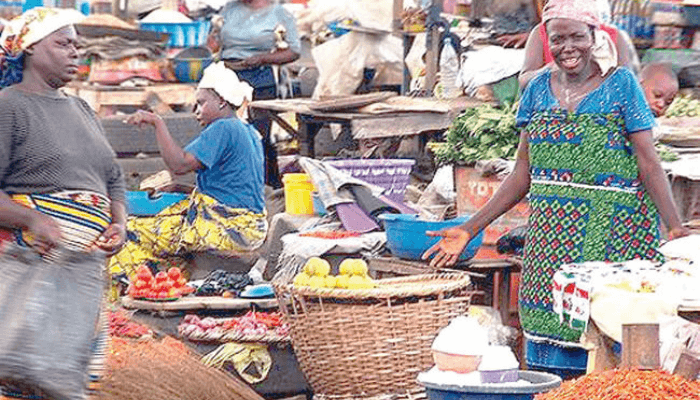
At neighbourhood markets in Nigeria, shoppers now bargain for cups instead of bags. A cup of rice replaces a sack, a slice for tubers, and four tomatoes instead of a basket. Not because tastes have changed, but because prices have. Food has become something to ration daily, not plan for weekly. This is what a food crisis looks like when supply chains fail.
Nigeria’s food crisis is not simply about hunger. It is the outcome of policy gaps colliding with insecurity and a weakened supply chain system. Decisions made far from farms now determine what appears on market stalls. When fuel costs rise, transportation becomes more expensive, and so does food. When insecurity spreads, farming slows or stops; when supply chains break, prices climb, and households absorb the shock.
Many Nigerian households now spend more than half of their income on food. When food takes up this much of household spending, everything else takes a back seat. Healthcare is delayed, school fees are stretched, and productivity falls. Food insecurity quietly becomes both an economic and public health problem.
Policy shifts have played a major role in this squeeze. The removal of fuel subsidies, currency pressures, and rising transportation costs have driven up food prices nationwide. What began as an energy or fiscal adjustment has ended up as higher food costs in local markets. Beans, garri, yams, plantain, vegetables, and other staples now carry price tags many families cannot afford.

For farmers, the pressure begins long before harvest. Fertiliser, seedlings, and basic farm inputs have become more expensive and harder to access. Smallholder farmers, who produce most of Nigeria’s food, struggle to keep pace. When farming becomes unprofitable, output declines. As supply tightens, prices respond quickly.
Insecurity compounds these pressures. In several farming regions, conflict, banditry, and displacement have pushed farmers off their land. Some have scaled back production; others have abandoned farming entirely. Each empty field narrows the national food supply. When farmers cannot farm safely, no policy can stabilise prices.
Even where government support programmes exist, access remains uneven. Improved seeds, credit schemes, and extension services often fail to reach farmers on time. Weak logistics, poor communication, and limited coordination dilute their impact. Good policy loses its value when it cannot travel the last mile.
Broken supply chains do not end at the farm gate. Much of Nigeria’s food never makes it to the market at all. Poor storage facilities, limited cold-chain infrastructure, and weak transport networks mean fruits, vegetables, dairy, and other perishable goods are lost between harvest and sale. Estimates suggest Nigeria loses up to 40 percent of fresh produce annually to post-harvest spoilage. This waste tightens supply, pushes prices higher, and leaves consumers paying more for less. While food rots in transit, households struggle to afford basic nutrition. The cost of these inefficiencies is quietly shared by farmers who lose income and consumers who must pay higher prices.
The public health consequences are significant. Poor nutrition weakens immunity, increases illness, and raises healthcare costs. Food-insecure households are more vulnerable to infectious and chronic diseases. Workers who cannot eat well cannot work well; children who lack proper nutrition struggle to learn. The health system absorbs the cost of a failing food system.

This crisis reflects misalignment, not a lack of effort. Agricultural, energy, security, and trade policies often operate in silos, yet their effects collide in the food market. Addressing food insecurity requires treating these systems as connected.
Policy decisions should be assessed for their downstream impact on food affordability. Rural security must be strengthened so farmers can return to their fields. Input distribution requires efficient logistics and stronger local engagement. Investment in mechanisation, storage, and transport infrastructure is essential to stabilise supply and reduce losses.
Food security must also be integrated into public health planning. Nutrition programmes, school feeding initiatives, and community health strategies work best when aligned with agricultural systems. When food systems stabilise, health outcomes improve, productivity rises, and economic resilience follows.
Food security is not charity. It is infrastructure. When supply chains break, households pay first, then the economy. Fixing Nigeria’s food crisis requires closing policy gaps, restoring safety, and rebuilding the systems that move food from farm to table.
The longer food remains unstable, the harder recovery becomes. Markets lose confidence, farmers exit production, and households adopt coping strategies that weaken long-term well-being. Rebuilding trust in the food system takes time, coordination, and deliberate investment. But the cost of inaction is higher. A country that cannot reliably feed its population compromises its health, labour force, and economic future, one market stall at a time.
Oluwatosin Oluwafemi, MPH, is a public health professional with experience in population health and public health policy. She holds an MPH from the University of New Haven, USA.