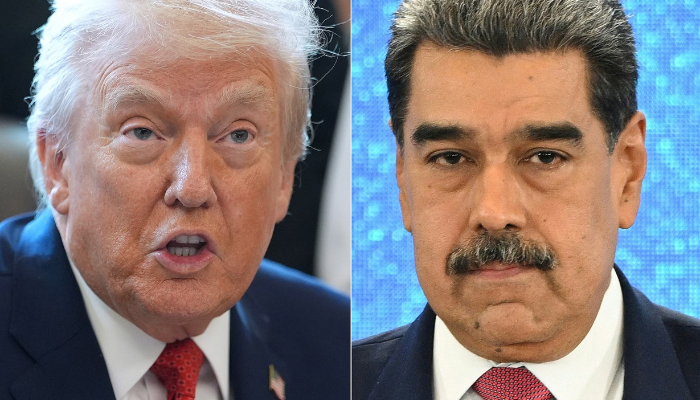
Donald Trump, the United States President, announced that American forces had carried out a large-scale strike against Venezuela and captured President Nicolas Maduro, marking the climax of a long and steadily escalating campaign that has unfolded over more than a decade.
In a post on Truth Social early Saturday, Trump said Maduro and his wife had been “captured and flown out of the country, a claim later echoed by senior US officials and reported by CNN and Fox News. The development has plunged Venezuela into deep political uncertainty and drawn sharp reactions across the region.
Read also: Trump says he will run Venezuela until proper transition, posts latest photo of Maduro
Here is how the events leading up to that moment unfolded.

2011 to 2020 criminal case takes shape
According to US court records and reporting by CNN and The New York Times, American prosecutors began investigating alleged Venezuelan drug trafficking networks as far back as 2011. By 2020, during Trump’s first term, Nicolas Maduro was formally charged in the Southern District of New York with narco terrorism, conspiracy to import cocaine, and related offences.
US officials alleged that Maduro and senior allies protected drug traffickers and worked with armed groups to move cocaine toward the United States. Maduro denied the accusations, calling them politically motivated.
That same year, the Trump administration announced a $15 million reward for information leading to his arrest.
From 2013 to 2024, disputed rule at home
Maduro took office in 2013 after the death of Hugo Chavez. Since then, every national election has been marred by controversy. The United States and several allies rejected the legitimacy of Venezuela’s 2018 and 2024 presidential elections.
In December 2025, a United Nations report accused Venezuela’s security forces of a decade-long pattern of killings, torture, and arbitrary detention of protesters and opponents. The government rejected the findings.

From 2024 to early 2025, pressure intensifies
After returning to the office for a second term, Trump sharply increased pressure on Caracas. According to CNN, the US stepped up maritime operations, launching strikes on suspected drug smuggling boats in the Caribbean and eastern Pacific. Since September, the US says it has carried out around 30 such strikes, with more than 110 people reported killed since the first attack on September 2.
Read also: Why the United States wants Venezuelan President Nicolas Maduro.
In early January 2025, in the final days of the Biden administration, the bounty on Maduro was raised to $25 million. In August 2025, Trump raised it again to $50 million after designating the Cartel de los Soles as a foreign terrorist organisation. US officials say Maduro led the group.
Marco Rubio, Secretary of State, later said Maduro had been offered “multiple very generous offers” to leave power.
“Instead, he wanted to play big boy,” Rubio told reporters on Saturday, according to CNN.
December 2025 first strikes inside Venezuela
In December, the pressure crossed a new threshold. CNN reported that the CIA carried out a drone strike on a port facility inside Venezuela, the first known US attack on land. Trump later confirmed strikes on a dock area linked to alleged drug trafficking boats, saying there had been a “major explosion”.
Around the same time, Trump ordered a blockade of sanctioned oil tankers entering and leaving Venezuela, signalling Washington’s intent to squeeze the country’s oil lifeline.
Read also: The Venezuela Blueprint: A clear and present danger to Nigeria’s future
Maduro publicly said he was open to talks with the US on drugs and oil. Trump later told Fox News that Maduro was “trying hard to make a deal” in the final days.
Planning the operation
Gen. Dan Caine, the Joint Chiefs Chairman, on Saturday described the operation to capture Venezuelan President Nicolás Maduro as an extensive, meticulously planned operation that took months to prepare for and hours to carry out on the ground.
Speaking at a press conference at Mar-a-Lago in Florida, Caine described the mission as a collaboration involving all branches of the military and intelligence agencies that requires months of preparation.
That included tracking Maduro to “understand how he moved, where he lived, where he traveled, what he ate, what he wore,” Caine said.
According to reports, intelligence came from multiple sources, including human intelligence inside Venezuela, signals intelligence, and surveillance from the air.
CBS News reported that a CIA source inside the Venezuelan government helped track Maduro’s movements ahead of the operation.
January 2 operation absolute resolve
Late Friday night, more than 150 US aircraft were launched from 20 bases across the Western Hemisphere, Gen. Dan Caine, Joint Chiefs Chairman, said at a press briefing reported by CNN.
Helicopters carrying US special forces flew into Venezuela at low altitude, protected by strikes in the area. They reached Maduro’s compound shortly after 1 a.m. ET.
Read also: U.S. forces capture Venezuela’s Maduro, fly him and his wife out of the country
The mission, dubbed Operation Absolute Resolve, involved what Caine described as multiple self-defence engagements as US forces came under fire. By 3.29 a.m. ET, the extraction force had left Venezuelan airspace with Maduro and his wife.
Trump later told Fox News he watched the operation live from Mar-a-Lago.
“I watched it literally like I was watching a television show,” he said.
What happens next
Pam Bondi, US Attorney General, said Maduro and his wife have been indicted in New York on charges including narco terrorism conspiracy, cocaine importation conspiracy, and weapons offences. “They will soon face the full wrath of American justice on American soil,” she said, according to CNN.
Trump has said the US will be “very much involved” in deciding what comes next for Venezuela, including its oil industry. Venezuelan officials insist Maduro remains the country’s constitutional president and have requested an urgent UN Security Council meeting.
As Maduro heads toward a US courtroom, the country he ruled for more than a decade now faces its most uncertain moment yet, with its leadership disputed and its future shaped by forces far beyond its borders.