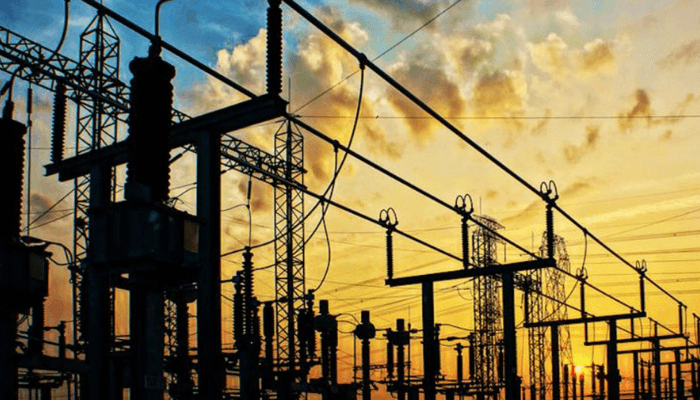
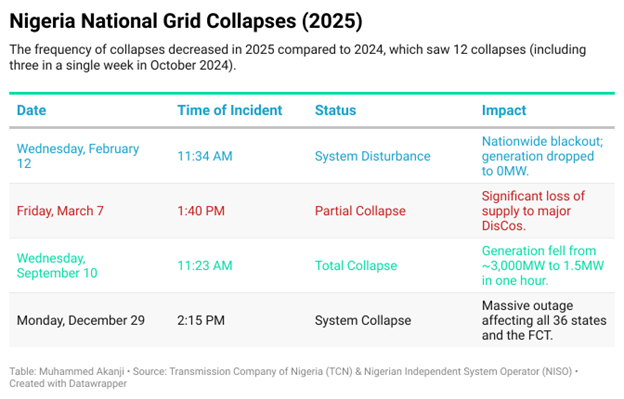
As Nigeria basked in the euphoria of the festive season, millions of homes and businesses were plunged not into light but into darkness, a familiar reminder of the country’s chronic power failures. Despite an installed grid capacity of over 13,000 megawatts (MW), actual power generation fell to about 3,000 MW, leaving households, hospitals, entertainment venues, and small businesses grappling with outages deep into Christmas. By Monday, December 29th, the grid collapsed, crashing to near 0 MW at 2:45 pm. It is needless to say that the latest incident means 2025 has seen at least 4 collapses, a fractional decrease compared to 2024, when the grid collapsed at least 12 times.
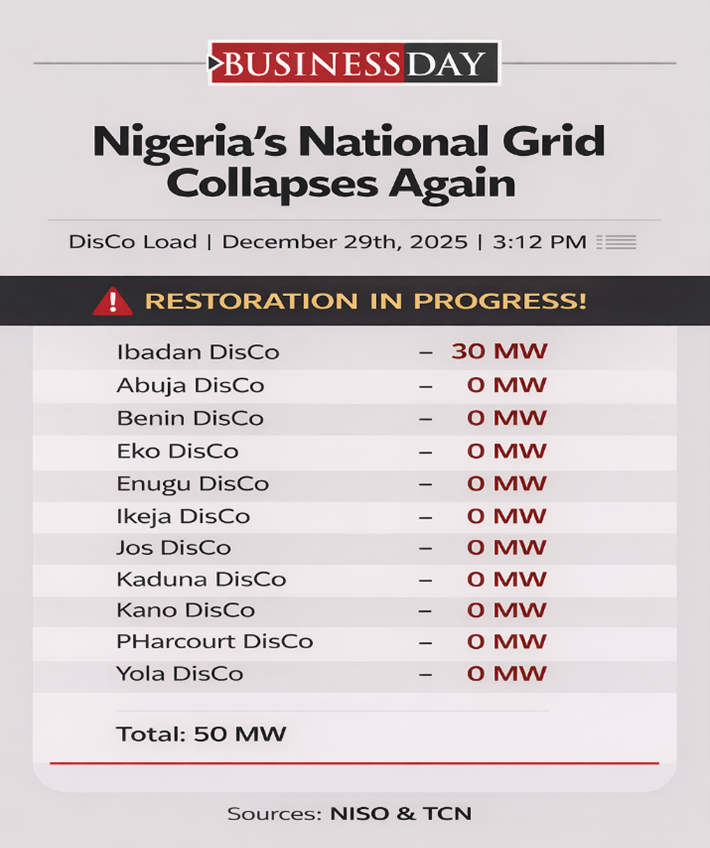
BusinessDay reports that this shortfall persisted despite official assurances of improved supply, with more than 60 per cent of available capacity remaining idle due to financial constraints, gas supply challenges, and ageing infrastructure.

Rather than a seasonal anomaly, the holiday blackouts exposed deep structural fragilities in Nigeria’s power system. BusinessDay noted that an explosion on the Escravos–Lagos gas pipeline, located along the critical infrastructure corridor in Delta State, further constrained supply during peak festive demand, compounding an already fragile grid prone to instability and system collapses. The result was a “Detty December” dimmed by darkness, where generators and solar installations replaced festive lights.
During the holidays, what was framed as a temporary inconvenience revealed itself as a systemic failure, raising a pressing question: Are Nigeria’s festive blackouts merely seasonal disruptions or enduring evidence of a power sector still urgently in need of reform?
The supply reality behind the outages
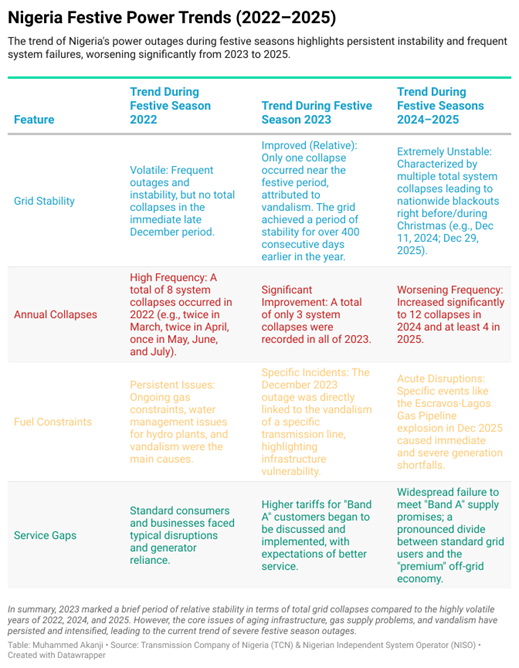
Nigeria’s persistent power outages during holidays are not isolated glitches caused by festive demand, but rather symptomatic of deep-seated weaknesses in the national electricity supply system. The trend in Nigeria’s power outages during festive seasons highlights persistent instability and frequent system failures, which worsened significantly from 2023 to 2025. This stark capacity shortfall has been evident during the Christmas period of 2025, when grid generation hovered near 3,000 MW even as system stress intensified.
The fragility of Nigeria’s power infrastructure is a structural issue. The nation remains heavily reliant on gas-fired thermal plants, and persistent gas supply disruptions- exacerbated by pipeline vandalism- have frequently undermined generation levels.
Moreover, transmission and distribution networks are obsolete and under-maintained, making them highly susceptible to system disturbances and grid collapses when demand fluctuates or key generating units trip. Recent incidents, including sharp drops in generation and partial grid collapses during peak demand periods, show that an already brittle grid buckles under pressure rather than being simply overwhelmed by holiday consumption. In this context, festive blackouts reveal structural instability, not only short-term stress: a reality that calls for urgent investment in infrastructure, a cleaner and more reliable fuel supply, and strengthened grid management.

Economic and social cost of holiday blackouts
Holiday blackouts in Nigeria impose outsized economic and social costs precisely because they strike during peak periods of consumption, mobility, and social activity. For small businesses, especially bars, restaurants, event centres, tailors, bakers, and informal traders, the festive season often accounts for a disproportionate share of annual revenue. Power outages force these operators to rely on diesel and petrol generators, sharply raising operating costs and eroding already thin margins.
In hospitality and tourism hubs, unreliable electricity dampens visitor experience, curtails operating hours, and weakens Nigeria’s ability to monetise its much-touted “Detty December” inflows.
Religious and cultural gatherings are equally affected. Churches, mosques, concerts, and family events incur higher costs for lighting, sound, and cooling, while many scaled-down celebrations altogether. At the household level, blackouts deepen welfare stress. Families divert scarce income to generator fuel, candles, and inverter charging, while perishable food spoils and living conditions deteriorate, particularly for children, the elderly, and those requiring medical equipment.
These festive outages ripple through the broader economy. Higher energy costs are passed on through food, transport, and services, amplifying inflation during a period when household spending is already stretched. What appears as temporary darkness thus translates into lasting economic strain, reinforcing the reality that Nigeria’s power failures extract their heaviest toll when the economy should be at its most vibrant.
Accountability gaps and institutional failures
Nigeria’s recurring holiday blackouts have again exposed deep accountability gaps across the power sector, with institutions offering explanations but little responsibility. The Transmission Company of Nigeria (TCN) often attributes outages to grid disturbances, equipment failures, or emergency system protection measures. Generation companies (GenCos), in turn, cite gas supply shortages, pipeline vandalism, and mounting market debt. Distribution companies (DisCos) cite transmission constraints and load allocation limits, while the Ministry of Power reassures Nigerians with familiar promises of imminent improvement. The result is a circular blame game in which failure is acknowledged, but ownership is absent.
This fragmentation reflects weak regulatory enforcement. Despite years of privatization, performance benchmarks are loosely enforced, sanctions are rare, and consumer protection is minimal. Market liquidity problems persist because tariffs fail to cover costs, yet inefficiencies and losses are routinely passed on to end users through estimated billing and unreliable supply. During the holiday season, these governance flaws become more visible as public patience wears thin and economic losses mount.
Calls for ministerial resignations following Christmas Day blackouts are less about individual culpability than collective frustration with systemic inertia. They signal a public demanding consequences, coordination, and reform, recognising that Nigeria’s power crisis is no longer a technical mystery, but a governance failure in plain sight.
Seasonal crisis or structural breakdown?
The recent holiday blackout was too easily dismissed as a seasonal mishap: “much ado about nothing” in a system prone to stress. Yet the evidence points elsewhere. Festive demand did not break the grid; it merely exposed the structural decay already embedded in Nigeria’s power sector. Chronic undergeneration, weak transmission capacity, fragile gas supply, and poor institutional coordination ensure that any surge in demand- whether during Christmas, elections, or heatwaves- pushes the system to failure.
What makes these festive outages especially telling is their predictability. Year after year, Nigerians endure darkness during moments intended for celebration, economic activity, and social cohesion. This normalisation of failure reflects not resilience, but resignation.
Until power reform moves beyond rhetoric to disciplined execution: investment, regulation, and accountability, holiday blackouts will remain a recurring feature of national life. The real question, then, is not whether the lights will go out next festive season, but how many more seasons must we pass in darkness before the needed system overhaul finally arrives?