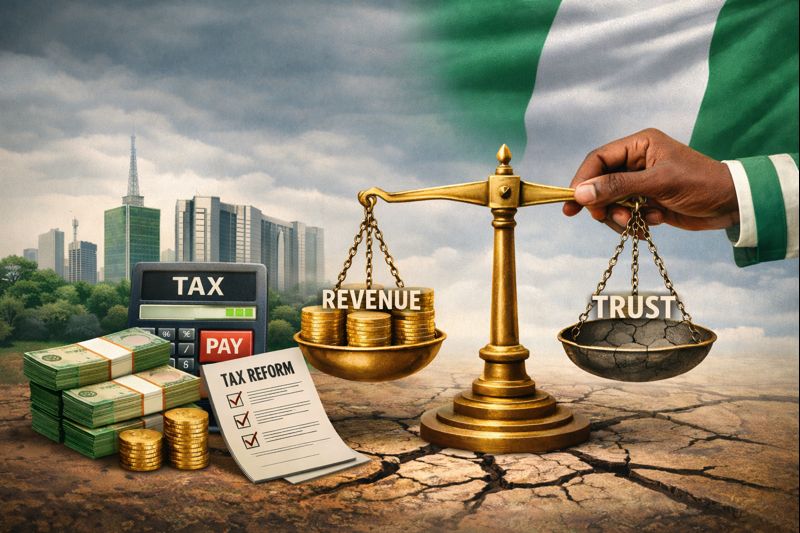
Every modern economy survives on a fragile but essential bargain between the state and its citizens. Governments demand taxes, citizens expect public value in return. Where this bargain holds, taxation becomes a foundation for development.
Where it breaks, taxation is experienced as extraction. Nigeria’s 2025 tax reform enters this uneasy terrain, not merely as a fiscal adjustment, but as a test of whether the Nigerian state can rebuild credibility in how it raises, manages, and deploys public revenue.
Nigeria’s fiscal weakness is well documented. With a revenue-to-GDP ratio hovering between 8 and 10 per cent, the country ranks among the lowest globally. The African average is more than double that figure, while peers such as South Africa and Morocco exceed 25 per cent. Even within West Africa, Nigeria trails Ghana, Senegal, Benin, and Côte d’Ivoire. This chronic underperformance has constrained infrastructure investment, weakened public services, and forced repeated reliance on debt to fund basic governance. In this sense, tax reform is not optional, it is inevitable.
The gazetted Nigeria Tax Act 2025, taking off in 2026, is expectedly framed as a corrective response to decades of structural imbalance, as it aims to broaden the tax base, modernise administration, reduce leakages, and align Nigeria’s fiscal framework with a diversifying economy that can no longer depend on oil. On paper, these goals are sound. Oil contributes less than 6 per cent of GDP, global energy transitions are accelerating, and Nigeria’s non-oil economy has outgrown its fiscal architecture. A modern state cannot be financed on outdated assumptions.

The central question however is not whether Nigeria needs tax reform. It does. The harder question is whether Nigeria’s political and institutional environment can translate higher revenue into national development rather than deeper public resentment. This is where the reform faces its greatest test.
Nigeria already collects significant taxes, most notably Value Added Tax. VAT rates have increased, compliance has expanded, and collections have grown steadily over the past decade. However, public confidence has not followed the same trajectory. Ordinary Nigerians struggle to identify tangible improvements in healthcare, education, transportation, or public safety that correspond to rising tax inflows. When revenue increases without visible returns, citizens naturally question the purpose of compliance. Any tax reform that ignores this perception gap risks failure, regardless of its technical sophistication.
More troubling is Nigeria’s long record of revenue mismanagement. About three years ago, a member of the House of Representatives alleged that stamp duty revenues running into billions of naira had been diverted into private accounts for years. Whether fully substantiated or not, such claims reinforce public belief that Nigeria’s problem is not revenue scarcity but systemic revenue theft. In systems with fiscal legitimacy, such scandals lead to prosecutions and institutional reform. In Nigeria, they often fade without consequence.
The new tax law seeks to widen the net by targeting Nigeria’s vast informal sector, which accounts for over half of GDP and employs more than 60 per cent of the workforce. No tax system can be equitable if only a narrow segment of the economy funds the state. Digital taxpayer databases, harmonised platforms, and better coordination between federal and subnational authorities are necessary steps. However, expanding the tax base without improving state performance risks spreading dissatisfaction rather than building inclusion.
The reform also addresses profit shifting by multinationals, digital transactions, and e-commerce, sectors that now form a significant part of Nigeria’s economic activity. Aligning with global best practices in these areas is long overdue. Equally important is the attempt to simplify compliance. Businesses in Nigeria spend over 300 hours annually navigating tax procedures, far above the global average. Complexity fuels evasion. Simplicity encourages participation.

Still, legislation alone cannot repair a broken fiscal social contract. Trust is not built through statutes, but through behaviour. Nigerians do not merely want assurance that revenue will be collected more efficiently; they want evidence that it will be spent more honestly and productively. Transparency mechanisms must therefore be non-negotiable. Public dashboards showing tax inflows and sectoral spending, independent audits with published outcomes, and clear accountability for misuse are not optional complements to reform; they are its foundation.
Responsibility does not lie with government alone. The private sector must abandon the normalisation of evasion as a survival strategy, as tax avoidance weakens institutions, distorts competition, and shifts the burden onto compliant actors.
Yet shared responsibility cannot exist where enforcement is selective and accountability uneven. Nigeria’s 2025 tax reform is therefore a defining moment. Its success will not be measured by revenue figures alone, but by visible, verifiable public benefit. Revenue without trust is not reform; it is extraction refined by technology. The trust from citizens also invites transparency from government in ensuring that there is no hidden agenda and no additional requirements other than that contained in the approved Act as passed by the National Assembly and signed by the President in June 2025.
If the government treats this reform as an opportunity to institutionalise transparency, enforce accountability, and visibly convert taxes into public value, it can rebuild confidence and strengthen citizenship.
If it does not, the reform will join a long list of technically sound policies undone by weak governance. The choice is not between taxation and growth, but between a state that earns compliance and one that demands it without credibility. The window for choosing wisely remains open, but it will not stay open forever.