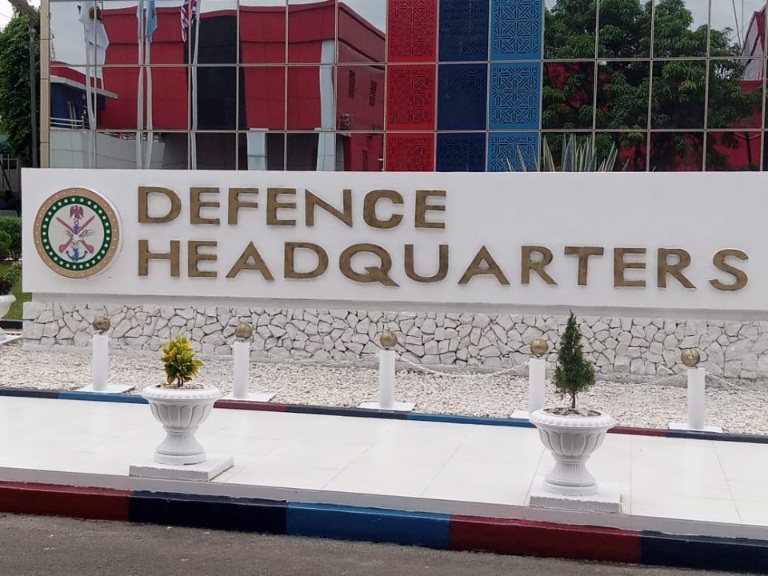
The Defence Headquarters (DHQ) has said that a comprehensive battle damage assessment is still underway following recent United States air strikes carried out in conjunction with Nigerian forces against Islamic State targets in north-western Nigeria.
The clarification comes amid public debate over the effectiveness of the strikes, which were announced by United States President Donald Trump on Christmas Day.
Trump disclosed that American forces had conducted lethal operations against Islamic State elements operating in the region.
The Federal Government later confirmed the strikes, describing them as part of sustained counterterrorism cooperation between Nigeria and the United States.

Read also: America vows more pounding for terrorists in Nigeria after first Christmas day strikes
Addressing journalists on Wednesday in Abuja, Michael Onoja, Director of Defence Media Operations, said the military would make its findings public once the assessment process was concluded.
“On the United States strikes in conjunction with Nigerian forces, there is a process of battle damage assessment. We are still in that process, and I can assure you that once that is completed, we will communicate to the public all our observations.
“In due course, we will give you all the information that you require from the U.S.–Nigeria strikes”, Onoja said.
Responding to questions on whether terrorists were actually present at the locations hit during the strikes, the defence spokesman said intelligence reports had confirmed their presence prior to the operation.

“Terrorists are ubiquitous, and we cannot confine them to one location. There is evidence to show that they are in the Sahel, and given the proximity of the Sahel to Sokoto, intelligence reports also confirmed their presence in those areas before the strikes were conducted”, he explained.
Onoja added that the operations were intelligence-driven and that details were not always publicised for operational security reasons.
“The fact that it was not publicised is sometimes for operational security reasons,” he said.
He disclosed that the armed forces were closely monitoring the movement of terrorist elements outside the targeted locations and were coordinating with field commanders to prevent them from infiltrating nearby communities.
“We are communicating with all the force commanders in areas identified as threat zones to ensure that these elements do not assimilate into communities and cause further havoc.
“As time goes on, you will hear about the activities we are undertaking. While we are acting, it is important that we keep certain operations confidential”, he said.
The defence spokesman also said the military was intensifying engagement with civilians to strengthen intelligence gathering and early warning mechanisms.
“We are mobilising the civilian population to be vigilant and to provide timely information to the military and other security agencies.
“The truth is that security can only be addressed through the cooperation of every member of society. It is what we call the whole-of-society approach”, Onoja said.
He further urged members of the public to return any suspicious or abandoned materials to security agencies, warning that such items could pose serious risks if mishandled.
“We don’t expect anybody to take away those materials. They should return them to the military or security divisions so that we can disarm them before they cause greater damage,” he said.
Commenting on criticisms surrounding the joint strikes, Onoja said it was not the responsibility of the Armed Forces to respond to every public opinion or statement.
“Every agency has its functions. It is not for the Armed Forces to focus on what some people in society do not agree with in our activities.
“Our role is to focus on kinetic operations and, where necessary, non-kinetic operations. Relevant agencies are tasked with addressing statements that may be against or for the country”, he said.
On recent security incidents, including attempted suicide attacks, the defence spokesman said the arrest of a suspected attacker earlier in the week had significantly disrupted planned terrorist activities and logistics.
He said security agencies were leveraging intelligence networks and other measures to prevent future attacks, assuring Nigerians that military operations against terrorist groups would continue into the new year.
Onoja also cautioned the public against spreading unverified information capable of causing fear or panic, urging reliance on credible and official sources.