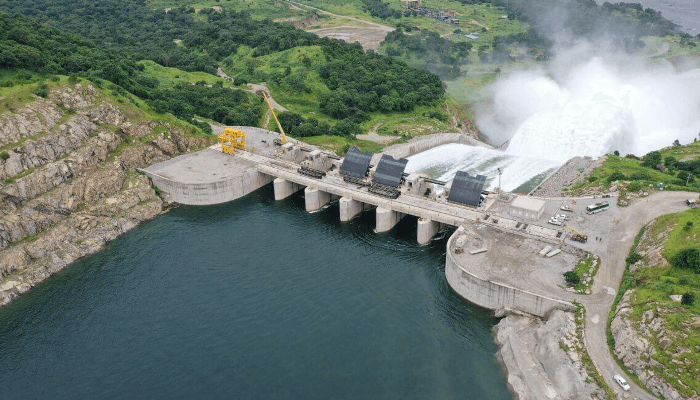
This article, which is a follow-up on last week’s, titled, “Behold, the Grand Ethiopian Renaissance Dam (GERD): Lessons for Nigeria,” takes the position that Nigeria needs more hydropower dams, and, indeed, two or three mega or multiple-thousand megawatt dams.
With the recent commissioning of the GERD in Ethiopia (September 2025) and the Julius Nyerere Dam (February 2024) in Tanzania, which until the commissioning of the GERD was the largest dam in Africa, Kainji Dam, the largest hydropower dam in Nigeria, is no longer among the 10 largest dams in Africa. Ghana’s Akosombo Dam, with a capacity of 1020 megawatts (mw) is now the 10th largest dam in Africa.
Akosombo Dam has the world’s largest artificial lake, with a surface area of 8,502 square meters and a massive storage capacity of about 144 billion cubic meters, compared to Kainjji’s 15 billion cubic meters. With the largest population in Africa, its enormous water resources, and as one of the continent’s largest economies, Nigeria is no doubt punching below its weight in terms of its hydropower generation.

Nigeria’s four main hydropower dams of Kainja (760mw), Zungeru (700 mw), Shiroro (600 mw) and Jebba (578 mw) with a total capacity of 2,638 mw (and the 3rd largest economy in Africa), compares poorly to over 9000 mw of hydropower generation in Ethiopia (8th largest economy in Africa); and 3,400 mw in Tanzania (11th largest economy in Africa). Hydrological experts in Nigeria are aware of the country’s huge shortfall in hydropower generation.
In an article published on its website in November 2020, the Director-General of the Nigeria Hydrological Services Agency (NiHSA), Mr Clement Nze, called for more dams for, among others, adequate power supply, irrigation and flood control. Mr. Nze repeated that call in an article in the Punch Newspaper of June 25, 2023, albeit his emphasis was on flood control. In the first article, he defined ‘large dams’ as dams measuring 15 meters or above and said Nigeria has about 50 to 56 of such dams, most of which are for irrigation and water supply, and he was speaking in the context of flood control.
By contrast, Canada with a population of 41.6 million people compared to Nigeria (238 million) has 933 large dams and India (1.47 billion people) has 23,000 large dams. So, either from the perspective of hydropower or irrigation and water supply/flood control, Nigeria is grossly under-dammed.
There are a number of reasons why Nigeria has no mega or multiple-thousand megawatt dams and why the nation has fallen behind in hydropower infrastructure, both in terms of number, size and performance. The key reasons however are absence of sufficiently ambitious vision, lack of political will and bad governance. The nation needs to develop the required political will driven by an ambitious vision to leverage on its water resources. It may be necessary in this regard for the President to pay state visits to Ethiopia and Tanzania to see the enviable engineering marvel they have each achieved recently in hydropower development.
Nigeria’s water resources, estimated at about 215 to 267 billion cubic meters, which doubles Ethiopia’s 122 to 124 billion cubic meters of water offer huge opportunity for the development of mega dams that could in the next five to ten years possibly add another 5000 mw 10,000 mw of hydroelectricity to the nation’s national grid.

While there is current great emphasis on thermal plants and gas as Nigeria’s adopted transition energy, sustainable development considerations still strongly recommends enormous investment in hydropower infrastructure, which is a huge component of renewable energy. African countries like DR Congo, Ethiopia, Lesotho, Malawi, Mozambique, Namibia, and Zambia rely over 90 percent on hydroelectric power supply. Nigeria needs to juggle its electric power mix, which essentially are hydropower, thermal power and solar energy to get an optimal result in the next decade, with hydropower playing a major role.
A key strategy in Nigeria’s hydropower development going forward is resolving issues that have delayed the take-off of the construction of the Mambilla Plateau hydropower project. The greatest hurdle to the takeoff of the project seems above all else to be political will and a national sense of urgency, which are powerful and sufficient enough to overcome the history of lack of political will, conflicting interests among highly placed public officers, corruption and mismanagement, poor planning and legal and financial hurdles the project has experienced.
The first thing to do will be for the President to set up a task force to be jointly led by the Minister of Justice and Attorney General of the Federation and the Minister of Finance and Coordinating Minister of the Economy to resolve all legal and financial encumbrances surrounding the project, including the current legal battles and arbitration going on abroad. Once that is achieved, the next thing will be to set up a high-powered project implementation committee to ensure the project takes off during the lifespan of this current administration which ends in May 2027.
The prospects of the Nigerian economy are becoming brighter by the day. Everything seems to be working in favour of the economy, from inflation trending downward consistently for almost a year, exchange rate stability, increasing crude oil production, and external reserves of over $45 billion, among other positive indices.
According to IMF data, Nigeria’s gross domestic product (GDP) was $285 billion, 4th largest in Africa and 52nd in the world in October 2025. But today, in the last week of December 2025, Nigeria’s GDP has risen to $334.341 billion, making it the 3rd largest in Africa after South Africa and Egypt and the 48th largest in the world. With the prospects of Nigeria LNG Train 7 coming on stream in 2026, which will increase the gas company’s output by 35 percent from 22 metric tons per annum (mtpa) to 30 mtpa, and increased industrial output from Dangote Industries, among others, the economy could possibly achieve 5 percent annual GDP growth.
Read also: Nigeria’s power plants operated below 40% capacity in September
The President Bola Ahmed Tinubu Administration that has done so marvelously well so far with the economy should ride on the crest of the expected economic tailwinds in 2026 to jumpstart the construction of the long delayed Mambilla Plateau hydropower project.
The remarkable project management and delivery record of countries like Ethiopia and Tanzania in the hydropower sector should challenge the Federal Government of Nigeria to go the extra mile by embarking on the delivery of the 3,050 mw capacity Mambilla Plateau power plant and other mega hydro power plants in Nigeria in the next five to ten years.
• Mr. Igbinoba is Team Lead/CEO at ProServe Options Consulting, Lagos