As 2025 drew to a close, Africa’s macroeconomic picture tells a story of various levels of recovery. Growth remained uneven, while inflation trajectories varied widely. Labour markets became more fragile, with currencies stabilising in select economies. Equity markets in particularly frontier exchanges delivered bumper returns.
Policy credibility, commodity dynamics, and external demand became the decisive differentiators. That reality prompted the World Bank to revise its 2025 growth forecast for sub-Saharan Africa upward by 0.3 percentage points from its April Africa’s Pulse projection, with 30 of 47 countries seeing improved outlooks.
Read also: New pension rules add sophistication to capital markets
“The projected acceleration in growth is underpinned by improved terms of trade across much of the region, contributing to currency stabilisation and, in some cases, appreciation,” the World Bank said, noting that easing inflation has allowed some central banks to begin cautiously loosening monetary policy.

An analysis by BusinessDay of Africa’s 10 biggest economies shows which markets stood out — and why.
GDP growth: Angola posts tentative turnaround

Among Africa’s biggest economies with third-quarter GDP data available, Angola stood out, recording a quarter-on-quarter improvement from contraction to expansion.
Data from Trading Economics, a global economic data and analytics platform, show that Angola’s economy grew by 0.05 percent in Q3, reversing a 0.1 percent contraction in the previous quarter.

Though marginal, the improvement marks a symbolic return to growth for Africa’s third-largest oil producer, whose GDP stood at $100.9 billion in 2024. Compared with Q3 last year, the economy also exited negative territory, reflecting stabilising oil output and modest gains from diversification efforts.
By contrast, South Africa’s economy—Africa’s most industrialised and valued at $401.1 billion—expanded by 0.5 percent in Q3, down from 0.9 percent in the previous quarter. While growth remained positive, momentum slowed amid persistent structural constraints, including logistics bottlenecks and subdued global demand. Notably, GDP had contracted in Q3 2024, underscoring how fragile the recovery remains.
Nigeria, Africa’s most populous nation with a $252.2 billion economy, saw growth moderate to 3.98 percent in Q3 from 4.23 percent in Q2. Despite the deceleration, performance remained stronger than the 2.55 percent recorded in the same period of last year, supported by services and trade activity following currency reforms.
Inflation: Morocco and South Africa anchor price stability
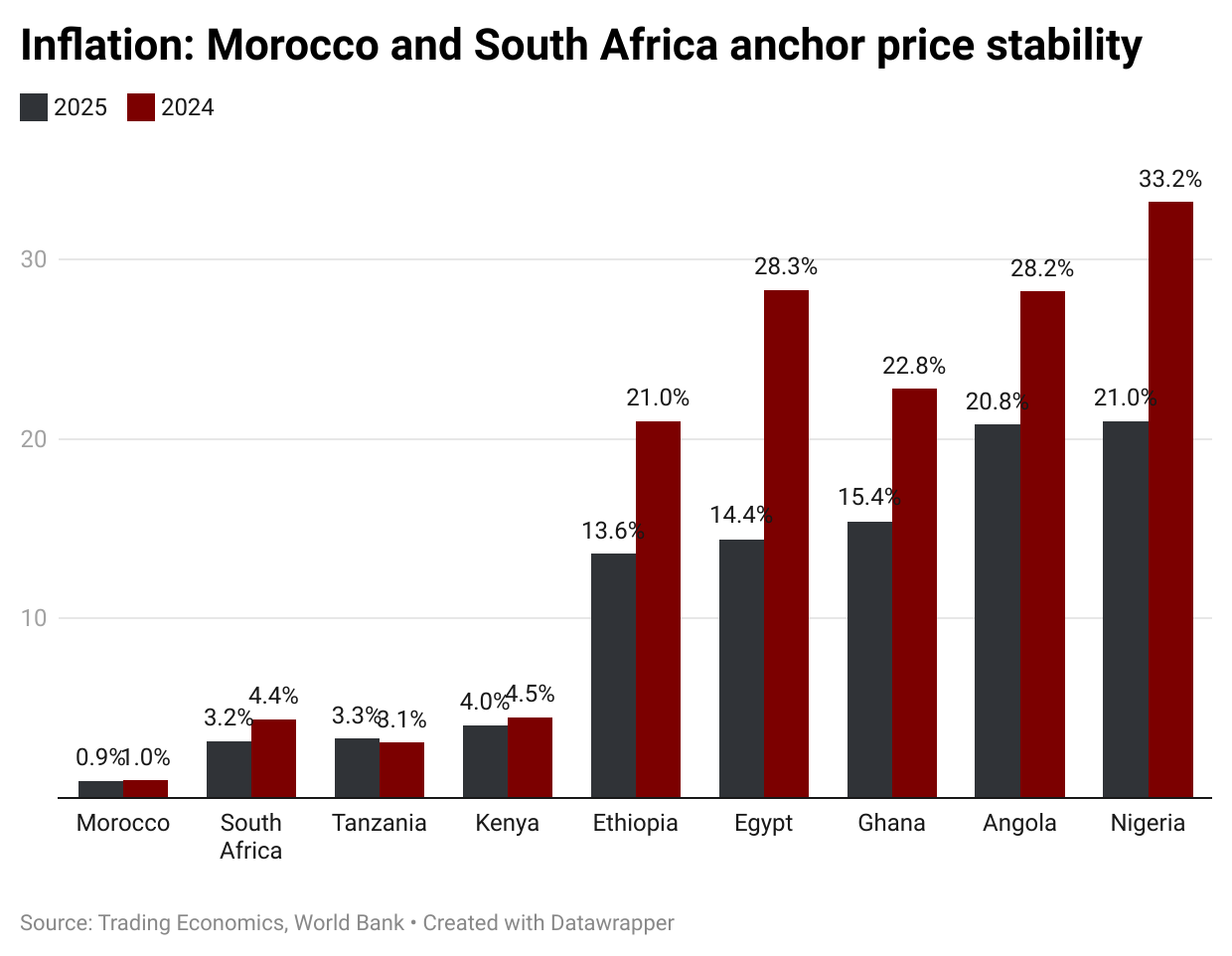
One of Africa’s clearest macroeconomic successes last year was the retreat of inflation from the highs of 2023–2024. Tighter monetary policy, stabilising food and energy prices, and calmer currency markets collectively eased price pressures across most regions.
Morocco recorded the lowest average inflation among Africa’s largest economies, at just 0.94 percent between January and October. South Africa followed at 3.15 percent, reflecting credible inflation targeting and easing supply constraints.
Morocco’s achievement was particularly striking. In November, the country recorded deflation for the first time in nearly five years, joining Algeria and Burkina Faso in negative inflation territory in 2025. While disinflation refers to slowing price increases, Morocco crossed into outright deflation—meaning prices actually fell, boosting consumers’ purchasing power.
Elsewhere, inflation outcomes varied widely. Between January and November, average inflation stood at 3.3 percent in Tanzania, 4.04 percent in Kenya, and 13.6 percent in Ethiopia. Egypt recorded 14.4 percent, while Ghana posted 15.4 percent, with Angola reporting 20.8 percent, and Nigeria recoroding 20.96 percent.
Read also: The new supercycle: Why Nigeria’s future markets will be built on digital scarcity
Labour markets: South Africa, Angola recorded declines in unemployment
While inflation eased, Africa’s labour markets told a more sobering story. The continent’s recovery in 2025 remained largely job-poor, particularly in large economies.
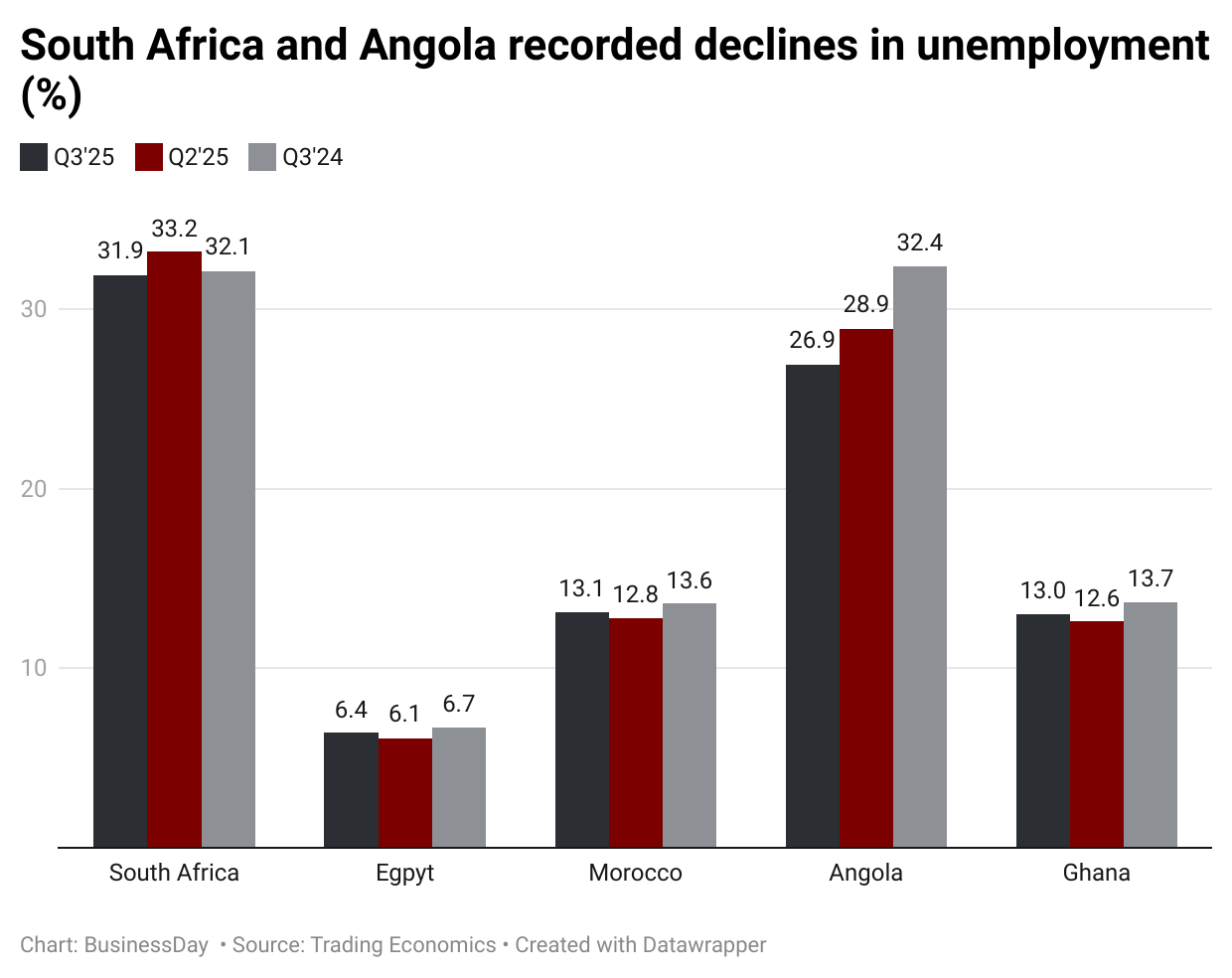
South Africa recorded a rare bright spot. The unemployment rate fell to 31.9 percent in Q3 from 33.2 percent in Q2—the first improvement this year and the lowest since late 2024.
The rebound defied fears that the 30 percent US tariffs under President Donald Trump would trigger job losses. Gains in construction, social services, and trade, alongside improved electricity supply, supported employment.
Angola also reduced unemployment to 26.9 percent in Q3, its lowest level since Q4 2023, boosted by diversification efforts, public works programmes, and formalisation of informal activities.
However, unemployment rose in Egypt, Morocco, and Ghana. Egypt’s jobless rate increased to 6.4 percent, Morocco’s to 13.1 percent, and Ghana’s to 13.0 percent. Even Morocco’s impressive inflation control failed to translate into job creation.
Stock markets: Frontier exchanges steal the spotlight

Africa’s equity markets outperformed global peers in 2025. According to DabaFinance, the PanAfrica Index — averaging dollar returns across 17 exchanges — surged more than 41 percent in the first nine months, beating major developed-market indices.
While South Africa’s JSE remained the continent’s largest exchange, the fastest gains came from smaller frontier markets.
The Malawi Stock Exchange led Africa with a staggering 251 percent gain in dollar terms as of December 22, according to real-time trading platform African Markets. Market capitalisation rose sharply, pushing the market cap-to-GDP ratio above 120 percent — a rare level for African exchanges.
Ghana followed as the GSE Composite Index gained about 132 percent year-to-date, driven by strong banking stocks, lower fixed-income yields, and improved macro stability. Financial equities returned 89 percent by mid-December, reflecting renewed investor confidence.
Adding to Ghana’s market momentum, last week First Atlantic Bank — a 30-year-old indigenous financial institution — listed on the GSE, becoming the first listing in over seven years. The move underscores growing investor confidence and adds depth to the local equity market.
Zambia’s market rose by 105 percent, Nigeria gained 55.9 percent, and South Africa advanced 55.5 percent. Botswana posted the least returns of 9.85 percent, with Mauritius seeing a negative performance.
Currency markets: Ghana and Zambia lead Africa’s FX turnaround

Several African currencies strengthened in 2025, supported by improved terms of trade, foreign exchange reforms, stronger export receipts, and a softer US dollar.
Ghana and Zambia emerged as the continent’s strongest currency performers.
The Ghanaian cedi appreciated by more than 20 percent in the first eight months, reversing a 19 percent depreciation in 2024. According to the World Bank, tighter monetary and fiscal policy, higher cocoa and gold prices, and restored investor confidence following debt restructuring underpinned the rally.
Read also: FCTA cracks down on pantaker markets over rising solar streetlight thefts
Bank of Ghana data also show that the average interbank exchange rate strengthened to 11.02 cedis per dollar in November from 14.97 in January, representing a 23.5 percent appreciation year to date.
The currency’s appreciation helped push inflation into single digits for the first time since 2021, easing to 9.4 percent in September. The disinflation trend deepened in November, with inflation falling further to 6.3 percent — marking nine consecutive months of deceleration.
“The speed of Ghana’s disinflation reflects a rare alignment of tight macro policy, improved FX inflows, and restored investor confidence,” SBM Intelligence said in a recent report, noting that the International Monetary Fund’s disbursements under the $3 billion Extended Credit Facility further boosted sentiment.
Zambia’s kwacha gained about 16 percent, supported by progress on debt restructuring and lower oil import costs. Inflation slowed to 10.9 percent in November, the lowest since August 2023.
But South Sudan’s pound and Ethiopia’s birr were the weakest performers, each depreciating by more than 10 percent amid export disruptions and FX market strains.