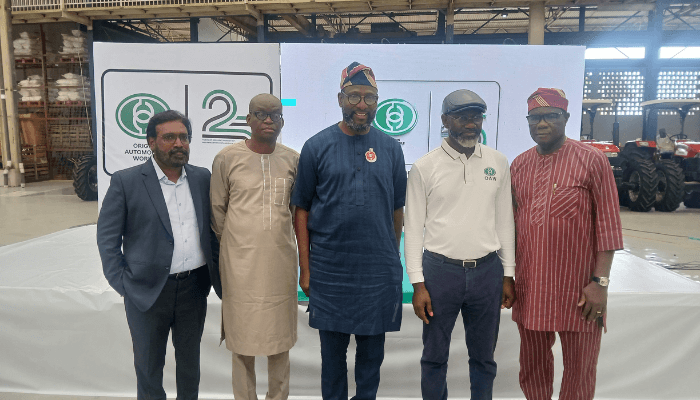
Prince Samuel, chairman of Origin Automobile Works, has said that the country does not have a robust framework to attract critical tractor leasing investments.
Samuel, who made this known in a recent press briefing as part of activities to mark the company’s 25th anniversary, noted that while leasing is critical to modern agriculture, Nigeria lacks the supporting framework, especially in maintenance services and insurance coverage.
He described it as deep structural gaps in the agricultural ecosystem, particularly the absence of a functional equipment leasing culture in mechanisation.
Speaking on government tractor intervention schemes, the chairman criticised interventions that focused narrowly on distributing machinery, especially tractors, to farmers, without building the systems required to make them productive and profitable.

According to him, replacing manual labour with machines without considering efficiency, training and maintenance has often resulted in losses rather than gains.
“You provided a tractor, but you didn’t teach the farmer how to efficiently use the tractor. That’s a problem.”
“Two, you didn’t teach the farmer how to efficiently use the tractor. You didn’t provide him proper maintenance, where he would get quick support and quick maintenance.”
Also, the chairman highlighted the logistical challenges that undermine tractor-hiring schemes, pointing to the wide dispersion of farms across rural areas.
“You put a good tractor in one location. The farmers within that area are five to 25 to 30 kilometres from each other. If they will pay you N10, you will use N30 to transport the tractor to where you will work for them. Will you go? You will not go,” he explained.

Despite these challenges, Samuel expressed confidence that farmers could achieve significant gains when productivity growth is guaranteed through pragmatic government policies and improved mechanisation.
He said Nigeria has the natural endowments to rank among the world’s leading food producers, but warned that productivity growth has remained moderate in recent years, threatening competitiveness and the country’s ability to meet rising domestic and global food demand.
Samuel called for a radical rethink of the nation’s food security strategy, urging the government to adopt a policy that would require ministers, commissioners and other top officials to own or partner in farming ventures as a condition for leadership.
He argued that the persistent agricultural challenges stem from a disconnect between policy formulation and on-the-ground realities.
According to him, the most effective way to close that gap is to ensure that policymakers have direct personal stakes in agriculture.
“If there’s any very serious policy I want the government to make, it is for ministers, commissioners and government officials to own at least a farm or partner in a farming project,” he said
“There’s no easier way of getting people to relate to something than when they own it and they are truly part of it,” he noted.
“Until you own something, you will not reach out. You will not even know those who are playing; you will not know the opportunities that are there,” the chairman added.
Samuel maintained that even modest engagement, such as operating a backyard farm, would transform how leaders understand the sector and naturally push them to deploy their influence in ways that strengthen agriculture and empower farmers.
Samuel stressed that data-driven farming would be critical in meeting global demands for sustainability and traceability.
He noted that Nigeria’s large and youthful population makes the moment particularly urgent. With the right policy support for mechanised agriculture, he said, the country could reclaim its position as a global agricultural powerhouse.