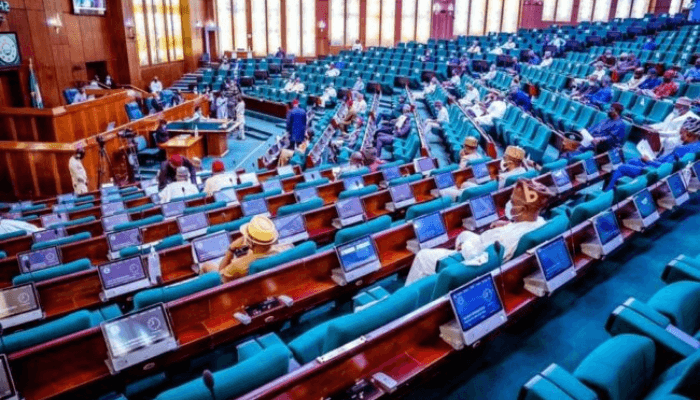
Nigeria’s federal lawmakers considered more than a thousand bills during the 2025 legislative year, but only a small fraction was passed and fewer became law. While the bulk of bills passed focused on establishing educational or medical institutions in lawmakers’ constituencies, a handful targeted other areas of the economy.
The Green Chamber of the National Assembly enacted or amended laws aimed at reforming key sectors including taxation, manufacturing, insurance, maritime, policing, among others
Some of the bills have been signed into law by President Bola Tinubu, while others await his assent. Here are some of the most notable legislation passed by the House of Representatives.
Read also: Akpabio asks Tinubu to reconsider withdrawal of police from federal lawmakers

Tax reforms laws
Perhaps, the most closely watched and hotly debated legislation was the package of four tax reform bills initiated by President Tinubu. The bill was passed after months of opposition in the House of Representatives, and has been signed by the President.
The bills, including the Nigeria Tax Bill, the Tax Administration Bill, the Joint Revenue Board Establishment Bill and the Nigeria Revenue Service Bill are designed to streamline tax administration, unify revenue agencies and reduce duplication in collection.
The laws create a new Nigeria Revenue Service to replace and consolidate existing bodies. They also introduce the Joint Revenue Board that will harmonise federal, state and local taxes to minimise conflicts over who collects what.
The government has described the laws as a shift toward improving collection efficiency rather than raising taxes. Under the new framework, many essential goods and services including food, healthcare, education, and utilities are formally zero-rated or exempt from value-added tax (VAT), providing relief to households while maintaining government revenue growth.
The reforms are to take effect in January 2026.

Insurance Reforms
The House enacted the Nigeria Insurance Industry Reform Act, 2024, which repeals previous regulations and introduces a stronger framework for supervision of insurance firms. The law significantly raises the minimum capital requirements for operators.
It is expected that the enhanced capitalisation will enable insurers to underwrite larger risks, reduce capital flight from foreign reinsurance markets, and improve retention capacity in the local market.
The legislation also emphasises policyholder protection, compels faster claims processing and strengthens the powers of the National Insurance Commission.
30% Value Addition Bill
The House also passed the Raw Materials Research and Development Council (Amendment) Bill, widely referred to as the ‘30% Value Addition Bill.’ The bill mandates that no raw material shall be exported from Nigeria without a minimum of 30% value addition.
The law is designed to boost domestic manufacturing, increase job creation, stimulate processing industries and reduce reliance on imported finished products. The bill is also expected to ease pressure on foreign exchange demand by reducing the export of unprocessed goods.
Read also: Lawmakers clash over 2026 revenue target as experts flag debt trap
Police Pension Board
This is notable because it is one of the most agitated legislations in the security sector. The House passed the Nigerian Police Force Pension Board after years of agitation by serving and retired officers.
The legislation exempts Police personnel from the Contributory Pension Scheme, placing them on a separate, dedicated pension system similar to that of the military and Department of State Services. The bill is expected to provide a fair and distinct scheme for Police who face unique career risks and service conditions.
Wildlife Protection Bill
The House also passed the Endangered Species Conservation and Protection Bill, a major update to Nigeria’s environmental laws. The bill introduces tougher penalties for wildlife trafficking and grants authorities expanded investigative powers, including financial tracking of illegal proceeds.
The legislation aims to improve international cooperation on wildlife crime and speed up prosecution timelines. It is awaiting Presidential assent.
Cabotage Reform to Protect Indigenous Shipping
In the maritime sector, the House passed the Cabotage Act Amendment Bill to restrict the use of foreign vessels in Nigeria’s coastal and inland waters. The legislation aims to strengthen indigenous participation in maritime trade, promote the development of domestic tonnage, and establish a Cabotage Vessel Financing Fund to support local shipping operators.
Public affairs experts score lawmakers low
Public affairs analysts have scored Nigeria’s 10th National Assembly low for its legislative performance, saying the federal lawmakers have not done enough to meet public expectations in key areas such as security, electoral reform, and economic policy.
Chinedu Obi, director-general of the Institute for Policy Analysis and Communication (IPAC), said the current Assembly “generally has not impressed Nigerians” and described it as “the worst assembly since we entered the fourth republic.”
Obi noted that while the House of Representatives traditionally holds robust debate due to the presence of younger lawmakers, he however expreseed disappointment that the vibrancy has been largely absent in the current legislature.
“Many of us expected them to do more, especially in two core areas, insecurity and constitution ammendment”, he said.
According to Obi, Nigerians had hoped the House of Representatives would introduce serious legal frameworks to curb growing insecurity, particularly kidnappings, mass abductions of schoolchildren, and violent attacks in the country.
“Nigerians are worried about the level of kidnapping, abduction of school children and bloodletting across Nigeria, particularly in the northeast and the middle belt. Carnage in Benue, in Plateau and almost everywhere within the middle belt. We expected serious legislation that would have supported the control of this madness and growing insecurity in Nigeria,” he said.
Obi also criticised the slow pace of Constitutional amendments that could support electoral reforms. For instance, he had expected that the Bill to make appointment of the chairman of the Independent National Electoral Commission purely independent would be passed before appointment of the new INEC Boss.
Obi said Lawmakers ought to have pushed electoral reforms faster, particularly those requiring concurrence from all State Assemblies, to ensure the next elections are credible and meet public expectations.
Chidi Omeje, a public affairs analyst, also scored the performance of Lawmakers below-average. According to Omeje, the legislature has not done enough to address pressing economic or security challenges and has focused more on internal matters and personal interests.
“You have a legislature that, in a democracy, is meant to be a strong arm of government, to check the executive, to act as a watchdog of democracy. But that’s exactly not what we’re seeing,” he said.
Omeje described the current legislature as “very compromised” and said it has failed to produce “progressive, or spectacular laws.” He cited the current economic hardship, insecurity, and declining standard of living as circumstances in which Nigerians expected bold legislative action.
“Apart from one brilliant member here and there, the totality of their performance is below average, as far as I’m concerned,” he said.