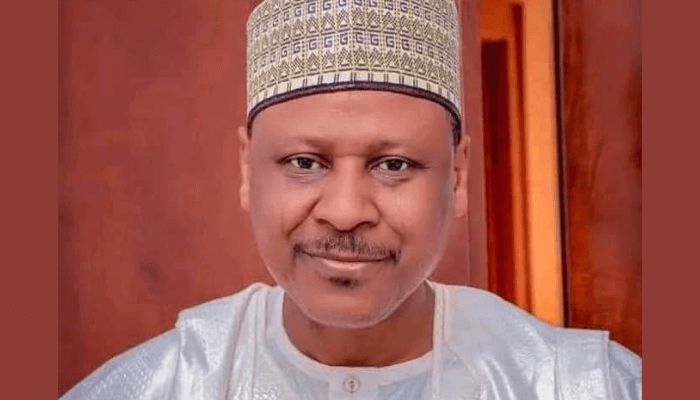
Mohammed Idris, Minister of Information and National Orientation, says President Bola Tinubu is focused on building a secure, competitive and prosperous Nigerian economy in 2026, as recent government reforms begin to produce results.
Idris made this known on Monday during the Federal Government’s end-of-year media briefing in Abuja.
According to him, 2025 was largely devoted to stabilisation and the consolidation of reforms across key sectors, while 2026 will focus on translating those gains into sustainable growth, improved security and national development.
Read also: “I’m confident Nigeria will establish state police” – Tinubu

“The journey of 2025 was one of reinforcing foundations. The mission of 2026 is to build a secure, competitive and prosperous Nigeria on that base,” Idris said, speaking on behalf of President Tinubu.
The minister began the briefing by announcing the release of all 230 pupils abducted from St. Mary’s Catholic School in Papiri, Niger State, following the rescue of the remaining students.
He said the Federal Government sympathised with the affected families and reaffirmed its commitment to preventing similar incidents.
Reviewing the administration’s performance in 2025, Idris cited key economic indicators, including a 3.98 per cent Gross Domestic Product (GDP) growth in the third quarter, eight consecutive months of declining inflation to 14.45 per cent in November, external reserves of about $44.56 billion, and a trade surplus of N6.69 trillion.
He also noted progress in sectors such as power, infrastructure financing, agriculture, youth empowerment and investor confidence. According to him, Nigeria exited the Financial Action Task Force (FATF) Grey List in 2025 and recorded an oversubscribed Eurobond issuance.

On security, Idris said President Tinubu declared a nationwide security emergency in 2025 and approved a new national counterterrorism doctrine.
He explained that this led to increased recruitment into the Armed Forces and the Nigeria Police, as well as the deployment of forest guards nationwide.
Under the new framework, the minister said groups involved in kidnapping, attacks on farmers or violence against communities would be designated and treated as terrorist organisations.
In the education sector, Idris said the Nigeria Education Loan Fund supported more than 788,000 students with interest-free loans and stipends totaling over N150 billion.
He also highlighted President Tinubu’s proposed N58.18 trillion 2026 Appropriation Bill, which he said reflects the administration’s focus on security, infrastructure and economic consolidation.
According to him, N26.08 trillion is allocated to capital expenditure, while defence and security received the largest single allocation of N5.41 trillion.
The budget, titled “Budget of Consolidation, Renewed Resilience and Shared Prosperity,” is designed to deepen reforms, protect lives and property, and promote economic growth.
“The temporary effects of reform are giving way to long-term gains,” Idris said, urging Nigerians to support ongoing reforms.
On foreign relations, the minister said Nigeria’s relationship with the United States has strengthened following the resolution of earlier diplomatic disagreements.
He disclosed that both countries signed a five-year, $5.1 billion bilateral health cooperation Memorandum of Understanding, under which the United States will provide $2.1 billion in grants, while Nigeria will commit $3 billion. He said the agreement would support Nigeria’s healthcare system and attract investment.
Idris also said Nigeria regained its Category C seat on the International Maritime Organisation (IMO) Council for the 2026–2027 biennium after 14 years and secured hosting rights for major international events, including the Creative Africa Nexus (CANEX) 2026, the World Public Relations Forum 2026, and the Intra-African Trade Fair (IATF) 2027.
He added that newly appointed ambassadors are expected to assume their posts in 2026 to strengthen Nigeria’s diplomatic engagement.
Despite these claims, opposition parties have criticised the administration’s assessment of economic stability and security, arguing that it does not reflect conditions across the country.