|
Getting your Trinity Audio player ready...
|
A statistical analysis of Nigeria’s 2023 presidential election has found that polling units in Labour Party (LP) strongholds recorded the highest concentration of irregularities, challenging the dominant narrative that manipulation was driven primarily by the ruling party.
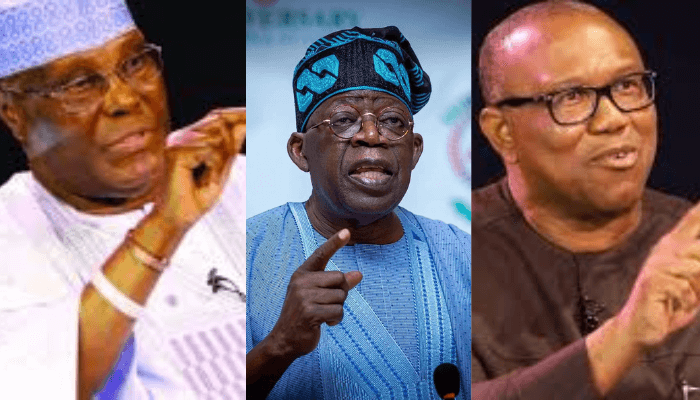
President Bola Tinubu of the All Progressives Congress (APC) won the election with 8,794,726 votes, according to official results released by the Independent National Electoral Commission (INEC).
Atiku Abubakar of the Peoples Democratic Party (PDP) finished second with 6,984,520 votes, while Peter Obi of the LP placed third with 6,101,533 votes.
The findings are contained in a study conducted as part of a master’s thesis in Data Science at Pan-Atlantic University, which analysed results from 123,918 polling units across Nigeria’s 36 states and the Federal Capital Territory (FCT).

Read Also: Peter Obi condemns “forged laws” as national shame, demands transparency in tax legislation
Using machine-learning techniques, including Random Forest classifiers, the researcher identified 4,351 polling units—about 3.5 percent of those analysed—as statistically anomalous.
While the proportion may appear limited, the study noted that such irregularities can be decisive in close elections, particularly when they are concentrated in politically significant areas.
South-east most affected
According to the analysis, irregularities were not evenly distributed nationwide but were heavily concentrated in specific regions.
“Anambra State recorded an anomaly rate of 24.9 percent, meaning nearly one in four polling units showed multiple fraud indicators,” the report said. Enugu State recorded 16.7 percent, while Imo State had 10.9 percent.

By contrast, Lagos State, the political base of the winning candidate, recorded an anomaly rate of 2.3 percent, while Oyo State stood at 0.3 percent.
The study said the pattern undermines claims of uniform, centrally coordinated manipulation.
“The data suggests electoral manipulation is geographically concentrated, crosses party lines, and appears driven more by opportunity than ideology,” the report said.
The researcher added that the analysis was limited to polling units with uploaded result sheets, noting that in some cases, final figures announced by INEC differed significantly from uploaded data.
Rivers State was cited as a notable example, where the Labour Party led in uploaded results but the final declaration favoured the APC.
Labour Party areas flagged most
The report said Labour Party strongholds showed the highest concentration of statistical red flags, despite the party finishing third nationally.
“LP recorded 2,328 instances of ‘perfect scores’—results clustering around suspiciously round percentages such as 50.00 or 75.00 percent,” the study said.
Although the party secured 29.1 percent of the national vote, it accounted for a disproportionately high share of flagged polling units, the analysis found.
The researcher said the findings complicate claims that electoral manipulation in 2023 was one-sided.
“It suggests that the election was not orchestrated solely from the centre,” the report said. “Multiple actors engaged in manipulation where conditions allowed.”
The study added that the concentration of anomalies in the south-east does not contradict Peter Obi’s popularity in the region, but may reflect the opposite.
“In areas of overwhelming support, manipulation becomes easier to conceal. In competitive environments, it is far more difficult,” the report said.
Neither free nor fully fraudulent
The study concluded that Nigeria’s 2023 presidential election was neither catastrophically fraudulent nor credibly free and fair.
According to the analysis, traditional methods such as blatant ballot stuffing have declined, replaced by more subtle forms of manipulation that produce statistically plausible outcomes.
“Instead of reporting 100 percent turnout with 95 percent for one candidate, modern perpetrators report 65 percent turnout with 58 percent for their candidate—plausible, defensible, and still fraudulent,” the report said.
The researcher recommended independent audits of election data, mandatory real-time transmission of results, the unbundling of INEC’s responsibilities, improved technical capacity, and the visible prosecution of electoral offenders.
The report said the 2023 election reflected Nigeria’s ongoing struggle between democratic ambition and flawed execution, despite heavy investment in electoral technology.