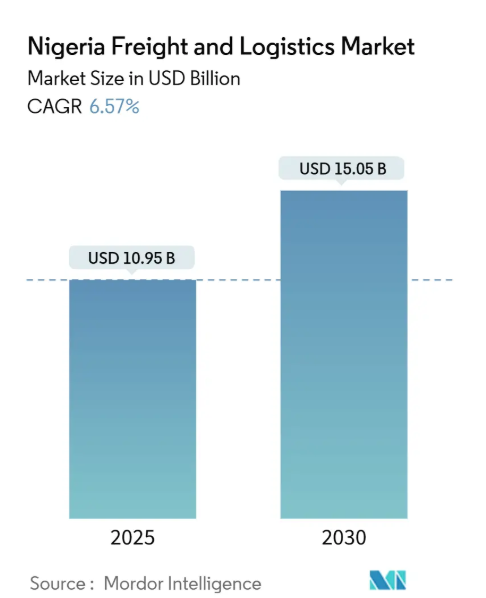
The atmosphere over Lagos is charged not only with vibrant commerce but also with the strain of goods that struggle to move. Every truck stuck in gridlock, each shipment left stranded at docks, and every pallet of perishable goods at risk of spoilage represent hidden costs to Nigeria’s economy. This reflects the persistent challenge faced by one of Africa’s largest markets: a logistics sector valued at approximately $10.95 billion by Mordor Intelligence, contributing around 3.5% to the GDP, yet hindered by outdated infrastructure that burdens every citizen.
Experts believe that with improved investment and infrastructure, the sector could increase GDP by up to 60%.
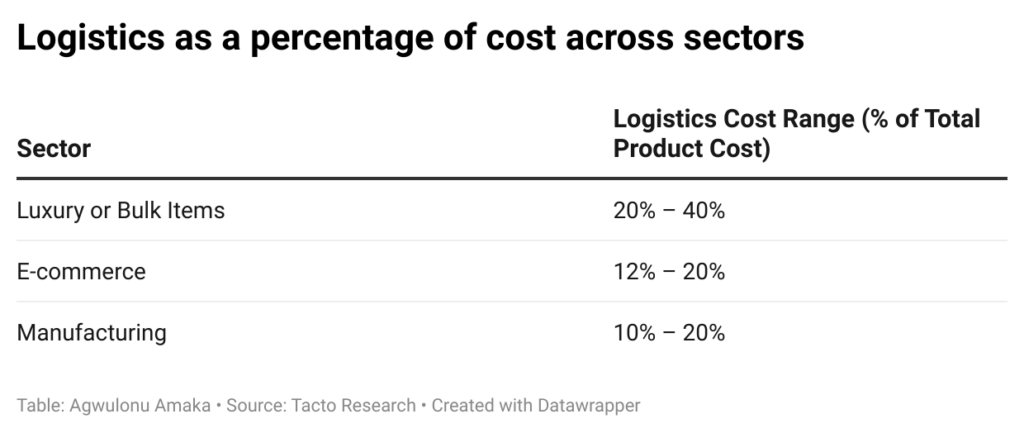
For too long, that burden has been borne by businesses and consumers alike: logistics costs accounted for between 10 per cent and 15 per cent of an item’s total manufacturing cost, according to Tacto Research. This exceeds the international benchmark of 8% to 11%, according to the African Centre for Supply Chain.

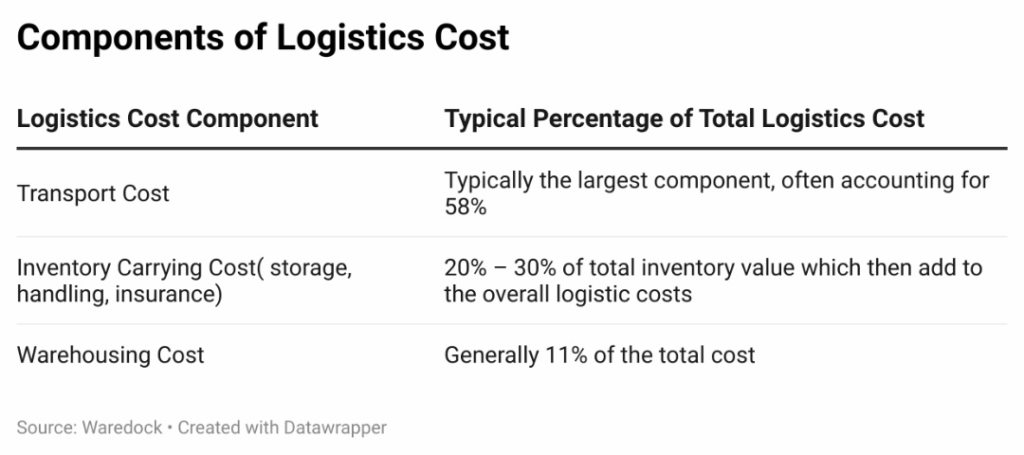
The result is a rapid loss of wealt h. The inefficiency is most critical in the cold chain, where inadequate transportation and storage infrastructure lead to post-harvest losses estimated at $10 million annually.
Imagine a truckload of fresh ginger or cashew nuts, finally harvested after months of labor, only to be rejected at the processing plant because the journey from the farm gate took too long. Companies like Valency Agro Nigeria Limited live this reality daily; their growth and the nation’s food security are threatened by constraints that turn potential profit into spoiled produce.
A failure to connect
At the BusinessDay Mobility & Logistics Conference, one key message emerged: Nigeria’s logistics problem isn’t just due to neglect, but also due to a failure to connect systems. As industry leaders stated, the country lacks a unified mobility and logistics framework that considers the movement of goods as essential economic infrastructure rather than an afterthought in transportation.
Nigeria still relies heavily on roads, which is risky for a fast-growing economy of over 230 million people.

With only about 60 percent of rural communities connected by reliable, all-season roads, highways are overstretched, trucks are often overloaded, and transit times are becoming less predictable. This inefficiency quietly burdens the economy—raising food prices, worsening inflation, and reducing competitiveness. As recent discussions point out, logistics inefficiency directly contributes to cost-push inflation, making it harder to maintain price stability.
The issue is no longer about understanding the problem; it’s about taking action. Without deliberate investment in rail, inland waterways, ports, and urban freight systems—and without recognizing logistics as vital infrastructure—Nigeria will keep moving goods in the difficult way, at a cost the economy can hardly afford.
The new rivers of trade
The first and most immediate relief must come from developing Nigeria’s underutilised waterways, transforming them into dependable arteries of commerce. Lagos State is leading this effort with the highly anticipated €410 million OMI ÈKÓ Project. This should not be just a theoretical proposal; it needs to be a concrete plan with an active goal of deploying 75 electric-powered ferries across 15 priority routes, supported by 25 new terminals. The environmental and economic benefits are significant: this single initiative is expected to cut CO2 emissions by 41,000 tonnes annually and save commuters up to three hours of travel time on key routes. If water transport can reliably handle light cargo logistics, it frees up vital road space for heavy haulage.
To support this shift and permanently resolve seaport congestion, investment must be directed toward developing Inland Dry Ports (IDPs) in key hinterlands like Kaduna, Ibadan, and Kano. These IDPs bring customs clearance closer to the final markets, greatly improving cargo turnaround times.
However, none of this is effective without addressing the root cause of the massive vulnerability—the cold storage facility. This requires a dedicated investment in modern warehouses and cold storage facilities located directly at farm gates. This infrastructure is the only way to protect high-value, perishable agricultural products, allowing Nigeria to finally unlock the significant export potential of crops like ginger and cashew.
The digital guardian of the fleet
Although new waterways and ports are structural solutions, efficiency on the existing road network demands a digital intervention. Here, fleet management technology acts as a vigilant guardian against loss and waste.
Logistics firms must move decisively to integrate Geo-fencing, telematics, and fuel sensors across their fleets. These digital eyes provide real-time data on everything from a truck’s location to fuel consumption, helping prevent fuel theft and unauthorised trips. The data goes deeper, monitoring driver behavior, tracking instances of harsh braking, excessive idling, and speeding.
By addressing these inefficiencies, fleet operators can achieve measurable gains, with industry data showing the potential to reduce fuel costs by up to 30% through optimised routes and improved driving habits. This is a crucial step toward injecting accountability into the transport ecosystem.
Solving the last mile
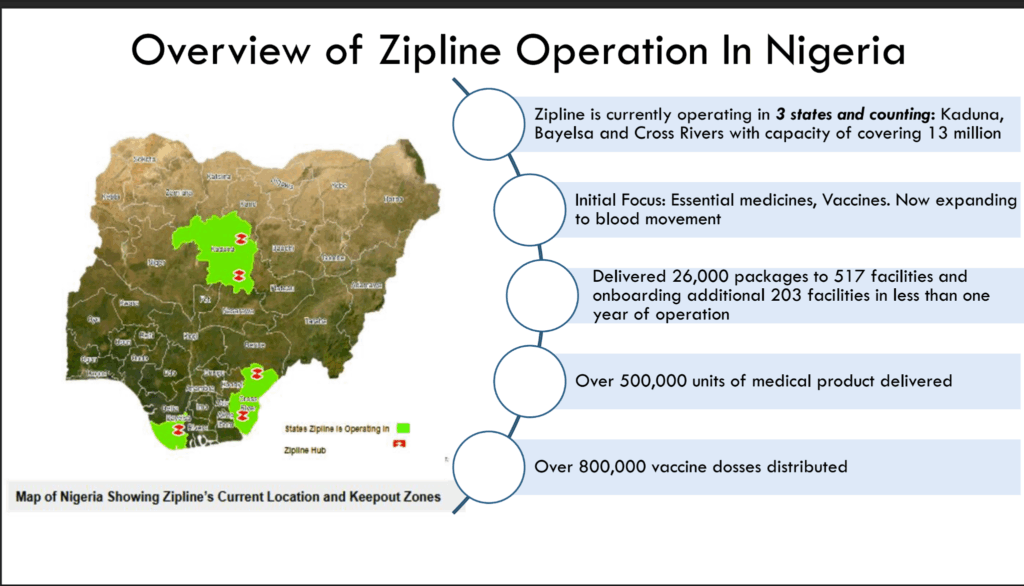
For the most remote and challenging environments, where roads fail seasonally or simply don’t exist, the solution is not on the ground, but in the air. Drone technology, once considered futuristic, is now a life-saving reality. Zipline Nigeria has demonstrated the power of this last-mile innovation in states such as Cross River and Kaduna. By deploying networks of autonomous delivery drones, Zipline is bypassing road networks to deliver critical medical supplies, blood, and vaccines, addressing the persistent challenge of reaching ‘zero-dose’ children (those who haven’t received basic vaccinations).
This capability proves that air logistics is not just a commercial convenience, but a critical tool for public health and national resilience.
Forging the talent pipeline
The final and arguably most critical challenge is the human capital gap. These modern solutions, EVs, automated ferries, and drone networks, cannot scale without a new generation of skilled operators, mechanics, and logistics analysts.
The industry’s path forward demands a radical shift toward partnership. Universities must shed their traditional roles and become “co-creators” with the private sector and government, embedding real-world scenarios and technical skills into the curriculum.
Encouragingly, industry leaders are already responding. Aviation academies such as Caverton Group and ARCO Aviation, with backing from the Nigerian Civil Aviation Authority (NCAA), are building local talent pipelines to train certified drone pilots and technical staff, ensuring the technology is locally managed and sustained.
The opportunity for investors is now clear: by funding the integration of people, process, technology, and infrastructure, stakeholders can directly address the $10 million crisis, reduce the 20-30% logistics burden, and unlock the full competitive potential of Nigeria’s $15-20 billion logistics sector. The time for talking is over; the time for action is now.