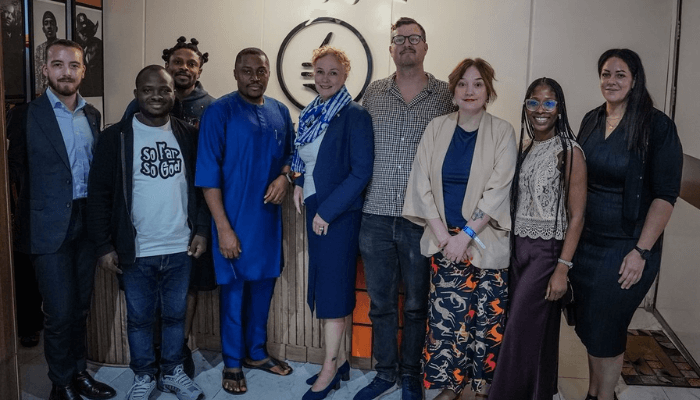
In what has been described as an endorsement of Nigeria’s growing automotive manufacturing sector, Jumoke Oduwole, Federal Minister of Industry, Trade and Investment, conducted an extensive tour of Elizade JAC Autoland’s facilities in Lagos, including the company’s headquarters and its expanded Ikotun assembly plant.
During her tour of the Ikotun facility, Oduwole inspected two state-of-the-art assembly lines: a single-track line dedicated to passenger vehicles and an innovative dual-track system for industrial vehicles, according to a statement. The facility’s expansion is a substantial increase in production capacity, positioning Elizade JAC to meet growing demand for locally assembled vehicles.
“What has impressed me most is that the company’s management has signified its willingness to really be vested in its product and stand behind its product for Nigerian people,” the Minister stated. “This is real commitment to making Nigeria work, which is the priority of the President Bola Ahmed Tinubu administration.”
The minister emphasized that the federal government is eager to support domestic investors like Elizade JAC who are reinvesting profits into expanding their operations and increasing production capacity to serve the Nigerian market, she said in the statement.

A central theme of both the ministerial visit and Elizade JAC’s strategic vision for 2026 is positively disrupting the Nigerian automotive market by making brand-new vehicles accessible to average citizens. Currently, Nigeria’s automotive landscape is dominated by used imported vehicles, commonly known as “tokunbo,” which often come with hidden risks and questionable reliability.
Demola Ade-Ojo, Managing Director and CEO of Elizade JAC Autoland Limited, according to the statement outlined the company’s ambitious plans: “For 2026, that’s exactly what we’re going to do. We want to begin to inform Nigerians so that they can begin to understand why it is actually beneficial to them and to the nation as a whole to drive new vehicles as opposed to used vehicles.”
Oduwole reinforced this message with stark warnings about the dangers of used vehicle imports. “Nigerians are buying used goods that have been damaged elsewhere, damaged by flood, damaged by fire, refurbished and packaged with paint and shipped into Nigeria,” she cautioned. “They’re essentially possible death traps if we’re not careful. So we don’t want Nigerians buying substandard used goods that other countries have rejected.”
Biola Odukomaiya, Executive Director of Sales at Elizade JAC Autoland Limited, emphasized the comprehensive nature of the company’s offering: “We want to try as much as possible to encourage people to take advantage of this offering to the public. Offering them lower-priced products and also giving them maintenance and service all as a package. You’re buying the car, you’re buying peace of mind.”
Looking ahead, Elizade JAC’s leadership articulated an ambitious agenda for 2026 centered on public education and market disruption. The company recognizes that shifting consumer preference from used imports to new domestic vehicles requires not just competitive pricing but also a comprehensive communication strategy.

“Right now, the Nigerian market is still very low when it comes to new vehicle sales as opposed to used vehicle sales,” Ade-Ojo acknowledged. “So we are looking at how we can begin to have Nigerians enjoy using and owning new vehicles.”
The company’s 2026 campaign will emphasize the total cost of ownership, highlighting how the higher upfront cost of new vehicles is offset by lower maintenance expenses, greater reliability, better fuel efficiency, higher resale value, and the peace of mind that comes with comprehensive warranties and nationwide service support.