|
Getting your Trinity Audio player ready...
|
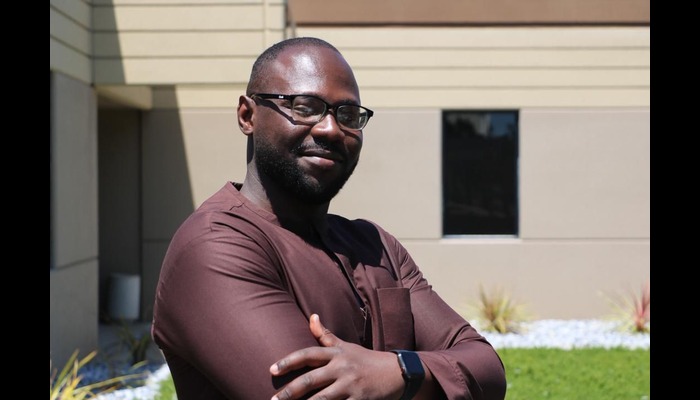
Eight years after he sat in a Covenant University lecture hall finishing his undergraduate project, Damilola Chukwudy Badejo finds his work shaping scientific conversations on four continents, teaching engineering students in the United States, and building a research agenda aimed at one of the planet’s most costly problems, post-harvest food loss.
What began as an undergraduate investigation into sustainable refrigeration, using liquefied petroleum gas combined with titanium dioxide nanoparticles as an alternative to harmful refrigerants, has grown into a body of work cited over one hundred times since its 2016 publication in Elsevier’s Case Studies in Thermal Engineering. For a student paper from a Nigerian university, that reach is exceptional; for Badejo, it was the start of a career that blends careful laboratory science with practical, systems-level thinking.
“I was investigating sustainable refrigeration, specifically, using liquefied petroleum gas combined with titanium dioxide nano-particles as an alternative to harmful refrigerants,” Badejo explains from Texas, where he is pursuing graduate studies. The methodological rigor and clarity of his early work, he and others say, helped the paper find an audience among researchers seeking environmentally friendly cooling solutions. But citations were only the opening act. What followed was a steady progression from academic inquiry to industry application and then to interdisciplinary research aimed at keeping perishable goods from spoiling in transit.
After graduating from Covenant in 2016 with a B.Eng. in Mechanical Engineering (Second Class Upper), Badejo moved into industry work that let him translate theory into measurable savings. In 2021 he joined Mar and Mor Engineering Company as an MEP project engineer, where he managed HVAC systems for buildings across Nigeria and applied his understanding of thermal systems to retrofit projects that improved energy efficiency. A careful review of project documentation even uncovered a critical error in a Bill of Quantities that would have cost his employer 60 million Naira, an intervention he attributes to meticulous checking, not luck. “Good engineering is often about preventing disasters you never see,” he says.

Badejo did not stop at hands-on engineering. He returned to academia to broaden his technical repertoire, completing an M.Sc. in Mechanical Engineering at the University of Lagos in December 2023 with a specialization in Design and Production. It was there that his work began to shift toward the systems problems that repeatedly surfaced in both construction and manufacturing contexts. The problem of coordinating the movement of goods that degrade over time. Food, pharmaceuticals and other temperature-sensitive products lose quality during distribution, and for many countries, Nigeria included, those losses represent enormous economic and human costs.
“Nigeria loses enormous agricultural value to spoilage. Globally, it’s a $200 billion problem,” Badejo notes. That realization reframed his research questions. Instead of treating refrigeration or production optimization in isolation, he began to ask how thermal engineering, how products degrade with temperature, could be embedded directly into operations research and network optimization models for supply chains.
In 2024 Badejo enrolled in the Industrial Management program at Texas A&M University–Kingsville to get the quantitative tools he needed. The program’s focus on mathematical optimization, network design and advanced statistical methods fit his emerging vision. He has maintained a perfect 4.0 GPA through coursework that includes operations research, supply chain optimization and advanced statistical methods. A summer internship in quality engineering at Alamo Group, a manufacturer of agricultural and industrial equipment, further crystallized his focus that production technology alone cannot solve spoilage if supply chains are not designed for perishables.
“The real challenge wasn’t just production technology or refrigeration science. It was designing entire supply chain networks that account for how quickly products degrade, especially in warm climates like Nigeria’s,” he says. That insight underpins Badejo’s graduate research on Perishable Food Supply Chain Networks. Traditional supply chain models typically treat products as stable and focus on cost-minimizing routes, facility locations and inventory levels. Badejo’s approach incorporates Arrhenius kinetics, thermodynamic equations that describe how degradation accelerates with temperature, directly into network optimization models so decisions about locations, routes, inventory and temperature control are made together rather than sequentially.
His preliminary computational results are striking. They show that modeling work suggests waste could be cut from typical rates of 25–30 percent down to about 5 percent, while keeping product quality at roughly 95 percent compared with usual rates of 70–80 percent. Badejo is careful to emphasize these are modeling outcomes that still require validation in real-world operations. “These are modeling results, not yet validated with actual companies,” he cautions. “But they show potential. Even half those improvements would substantially impact food security and supply chain economics.”

Alongside his research, Badejo serves as a Graduate Research and Teaching Assistant at Texas A&M, where he teaches approximately 60 undergraduates in materials science and manufacturing processes. He supervises laboratory work, demonstrates testing equipment, and connects classroom theory to practical machining and testing skills. “When you explain concepts clearly enough for undergraduates to grasp, you deepen your own understanding,” he says. The reversal is notable as a Nigerian-trained engineer now helping to train American students, reinforcing the international credibility of his academic formation.
Badejo insists his trajectory is not a departure from Nigeria but a continuation of it. He credits Covenant University for early research training and the University of Lagos for deepening his engineering foundation and interest in production systems. Those institutions, he says, gave him the analytical thinking and technical rigor that inform his current work. He envisions the computational tools and frameworks he is developing as immediately applicable back home with better-designed cold chains, optimized distribution networks and investments in targeted temperature control that could help more of Nigeria’s food reach consumers.
Looking ahead to 2025, as he nears completion of his Texas A&M master’s degree, Badejo is expanding his research toward practical toolsets, pursuing journal publications and seeking collaborations that can link Nigerian universities, U.S. institutions and industry partners. “My goal is creating methodologies companies can actually use,” he explains. “Not just theoretical papers but practical tools that reduce waste and improve efficiency, whether that’s in the United States, Nigeria, or anywhere food moves from farm to table.”
Damilola Chukwudy Badejo’s journey, from a Covenant undergraduate whose paper continues influencing scientists worldwide, to an engineer who saved millions for an employer, to a postgraduate researcher and instructor in the United States, illustrates what rigorous training combined with opportunity can produce. His work brings together thermal science, optimization theory and practical industry knowledge in a way that could materially reduce post-harvest losses and improve food security. For Nigeria, his path is both an assertion of the international competitiveness of its universities and a reminder that locally rooted research can have global application.
Badejo holds a B.Eng. in Mechanical Engineering from Covenant University (2016, Second Class Upper) and an M.Sc. in Mechanical Engineering (Design and Production option) from the University of Lagos (2023). He is currently pursuing an M.Sc. in Industrial Management at Texas A&M University–Kingsville while serving as a Graduate Research and Teaching Assistant; his undergraduate research, published in Elsevier’s Case Studies in Thermal Engineering, has been cited more than 100 times internationally.