|
Getting your Trinity Audio player ready...
|
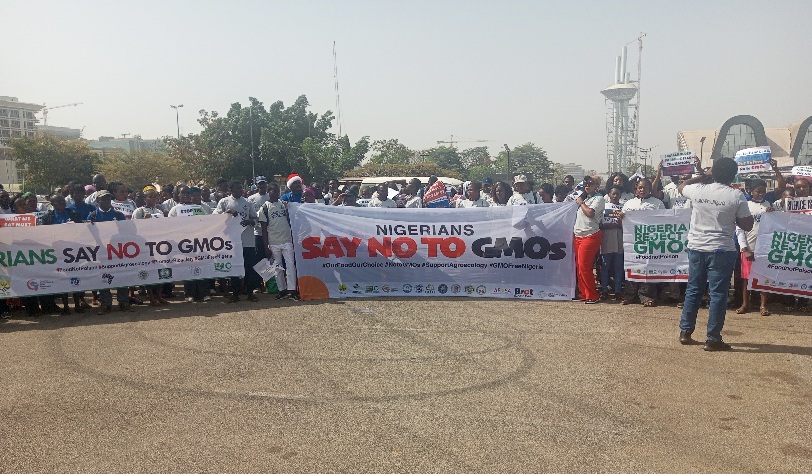
A coalition of 78 civil society organisations (CSOs), spanning farmers, scientists, nutritionists, legal and medical practitioners, women and youth groups, has renewed calls for an outright ban on genetically modified organisms (GMOs) in Nigeria, urging the government to invest in agroecology and other organic farming systems to promote healthy food systems.
The coalition also called on the Federal Government to implement a 2024 recommendation of the House of Representatives made during a public hearing, which urged a halt to the promotion of GMOs in Nigeria pending scientific proof of their harmlessness to humans.
The call was made on Tuesday in Abuja during a national rally for food sovereignty and environmental justice organised by the Health of Mother Earth Foundation (HOMEF) in collaboration with GMO Free Nigeria.
Participants also submitted a petition to the House of Representatives demanding immediate action to suspend GMO approvals pending a comprehensive review of Nigeria’s biosafety approval processes and regulatory framework.

Read also: Pros and cons of GMO foods: What you need to know
The coalition warned that the continued deployment and commercialisation of GMOs threaten Nigeria’s food sovereignty, biodiversity, farmers’ livelihoods, public health and environmental sustainability.
They traced public opposition to GMOs to the establishment of the National Biosafety Management Agency (NBMA) and the issuance of early permits to Monsanto Nigeria Limited and the National Biotechnology Research and Development Agency. Resistance intensified in 2024 following the approval of genetically modified TELA maize.
HOMEF said Nigeria risks losing its indigenous seed diversity through cross-pollination from genetically engineered crops.
Joyce Brown, director of programmes at HOMEF, who represented Nnimmo Bassey, executive director of the organisation, said genetically modified crops could lead to soil degradation and undermine farmers’ independence by forcing them to buy seeds every planting season.

She cited Bt cowpea and cotton as examples where toxins introduced into crops could affect soil health.
Mariann Bassey-Olsson, deputy director of Environmental Rights Action/Friends of the Earth, said opposition to GMOs is global, noting that more than 30 countries have imposed bans.
She listed several European Union countries, Switzerland, Russia, parts of the Asia-Pacific, the Americas, and African countries such as Algeria, Madagascar and Zimbabwe.
She added that Mexico placed an indefinite ban on genetically engineered corn in 2024 following a court ruling that cited risks of environmental harm.
Jacqueline Ikeotuonye, country director of the Bio-Integrity and Natural Food Awareness Initiative, challenged claims that GMOs significantly boost yields.
She referenced a 2024 report by the National Cotton Association of Nigeria, which showed no meaningful yield increase from genetically modified cotton compared with local varieties.
According to the report, yields per hectare remained almost unchanged after three years, while farmers observed that other crops failed to germinate on fields where GM seeds had been planted.
Ikeotuonye added that farmers across Nigeria complain of declining productivity in subsequent planting seasons, making it impossible to reuse seeds and forcing repeated purchases.
Martins Ogunlade, associate director, climate and environment programme, at Corporate Accountability and Public Participation Africa, called for greater accountability from the NBMA.
He said there is no publicly available evidence of long-term risk assessments or clinical trials conducted before the commercial release of GM crops in Nigeria.
Other speakers cited studies linking GMO consumption to health concerns, including antibiotic resistance. They pointed to the commercially approved Bt cowpea, which expresses an enzyme associated with antibiotic resistance, and animal studies indicating immune system disruptions.
Lovelyn Ejim, a farmer, said government decisions should reflect public interest.
She noted that since 2013 Nigerians have consistently demanded a ban on GMOs across various platforms, adding that continued approvals show disregard for public opinion and raise concerns about vested interests.
The coalition’s demands include an immediate ban on all GMO materials for planting, food and feed production in Nigeria.
They also called for a ban on imported processed foods containing bioengineered ingredients, the nullification of existing GMO permits, and increased investment in agroecology and organic farming systems to strengthen food security and the national economy.