…as Federal High Court records 165,905 pending cases
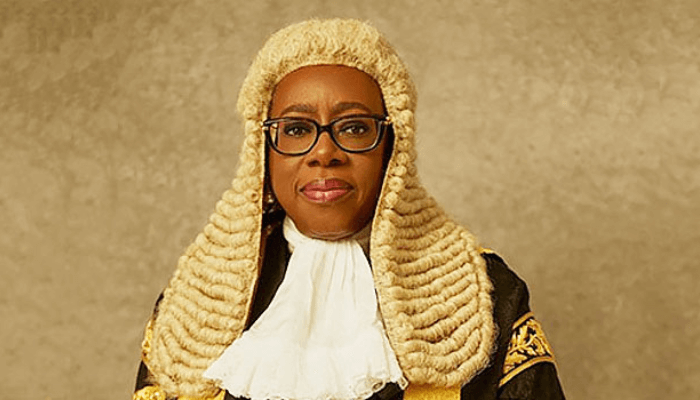
Justice Kudirat Kekere-Ekun, Chief Justice of Nigeria (CJN), has called on courts nationwide to begin virtual hearings to address the mounting backlog of cases awaiting adjudication.
Kekere-Ekun made the call at the opening of the 2025/2026 Legal Year of the Federal High Court, emphasising that traditional courtroom practices alone can no longer handle the increasing volume and complexity of the judiciary’s workload.
She said, “Globalisation, technology-driven crimes, financial innovations, cross-border commercial disputes, terrorism-related cases, and evolving regulatory frameworks now define much of the Court’s docket.

Read also: PDP faults Supreme Court on emergency rule judgment
“These developments demand new skills, stronger case management, and swift judicial adaptation.”
Justice Kekere-Ekun stressed that digitisation should no longer be treated as a project-based initiative but as a central institutional priority.
According to her, “Virtual hearings, electronic filing, digital case tracking, secure record management, and functional ICT support are now essential for efficient justice delivery. Digitisation improves speed, accountability, predictability, and public trust. When court information is accurate and readily accessible, uncertainty decreases, and confidence in the judiciary grows.”
She commended the Federal High Court for introducing the Information Electronic Directory Table, Electronic Notice, and Advertorial Display Screens, calling them more than mere technological upgrades. “These systems represent a deliberate move toward transparency, order, and user-focused court administration,” she said.

The Electronic Display Notice Board allows real-time sharing of court-approved information, including daily and weekly cause lists, administrative circulars, official announcements, and emergency notices.
Justice Kekere-Ekun said the Electronic Display Directory Table helps visitors navigate court premises efficiently, reducing congestion and delays while improving access to services. “Together, these initiatives foster dignity, efficiency, accessibility, and institutional coherence—values that should define the modern Nigerian judiciary,” she noted.
Ahead of the 2027 general elections, the CJN also warned judges against the misuse of interim injunctions. She emphasized that election-related cases must be handled with discipline, consistency, and strict adherence to constitutional and statutory timelines.
“The nation looks to the courts for clarity and balance at critical moments. Conflicting interim orders, forum shopping, and the abuse of ex parte processes undermine the credibility of the justice system and weaken public confidence,” she said.
Justice Kekere-Ekun further underscored the importance of effective case management, noting that delays in the administration of justice remain a major concern for both the Bar and the public. “Some delays are structural, but many are preventable. Judges must actively guide proceedings with firmness and purpose. Case management is central to judicial responsibility, not optional,” she explained.
She added that the National Judicial Council (NJC) will continue monitoring case progression—not to intimidate, but to support discipline and enhance justice delivery.
Justice John Tsoho, Chief Judge of the Federal High Court, disclosed that by the end of the 2023/2024 Legal Year, 161,999 cases were carried over into 2024/2025.
Tsoho said that during this period, 19,925 new cases were filed, bringing the total pending cases to 181,924. Of these, 16,019 cases were disposed of, including 3,113 civil cases, 5,818 criminal cases, 3,724 motions, and 3,364 Fundamental Human Rights cases.
Read also: Alleged N2.2bn fraud: Ngige remains in Kuje prison as court defers bail ruling to Dec 18
This left 165,905 cases still pending, comprising 44,650 civil cases, 44,078 criminal cases, 46,228 motions, and 30,949 Fundamental Human Rights applications.
“Despite the heavy workload and expansive jurisdiction, our performance has been commendable,” Justice Tsoho stated, noting that the judiciary’s achievements extend beyond case statistics.
Also speaking, Afam Osigwe, SAN, President of the Nigerian Bar Association (NBA), called on the judiciary to strengthen institutional integrity.
Osigwe highlighted the frustrations faced by litigants and lawyers due to unpredictable court sittings. “Many Nigerians travel long distances, face security risks, and spend scarce resources to appear in court, only to be told the court is not sitting or that their case has been adjourned.
“Such experiences undermine public confidence and hinder access to timely justice,” he said.
The Association stressed that justice must be predictable to remain accessible, noting that repeated disruptions compromise the constitutional guarantee of a fair hearing within a reasonable time.