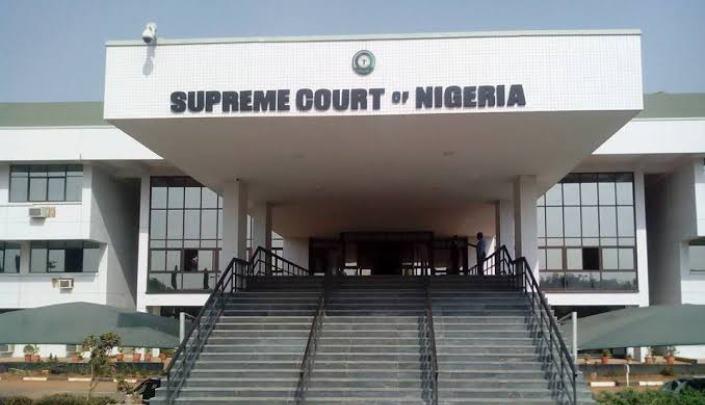
The Supreme Court on Monday held that the President has constitutional authority to declare a state of emergency in any part of the country when public order and security are threatened.
In a six-to-one majority decision, a seven-member panel of the apex court ruled that the President may suspend elected state officials during an emergency, provided the suspension is temporary and intended to prevent a breakdown of governance.
The decision followed the dismissal of a suit filed by 11 states challenging actions taken by President Bola Tinubu in Rivers State.
The states, governed by the Peoples Democratic Party (PDP) at the time the suit was filed, approached the court through their Attorneys-General, alleging that the President acted outside his constitutional powers.

The plaintiffs questioned the President’s authority to suspend a sitting governor, deputy governor, and members of a State House of Assembly after declaring a state of emergency.
They asked the court to interpret Sections 1(2), 5(2), and 305 of the 1999 Constitution (as amended) and to rule that the President lacks the power to suspend elected state officials under an emergency proclamation.
They also argued that Sections 192(4), 192(6), and 305 of the Constitution do not permit the suspension of a state legislature, maintaining that the actions taken in Rivers State violated constitutional provisions.
The Attorney-General of the Federation and the National Assembly were listed as the first and second defendants in the suit, marked SC/CV/329/2025.
In the lead judgment, Justice Mohammed Idris held that Section 305 of the Constitution empowers the President to take extraordinary measures to restore order once a state of emergency is declared.

The court noted that the section does not specify the nature of such measures, leaving their application to the President’s discretion.
The court upheld preliminary objections raised by the defendants and ruled that the suit was incompetent. It held that the plaintiffs failed to establish a cause of action sufficient to invoke the Supreme Court’s original jurisdiction.
The justices explained that the court can only exercise original jurisdiction where there is a dispute between the Federation and a state or states. They found that the issues raised did not meet this requirement and struck out the case for lack of jurisdiction.
Read also: Supreme Court nullifies Tinubu’s pardon, upholds Maryam Sanda’s death sentence
Justice Obande Ogbuinya dissented, holding that while the President may declare a state of emergency, such authority does not extend to suspending elected officials, including governors, deputy governors, and state legislators.
Justices Inyang Okoro, Chioma Nwosu-Iheme, Haruna Tsammani, Stephen Adah, and Habeeb Abiru concurred with the majority decision.
The suit arose after President Tinubu declared a state of emergency in Rivers State on March 18 and suspended Governor Siminalayi Fubara, his deputy, and members of the State House of Assembly for six months.
He later appointed Ibok-Ete Ibas, Vice Admiral (rtd) as Sole Administrator to manage the state during the emergency, a move approved by the National Assembly.
The PDP-controlled states filed the suit in response, which the Supreme Court dismissed on Monday.