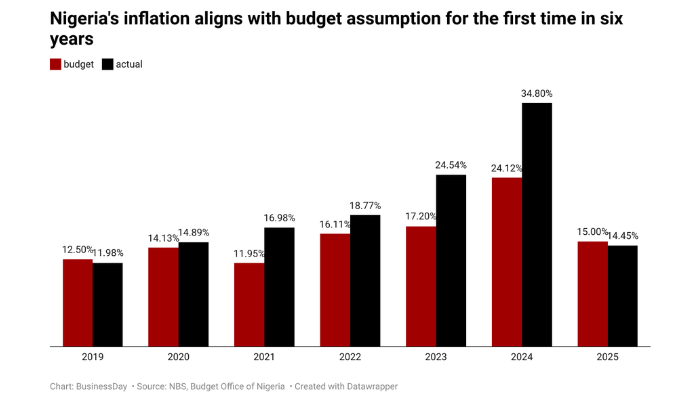
In what is much-needed relief for Nigerians, the country’s headline inflation has dropped to 14.45 percent in November, aligning with the president’s projected figure of 15 percent at the end of the 2025 and budget projected target.
Nigeria’s 2025 Budget, themed “Budget of Restoration,” aims to stabilise the economy by targeting a significant drop in inflation from over 34 percent to around 15-16 percent, alongside achieving GDP growth and exchange rate stability (N1500/$1).
Bola Tinubu also set an inflation target of 15 percent for Nigeria by the end of December 2025. He announced this goal during his presentation of the 2025 Appropriation Bill to the National Assembly in December 2024 and reiterated it in his New Year’s address for 2025
Read also: Nigeria’s manufacturing grows 1.25% in Q3 amid easing inflationary pressure

Ayo Teriba, the chief executive officer of Economic Associates, explained that the cooling inflation was more of a lag effect than the earlier rebasing exercise conducted by the National Bureau of Statistics.
Nigeria rebased its Consumer Price Index (CPI) in early 2025, with the NBS shifting the base year to 2024 and updating consumption weights, leading to a significant statistical drop in the headline inflation rate from around 34.8 percent (Dec 2024) to 24.48 percent (Jan 2025) and since seen a continuous decline except for February.
According to analysts at Meristem, inflationary pressures in the domestic economy continued to soften, driven mainly by the lingering impact of harvest supply on food prices and a relatively stable currency environment.
Wide-spread price declines across key staples, including maize, sorghum, paddy rice, and soybean, reinforce the easing trend. During the same period, the Naira appreciated by 1.45 percent Month-on-Month, averaging N1,443.85/dollar compared to N1,465.04 dollar in October.
Read also: How Nigeria can curb food inflation and restore purchasing power – World Bank

This is why both food inflation declined to 11.08 percent from 13.12 percent in October, while core inflation eased to 18.04 percent (from 18.69 percent ).
Teriba projects that Nigeria’s inflation could slow to a single digit by January 2026 as the lag effect of ‘Detty December’ is poised to further cool prices that have remained in the double-digit range for more than five years.