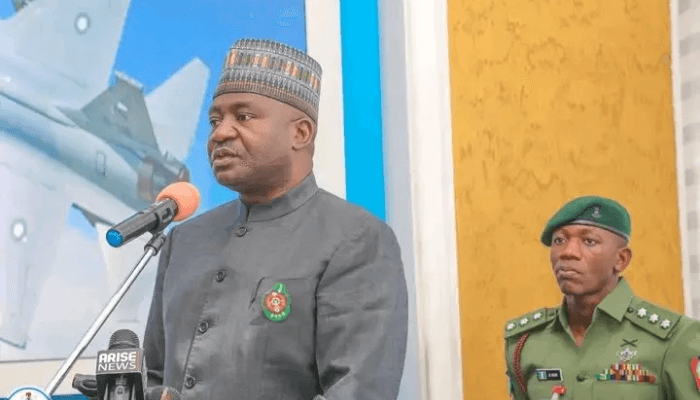
Nigeria has a new Defence Minister, and unlike most political appointees who shuffle into the position with vague talking points and ceremonial optimism, General Christopher Musa walked in with a blunt diagnosis: Nigeria cannot win its internal wars without a unified national database.
That single statement cuts to the heart of Nigeria’s security crisis — fragmentation, anonymity, and the absence of any national system capable of tracking the movement, financing, identity, or networks of violent actors.
“Nigeria’s political class gets nervous around any system that centralises data. They fear surveillance of their own networks more than national collapse. But for a country fighting five overlapping insurgencies — Boko Haram/ISWAP, bandits, IPOB/ESN, oil thieves, and extremist cells spreading from the Sahel — anonymity is the oxygen of violence.”
Musa replaces Mohammed Badaru Abubakar, who stepped down on health grounds. But this is more than a personnel swap. Musa’s arrival signals a shift from political stewardship to operational realism. After leading the Nigerian military as Chief of Defence Staff through some of the most volatile years of insurgency and banditry, he understands, better than most ministers before him, that Nigeria’s war is not merely kinetic — it is informational.
And Nigeria is losing the information war.

1. The Database Deficit — Nigeria’s Blind Spot
General Musa’s core argument is brutally simple:
You cannot fight enemies you cannot see, track, map, or financially choke.
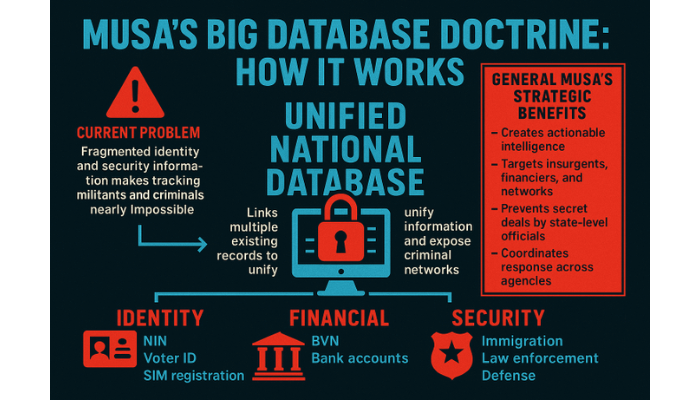
Nigeria’s identity ecosystem is a mess:
- NIN is partially adopted, with millions unregistered.
- BVN covers only a section of financial actors.
- Telecom SIM registration remains leaky.
- Immigration databases are weak.
- Police, DSS, military, FRSC, NCC, and CBN all operate in silos.
No agency talks to the other unless a crisis forces them.
Bandits, kidnappers, ISWAP financiers, gun runners, illegal miners, and separatist cells thrive inside this fragmentation. The absence of unified identity and financial linkages allows insurgent groups to:

- collect ransom payments anonymously
- use bank accounts registered with fake identities
- buy motorcycles, drones, fertiliser, arms
- move personnel across state borders undetected
- run propaganda networks without digital footprints
- exploit SIM cards registered with ghost identities
A unified national database is not a luxury; it is a weapon.
Musa’s point is this: Nigeria’s enemies are modern. Nigeria’s systems are not.
2. A “Big Brother” Database Isn’t Scary — It’s Necessary
Nigeria’s political class gets nervous around any system that centralises data. They fear surveillance of their own networks more than national collapse. But for a country fighting five overlapping insurgencies — Boko Haram/ISWAP, bandits, IPOB/ESN, oil thieves, and extremist cells spreading from the Sahel — anonymity is the oxygen of violence.
A unified national database linking:
- NIN
- BVN
- voter data
- immigration records
- telecom SIM registration
- vehicle registration
- land ownership
- banking and fintech accounts
- passports
- law-enforcement records
…would immediately close dozens of operational loopholes.
This is not science fiction. This is how modern states function.
The United Arab Emirates, Singapore, South Korea, India, and even Rwanda rely on unified digital identity to maintain internal stability. Nigeria, by contrast, processes insecurity manually — a filing cabinet against militants running online networks.
Read also: Gen. Christopher Musa (retd): Walking the talk on security
Musa’s doctrine is simple:
Punch holes in their anonymity, and you cripple their operations.
3. The Political Sabotage Problem — Musa Wants It Ended
One of the most significant portions of Musa’s statement — and one that will make state governors uncomfortable — is his vow to work with the National Security Adviser (NSA) to stop state governments from negotiating secretly with armed groups.
This has been one of the most corrosive practices in Nigerian counterterrorism:
- Governors paying ransoms
- Governors’ funding “peace deals” with killers
- Governors providing political cover for bandit kingpins
- Local leaders striking undocumented agreements for votes
- Back-channel negotiations with IPOB cells
- Oil bunkerers receiving protection from political elites
Every time a state government cuts a deal, bandits grow richer, insurgents grow bolder, and rival states are forced to pay even more to protect their citizens.
Musa understands what many politicians refuse to admit:
-Criminal groups evolve when the state compromises.
You cannot negotiate with hunger. You cannot appease greed. You cannot bribe ideology.
Stopping these deals requires:
- central oversight from the NSA
- explicit federal policy
- intelligence tracking of any back-channel communication
- punitive measures for governors who break protocol
No minister has said this so openly before. Musa did.
4. The Strategy — Data + Coordination + Accountability
General Musa’s security philosophy has three pillars:
A. Data Integration
A national database is not just a surveillance tool; it is a fusion engine for intelligence. It enables pattern recognition, financial tracing, border prediction, and the rapid identification of networks.
B. Inter-Agency coordination
Nigeria has never won an insurgency because Nigeria has never fought with a unified command. Musa intends to change that by aligning Defence with NSA oversight.
C. Political accountability
The era of governors freelancing security policy on the basis of local politics must end.
5. What Musa’s appointment means for Nigeria’s war effort
We’ve had ministers who talked about procurement.
We’ve had ministers who talked about patriotism.
We’ve had ministers who vanished into the bureaucracy.
Musa is different.
He is fighting for something far more important than equipment: the operating system of Nigerian security.
If he succeeds in building a unified national database, insurgent groups will lose their anonymity, financiers will lose their networks, and Nigeria’s security agencies will begin the process of fighting as one.
If he fails, Nigeria returns to business as usual:
darkness, fragmentation, and permanent war.
This article was first published by Defence Watch Africa.
Majemite Jaboro, a defence analyst, writes for Defence Watch Africa (DWA).