Nigeria faces an imminent risk of failing to meet its 2030 targets for universal health coverage, as performance in key areas, including insurance, financing, and primary healthcare access, remains lagging.
Experts and stakeholders tracking the quality performance of health services against diverse demands have grown concerned about how health outcomes increasingly favour those with stronger purchasing power.
Despite institutionalised efforts to democratise healthcare access through the National Health Insurance Act 2022 and other measures such as the Basic Health Care Provision Fund, out-of-pocket health expenses remain a key determinant of health outcomes for most Nigerians, experts decry.
The country has struggled to draw a significant part of the population under the national insurance net, partly due to huge distrust in the health system and the weakening purchasing power of the populace.

According to PharmAccess and the Nigeria UHC Forum, there are wide gaps existing between policy ambition and practical health outcomes.
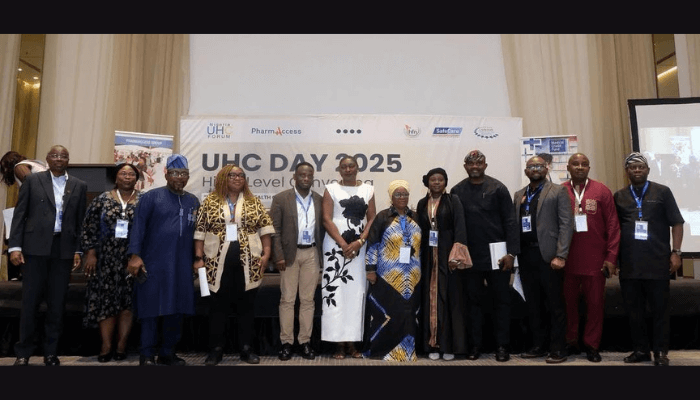
While the Nigeria Health Sector Renewal Investment Initiative aims to strengthen the health system towards achieving 2030 UHC goals, poor health financing and inefficient resource allocation concurrently haunt those goals, they said during the commemoration of the 2025 UHC Day.
This year’s programme was themed “Unaffordable Health Costs? We’re Sick of it!”.
Njide Ndili, PharmAccess country director and president of the Health Federation of Nigeria, said progress towards the 2030 goal has been slow, stating that ideas must be rethought to scale methods that have proven productive.
The HFN president noted that one area of progress is the working relationship between the current health sector leadership and private sector contributors, saying the minister listens.

But all tiers of government must come together to play their part, Ndili said.
“We will not achieve UHC by 2030 except something drastic happens,” said Ndili. “Quality is the core for UHC. You only prepay for health insurance when you know you will get quality care. We have sung this for many years, and we are still not there. In some areas we are regressing, and in some we are making progress.”
While under 5 mortality rate declined from 32 deaths per 1,000 live births in 2018 to 110 in 2014, neonatal mortality has worsened slightly from 39 to 41 deaths per 1,000 live births. Both remain above targets of 25 and 12 deaths per 1,000 live births, according to the World Health Organisation (WHO) and United Nations International Children’s Emergency Fund (UNICEF).
But on the supply side of healthcare, some progress is occurring with the HFN leading private sector integration for the UHC through policy advocacies for improvements in power access and infrastructure, domestic health insurance financing, and strategic purchasing for primary healthcare centres, among others.
On power, for instance, Ndili said the federation conducted a survey that discovered that 50 percent of hospitals’ revenue was consumed by diesel cost for alternative power generation.
She said the survey submitted to the Minister of Health recommends that some areas should be provided with private mini-grids that hospitals and businesses can tap into, while excess power generated is sold off.
Meanwhile, Moji Makanjuola, chair of the Nigeria UHC Forum, during her remarks stressed that the divide between operators and policymakers must be bridged in order to accelerate the goals of the UHC.
She added that the politics surrounding healthcare must improve, noting that manifestoes of simply building hospitals without the guarantee of systems to equip them with expert professionals and equipment needs to be discarded.
“After four years, they come back to us and promise to build new hospitals as if that is all it takes. Who are the human resources to man them? They site these hospitals in hard-to-reach places, and we have a liter of them abandoned all over the country.
She further explained that the goal of the forum is to improve the education of the reality of healthcare in Nigeria, and to this end, Mohammad Alli Pate, the Minister of Health and Social Welfare, has endorsed the group as the civil society organisation to partner with.
She urged that the tenets of humanity need to be restored in the care profession at a time when ethics are eroding too easily.
“We speak to all the technicalities, yet people don’t have trust in the health system in Nigeria. What are we saying to it? How do we build that trust?” she said.
According to Gafar Alawode, CEO, DGI Consult, the quality of Nigeria’s current universal healthcare coverage remains questionable, noting that more needs to be done across the board.
Citing the World Health Organisation UHC Service Coverage Index (SCI), Alawode said that Nigeria performed below the global average at 38.
He urged the government to adopt targeted intervention to fix the gaps, explaining that the overall index easily conceals the true picture of underperformance in certain states.
For instance, in 2018, the national SCI average was 38.2, with only three states scoring above 50 – Lagos, FCT, and Anambra.
But by 2023, the national average had declined to 35.8, with the three states identified earlier only scoring above 50.
“We are saying this because we are talking about equity and Nigeria as a whole. We need a roadmap for UHC that takes into consideration the regional disparity in terms of access,” Alawode said.