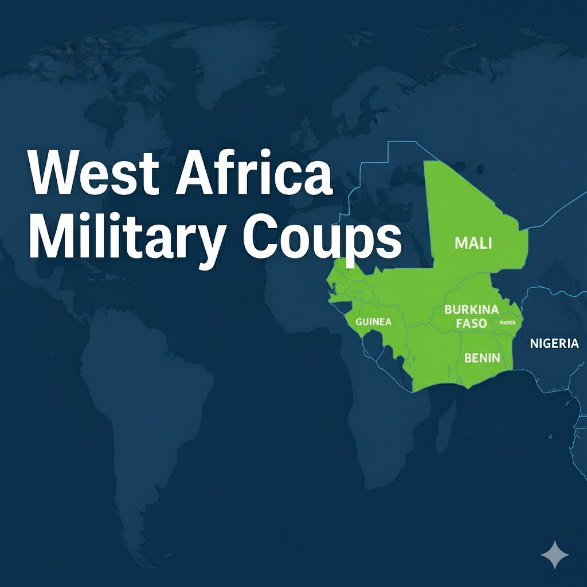
Armed men in Cotonou, a grounded Nigerian military plane in Bobo Dioulasso, and frantic troop movements across capitals – West Africa’s recent weeks read like a geopolitical fever dream.
Starting in the Benin Republic, where an attempted putsch, declared by a self-styled “Military Committee for Refoundation (CMR)” led by Lt. Col. Pascal Tigris, was bluntly denounced and crushed within 24 hours after loyal forces, backed by Nigerian air strikes and regional deployments, reasserted control. Meanwhile, the Alliance of Sahel States (Mali, Niger, Burkina Faso) publicly grounded a Nigerian C-130 over an alleged airspace breach, signalling how fragile regional norms have become.
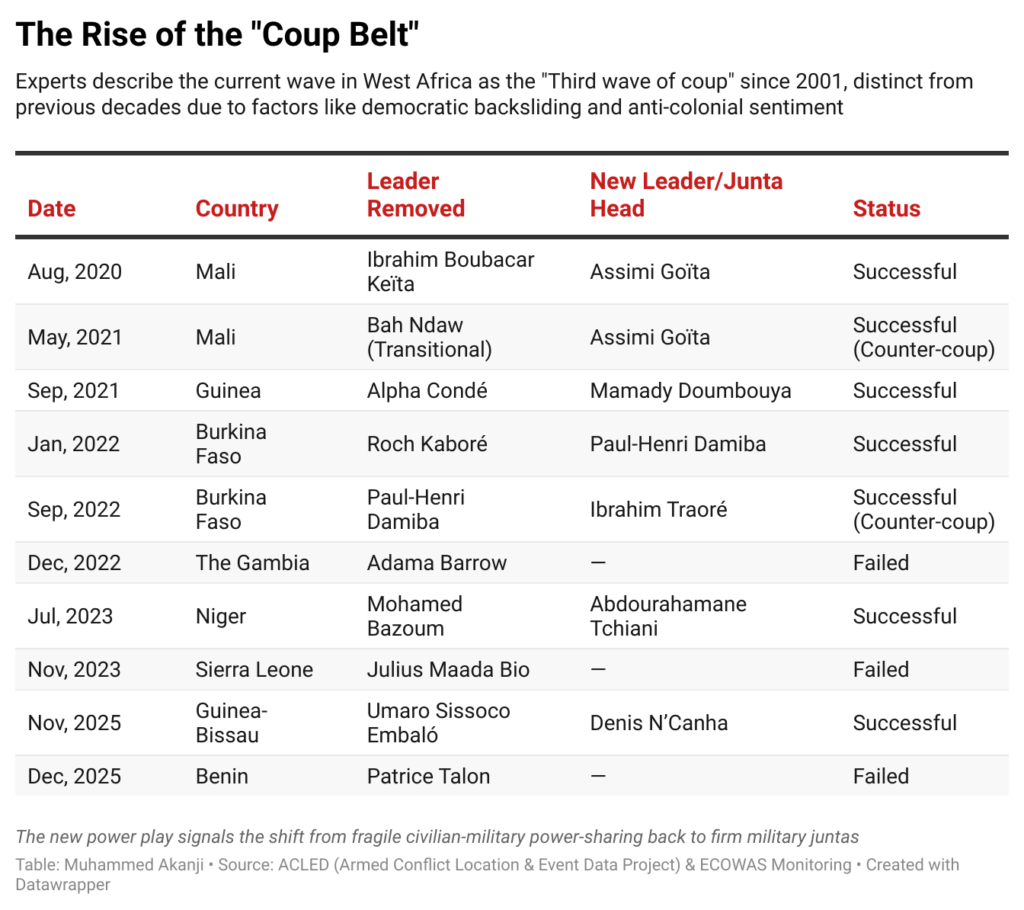
These events are not isolated outbursts but symptoms of a deeper reversal: a cascade of military takeovers across the Sahel and parts of West Africa that have remapped power, rattled fragile institutions, and rewritten security bargains. The immediate costs are tangible: interrupted governance, troop movements, and heightened border risks; but the long runway effects are economic and geopolitical: investor flight, aid recalibration, supply-chain disruption, and new patronage networks tilted toward outside backers.

The urgent question for policymakers and markets is blunt: how will democracies, regional blocs, and external partners respond to a fast-shifting power map that prizes guns over ballots; and who pays the economic price when order is bought at the barrel of a gun?
The big picture – A region slipping backwards
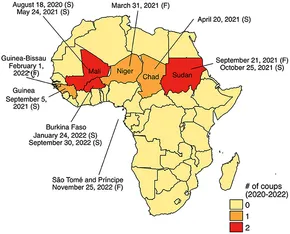
West Africa and the wider Sahel are experiencing a dramatic democratic backslide- one that many analysts describe as the region’s most severe reversal since the early 1990s. Since 2020, Mali, Guinea, Burkina Faso, Niger, and Gabon have all experienced successful coups, while several others; including Sierra Leone (2023) and Benin (2025)- have faced attempted ones. According to African Union data, more than 50% of all coups and coup attempts recorded globally since 2020 have occurred in West Africa and the Sahel, making the region the world’s most volatile political corridor.
This resurgence is not happening in a vacuum. It reflects deepening economic despair, worsening insecurity, and collapsing public trust in state institutions. Across the Sahel, jihadist violence has surged more than 250% since 2018, displacing over 5 million people and hollowing out state authority. Inflation spikes, food insecurity, and currency instability have eroded purchasing power, while youth unemployment- averaging above 30% in many ECOWAS states- 9663fuels disillusionment with ballot-box democracy.
What emerges is a region caught between democratic fatigue and authoritarian temptation. As states struggle to deliver basic security and economic stability, soldiers increasingly present themselves as “saviours,” even as history shows military rule rarely solves the crises it inherits. The Sahel’s democratic recession, if unchecked, risks becoming a generational setback.
The Benin putsch
The failed coup attempt in Cotonou, Benin, on Sunday, December 7, 2025, confirmed that West Africa’s governance crisis has reached a critical stage. While the attempted putsch was swiftly neutralized by coordinated regional allies, its occurrence is highly significant.

The incident underscores the volatility of the “Coup Belt,” a region seeing a surge of military takeovers: nine successful coups and several attempts since 2020. This instability is driven not by chance, but by deep-seated structural issues: weak institutions, widespread public frustration, and internal power struggles. These factors collectively create the opportunity and the popular support necessary for military forces to seize power, transforming fragile democracies into easy targets across the region.
The economics of instability
Added to the layer are the region economies struggling under a toxic mix of slow growth, persistent poverty and fiscal strain — conditions that fuel political instability and heighten coup risks.
In much of the Sahel, average GDP growth stubbornly hovers around 2–3%, trailing population growth and failing to create enough jobs or raise living standards. Poverty rates in many countries exceed 40-45%, with limited social safety nets to protect vulnerable households.
Governments face persistent fiscal deficits, while inflation and exchange-rate pressures erode real incomes and investment confidence. Rising debt service costs and tightening financing conditions further squeeze budgets, even as security spending absorbs increasingly large shares of scarce revenue.
The IMF’s debt-distress indicators highlight that many coup-prone states have limited buffer capacity: high debt ratios, constrained revenue mobilisation, and growing external vulnerabilities restrict policy space. These economic headwinds help explain why instability and leadership upheavals have become systemic rather than exceptional.
The security-development vortex
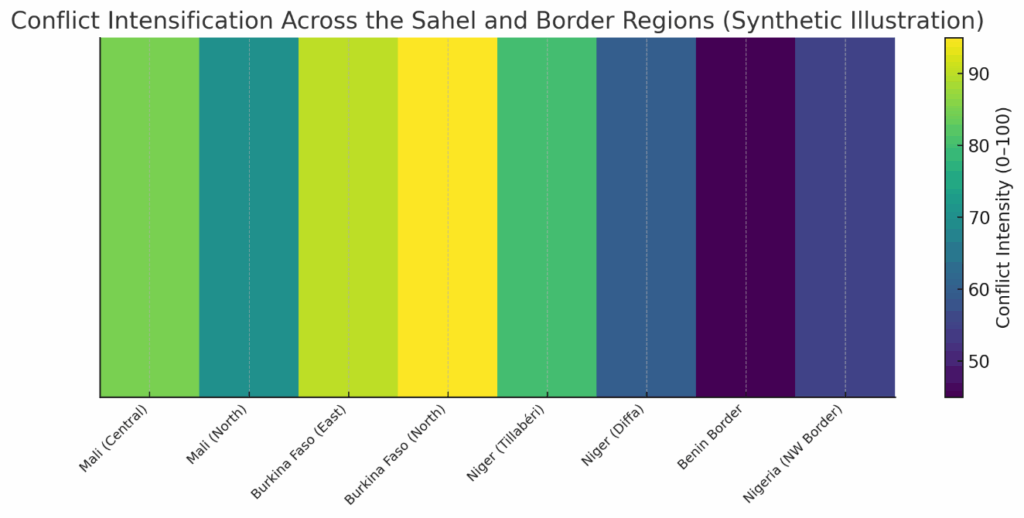
In the Sahel’s evolving conflict landscape, insecurity and underdevelopment are mutually reinforcing, creating a cycle that weakens state authority and fuels militant expansion. According to ACLED data, the central Sahel — particularly Mali, Burkina Faso, and Niger — experienced persistently high violence in 2025 as Jama’at Nusrat al-Islam wal-Muslimin (JNIM) and the Islamic State Sahel Province (ISSP) intensified attacks, pushing operations into new border regions with Nigeria and Benin. This escalating violence is part of broader instability, capturing territory and civic space.
—
Parallel to this, socio-economic despair is a powerful driver of recruitment. UNDP research shows that many recruits join extremist groups for economic survival rather than ideology, with lack of livelihood cited as a primary factor in decisions to join armed movements. Weakened security institutions struggle to protect communities and deliver basic services, creating political vacuums that both militants and opportunistic military regimes exploit. As states redirect scarce resources to combat insecurity, development spending suffers, deepening poverty and disaffection.
Democratic backslide & mineral politics
In several recent coups, control over strategic mineral wealth has been a powerful undercurrent driving political shifts. In Niger, the junta now presides over Africa’s second-largest uranium exporter, a critical source of nuclear fuel. In Mali and Burkina Faso, gold mining — which contributes significantly to export revenues — has become a prize for military elites seeking financial autonomy and leverage.
Data from the Extractive Industries Transparency Initiative (EITI) shows that mining output in these states accounts for a material share of GDP, yet revenues remain opaque and vulnerable to elite capture. Amid these dynamics, ECOWAS’ enforcement capacity has eroded, as sanctions and political pressure have failed to deter power grabs. The intersection of mineral politics and democratic erosion underscores how economic incentives, not ideology alone, shape the Sahel’s political reversals.
What this means for Nigeria & the region
The coup wave reshaping the Sahel is not a distant crisis; it sits on Nigeria’s doorstep. With 1,600km of shared borders across Niger, Cameroon, and Benin, every political shock in the neighbourhood carries direct implications for Nigeria’s security, economy, and internal stability. Instability in Niger threatens cross-border trade valued in billions annually, disrupts agricultural supply chains from Maradi–Katsina, and accelerates irregular migration flows.
Beyond security, there are fiscal consequences: heightened defence spending, pressure on FX markets from disrupted regional trade, and potential fuel-smuggling surges when borders tighten. A militarised neighbourhood also weakens ECOWAS’ bargaining power and emboldens illicit mining networks that already feed into Nigeria’s informal gold economy.
Going forward, key indicators to watch include Nigeria’s security expenditure trajectory, governance reforms in border states, ECOWAS cohesion, cross-border mining flows, regional inflation dynamics, and the federal government’s fiscal stability amid rising geopolitical stress.