As of December 10, 2025, Nigerian corporates have raised a total of N1.55 trillion through fixed-income instruments, including commercial papers (CPs) and corporate bonds. This represents a 19 percent increase from the N1.31 trillion mobilised in 2024.
It underscores the growing appetite for debt financing, considering the prohibitive commercial lending costs in Nigeria since 2024.
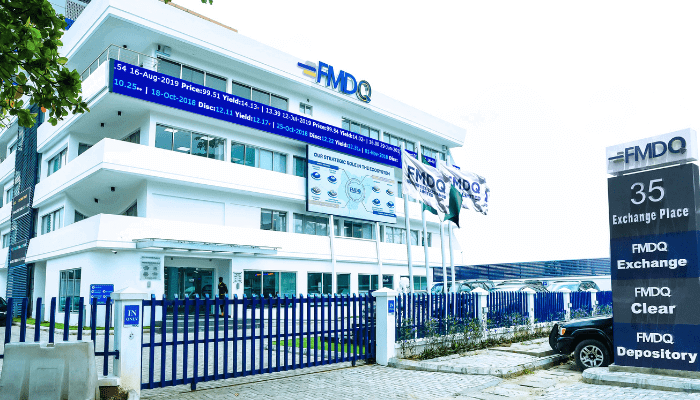
These figures are based on listings of commercial papers and corporate bonds on the FMDQ Exchange platform.
However, while the overall value of funds raised increased, there was a marginal decline in the number of companies tapping the market. In 2024, 48 companies issued corporate bonds and CPs; in 2025, this number slipped slightly to 46. What stands out more sharply is the shift in preference towards short-term financing.

In 2025, the value of CPs issued jumped by 23 percent to N1.44 trillion from N1.17 trillion in 2024, signalling corporates’ growing reliance on short-duration liquidity instruments.
Read More: Nigerian firms tap commercial papers for funding amid high MPR – Businessday NG
Yet, this value growth came with a contraction in issuance volume. The number of CP tranches fell from 161 in 2024 to 127 in 2025, indicating larger but fewer issuances. The bond market also saw reduced activity. In 2024, issuers raised N114.2 billion across five corporate bonds. However, in 2025, only a single bond issuance, Presco’s N82.9 billion offer, made it to the market.
Despite a slight uptick in average yields, from 22.16 percent in 2024 to 22.64 percent in 2025, corporates remained undeterred. According to data, they leaned further into the debt market as borrowing costs in the conventional banking system stayed elevated.
Breakdown of the numbers
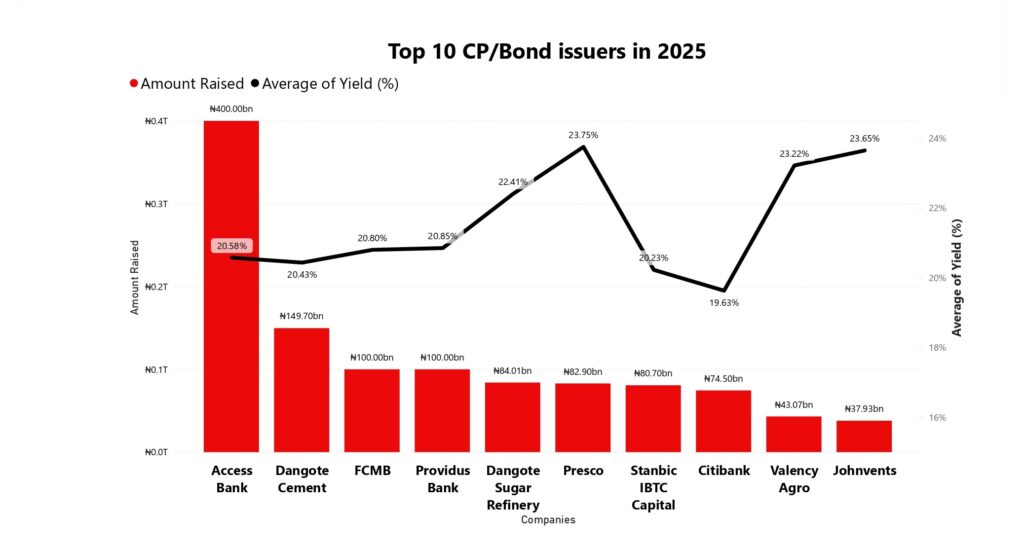

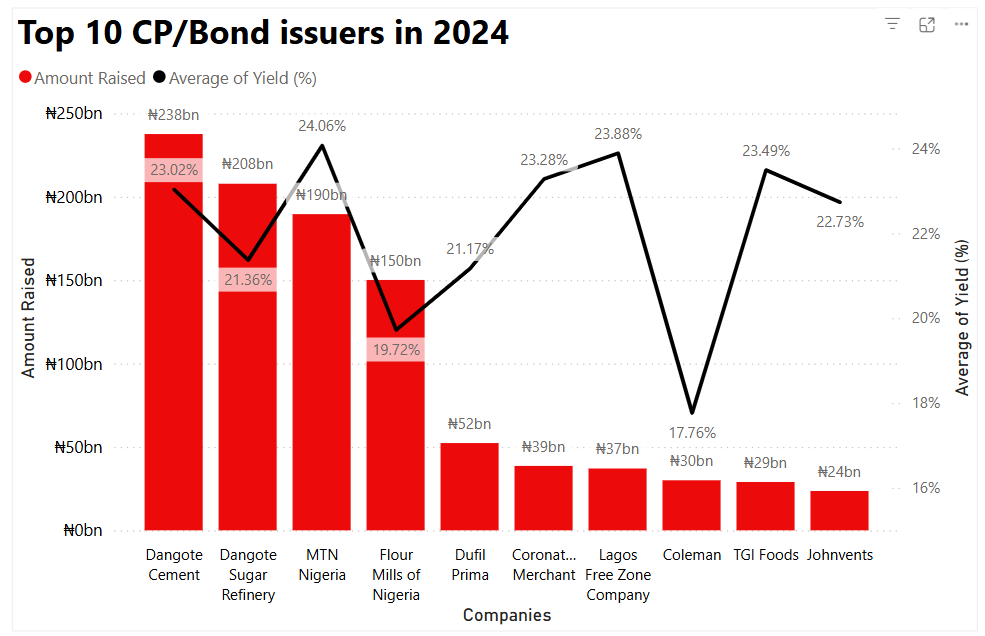
Access Bank dominated the CP market in 2025, raising N400 billion at an average yield of 20.58 percent. This marks a shift from 2024, when Dangote Sugar Refinery led the pack with N207.8 billion in CP issuances. Dangote Sugar followed up with an additional N84.01 billion from two new CP issuances in 2025.
Dangote Cement ranked second among CP issuers in 2025, mobilising N149.7 billion across three tranches. However, this was markedly lower than its N199.4 billion CP haul in 2024. In addition, the cement maker raised N38.2 billion from a corporate bond in 2024, although it made no such move in 2025.
One notable trend in 2025 was the heightened participation from the banking sector. Beyond Access Bank, Providus Bank and FCMB each issued N100 billion in CPs, while Citibank raised N74.5 billion. Stanbic IBTC Capital, an investment banking player, mobilised N80.7 billion, and FSDH Merchant Bank raised N15.1 billion.
Altogether, financial services companies accounted for N782.38 billion in CP issuances. This represents about 54 percent of the total market, reinforcing the sector’s dominance in short-term debt mobilisation.
In the consumer goods sector, Valency Agro Nigeria, makers of Champion Milk Powder and Champion Custard, raised N43.07 billion across eight CP issuances in 2025. This builds on the N15.93 billion the company raised in 2024 from six CP tranches. For Valency, the year also came with improved borrowing conditions, as its average financing rate eased from 25.01 percent in 2024 to 23.22 percent in 2025.
Johnvents, the Akure-based cocoa processor, raised N37.93 billion in CPs, up from N23.6 billion in 2024. Daraju Industries, makers of MYMY toothpaste, followed with N20.35 billion in issuances. Also, cable manufacturer Coleman grew its CP activity with N17.11 billion raised.
In the pharmaceutical segment, Mecure Industries led with N31.3 billion raised, while fellow drugmaker Fidson issued N10.5 billion in CPs.
Another significant shift in 2025 was the broader diversification of issuers. In 2024, three companies, MTN Nigeria, Dangote Cement and Dangote Sugar Refinery, accounted for around 51 percent of all CP issuances.
In 2025, the number of issuers decreased slightly. However, the distribution of capital raised became more balanced across sectors, reflecting a deeper and more diversified short-term debt market.
Commercial lending rates have remained prohibitively high since the second half of 2024. As a result, Nigerian corporates have continued to rely heavily on CPs and bonds. These instruments offer less restrictive financing options. The sustained shift shows how important the fixed-income market has become. It also suggests that the short-term segment will remain a central funding channel for businesses navigating Nigeria’s tight credit environment.