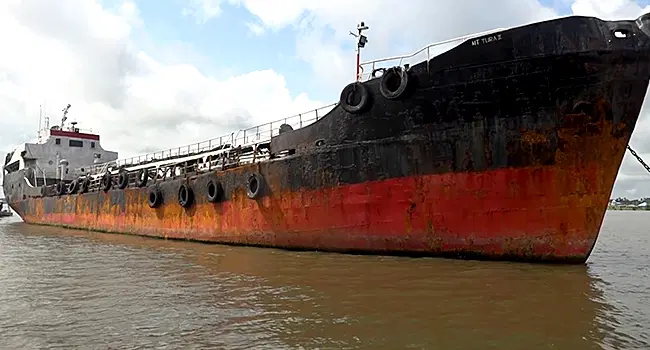
The United States Coast Guard, working with the US Navy, has intercepted a Nigerian-owned supertanker over allegations of crude oil theft, piracy and other transnational crimes, according to US security sources and reporting by Vanguard.
The vessel, Skipper, a 20-year-old Very Large Crude Carrier with IMO Number 9304667, is reportedly owned and managed by Nigeria-based Thomarose Global Ventures Ltd., although its registered owner is listed as Triton Navigation Corp. in the Marshall Islands.
Authorities said the tanker was illegally flying the Guyanese flag at the time of its arrest. Guyana’s Maritime Administration Department later confirmed Skipper is not on its national registry and was using the flag without authorisation.
US officials said the seizure was conducted under American law enforcement authority, and former President Donald Trump publicly announced the operation. Beyond suspected stolen crude, the tanker is also being investigated for allegedly transporting hard drugs and operating within a network backed by suspected Iranian and Islamist-linked money-laundering financiers, according to US sources.

Read Also: How we survived the naira fall and sustained growth in the past decade — Tinubu
A search of Nigeria’s Corporate Affairs Commission records showed Thomarose is inactive. The company’s registered address, according to Vanguard, is in Effurun, Delta State, though there are no listed contact numbers.
Nigeria loses billions to oil theft
The interception comes months after the Nigerian Extractive Industries Transparency Initiative (NEITI) reported that the country lost 13.5 million barrels of crude oil — worth an estimated $3.3 billion — to theft and pipeline sabotage between 2023 and 2024. NEITI executive secretary Ogbonnanya Orji said the losses equalled a full year of the federal health budget and highlighted long-standing governance gaps in the energy sector.
Orji said NEITI had expanded its role beyond auditing to include broader governance reforms, including beneficial ownership tracking, collaboration with industry regulators and new transparency frameworks for Nigeria’s energy transition.