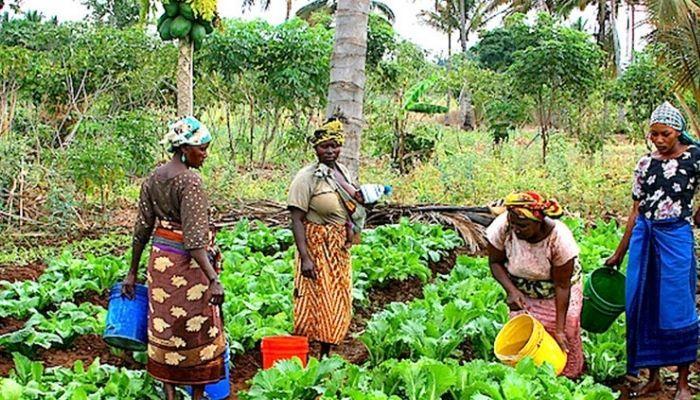
The 2024 budget analysis for Nigeria’s states reveals a stark and disturbing contradiction. Six state governments – Bayelsa, Adamawa, Borno, Rivers, Anambra, and Zamfara – recorded zero budget allocations or specific interventions for women in agriculture.
According to the BudgIT report on the State of Women’s Economic Empowerment (WEE), it is a cold, fiscal denial of a burning economic reality that these women are the hands that feed the nation. In a country struggling with food inflation and insecurity, this failure to invest in the primary producers, who handle the bulk of food production, processing, and rural labour, is not mere oversight; it is an act of political invisibility.
Read also: Land they work but can’t own: Story of Nigerian women farmers
The political, human cost of a zero

This neglect is acutely felt in states already facing severe challenges:
In north-eastern states like Adamawa and Borno, women farmers are often the first to return to the land to rebuild livelihoods amidst conflict. Yet, their state governments have failed to allocate specific funds to fortify these recovery efforts. While Borno State does have collaborations with NGOs and benefits from the Federal First Lady’s Renewed Hope Initiative (RHI), the state’s own specific budget is missing.
The BudgIT analysis points to systemic gaps across Nigeria that prevent women from accessing resources, even where legal frameworks exist. A major barrier is land ownership, as women’s tenure security is notoriously low. For instance, in Bayelsa, where a high percentage of women are employed or self-employed (64.3 percent and 83.4 percent respectively) , a massive 82.4 percent of women do not have a land deed/title. Since agricultural financing and subsidies are often tied to land titles, a zero budget ensures this systemic exclusion continues.
Budgeting for hunger: Food security threat
Failing to invest in women in agriculture is a conscious decision to undermine food security. The low performance in the Women in Agriculture pillar across Nigerian states, with no state hitting the aspirational target, highlights a national challenge.

For the six defaulting states, the zero budget risks exacerbate the crisis.
Worsening the yield gap
Without specific interventions, which often include tailored inputs, extension services, and agribusiness support, the productivity of women smallholders, who form the backbone of subsistence farming, is constrained.
Read also: Food trade hits nearly N5trn under NAPM as farmers grapple with losses
Increasing food costs
The inability of women processors to acquire modern technology or storage means preventable post-harvest losses from continuing unabated, translating directly into higher food prices for every citizen.
The BudgIT assessment even placed four of the defaulting states – Rivers, Zamfara, Adamawa, and Anambra – in the red category for the Women in Agriculture pillar. Adamawa and Zamfara also tied for the lowest overall WEE score, emphasising that the failure to invest in women farmers is indicative of a broader development problem.
Roadmap: Learning from the ‘green’ states
The six states are not without a path to redemption. The BudgIT report identifies clear roadmaps from states that are progressing and transforming in women’s economic empowerment.
States that are doing it right have adopted targeted, gender-responsive budgeting, including targeted interventions.
Targeted interventions
Lagos, Nasarawa, Edo, Osun, and Ondo have distinct, state-owned initiatives. Examples include: The Lagos Agripreneurship Program, The Plant, Nurture, Eat, Edo Girls’ Farm Project, and The Ondo State Agriculture Empowerment Centre.
High performance
Cross River State stood out, achieving the highest score (3.5 out of 4) in the Women in Agriculture pillar, putting it in the green performers category. Other high-performing states that offer broad lessons are Akwa Ibom, Delta, Ekiti, Kaduna, Kwara, and Lagos.
Read also: Women farmers canvass for market access for agroecological products
These successful states demonstrate that the solution is to move beyond general allocations and embrace gender-responsive budgeting: creating dedicated funds, providing support decoupled from formal land titles, and investing in processing and market access specifically for women’s cooperatives.
The zero budget from Bayelsa, Adamawa, Borno, Rivers, Anambra, and Zamfara is more than a missed opportunity—it is a self-inflicted wound on their economy. It is a political choice that guarantees continued underdevelopment, and it must be reformed with urgency, the report added.