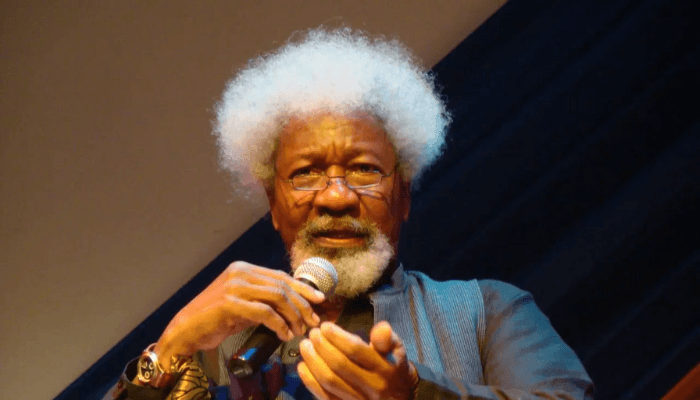
Nobel laureate Wole Soyinka has criticised what he called the excessive and unnecessary deployment of armed security personnel around the family of President Bola Tinubu, saying the scale of protection reflects poorly on Nigeria’s security priorities.
Speaking on Tuesday at the 20th Wole Soyinka Centre for Investigative Journalism (WSCIJ) Awards in Lagos, Soyinka recounted witnessing what he described as an “astonishing” security detail attached to the president’s son at a hotel in the Ikoyi district.
“I was coming out of my hotel, and I saw what looked like a film set,” he said. “A young man detached himself from the actors and greeted me politely… I looked around, and there was nearly a whole battalion occupying the ground of the hotel in Ikoyi.”
Read Also: Gumi says child kidnappings are a ‘lesser evil’ than killing soldiers

Soyinka then said he counted roughly 15 heavily armed officers, including what appeared to be SWAT personnel, and joked that the detachment “looked sufficient to take over a small neighbouring country like Benin”.
Alarmed, he said he attempted to reach the national security adviser to confirm whether the deployment was official. “I said, do you mean that a child of the head of state goes around with an army for his protection? I couldn’t believe it,” he said.
Soyinka also added that subsequent inquiries suggested that such a large escort was standard for the president’s son.
He then went on to jest that President Tinubu might not need military mobilisation to confront threats abroad or domestically. “Next time there’s an insurrection, I think the president should just call that young man and say, ‘Seyi, go and put down those stupid people there. You have troops under your command’,” he said.
But Soyinka stressed that his concern was serious, arguing that misallocated protection undermines national security. “This is not the first country whose head of state has family. Children should know their place. They are not potentates; they are not heads of state,” he said.

“The security architecture of a nation suffers when we see such heavy devotion of security to one young individual.”