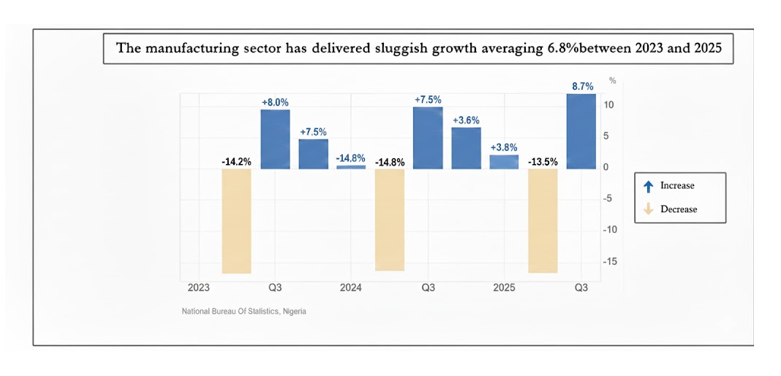
The manufacturing sector is central to the country’s economic prospects but remains notably underpowered. Although it has the potential to generate employment, boost exports, and drive structural change, its growth has been sluggish, averaging 3.4% in 2021 and 2.5% in 2022, falling short of the levels required to elevate the broader economy significantly. Its contribution to GDP has remained stagnant at a single-digit percentage for nearly twenty years, lagging behind competitors such as Malaysia, China, and Singapore.

The sector’s weaknesses are structural: high inflation, FX soaring production costs, limited access to finance, multiple taxation, and significant infrastructure gaps. Nigeria currently invests only $5.9 billion annually, compared with the $14.2 billion required to close its industrial infrastructure gap.
Export performance is even more concerning: manufacturing accounts for only 6.4% of total exports, whereas successful industrial economies typically have over 70%.
The potential remains vast. Manufacturing already anchors major value chains, absorbs labour, expands the tax base, and supports MSMEs, which make up 96% of Nigerian businesses and provide over 87% of jobs. With the right reforms, policy consistency, technology adoption, affordable finance, and large-scale infrastructure investments, Nigeria can shift from subsistence-level production toward global competitiveness. This is the moment for Nigeria to treat manufacturing not as an afterthought, but as the engine of national prosperity.

The Big Picture: Why Manufacturing Matters Now
Nigeria stands at an industrial crossroads. For two decades, the manufacturing sector has remained stuck at 8–10% of GDP, a level far too low for a country aspiring to lift millions out of poverty and build a resilient, diversified economy. While nations such as Malaysia and China have used manufacturing to contribute 25–30% of GDP as the backbone of rapid economic transformation, Nigeria’s industrial base has stagnated. Growth has been sluggish: 2.7% in 2023 & 3.3% in 2024, well below the momentum required to drive job creation, export growth, and productivity gains.

Manufacturing matters because no country has achieved lasting prosperity without it. It creates high-productivity jobs, stimulates value chains, attracts technology and skills, and boosts export competitiveness. For Nigeria, with its vast labour force and rising domestic demand, the potential is enormous but unrealised.
The urgency is apparent: reliance on commodities exposes the economy to volatile oil boom-bust cycles; services-led growth is not generating sufficient quality jobs; and rising import dependence drains foreign exchange reserves. Without a strong manufacturing base, Nigeria risks entrenching low productivity, high unemployment, and widening inequality. Reviving manufacturing is not an economic choice; it must be a national imperative for long-term transformation.
The structural binds
The manufacturing sector in Nigeria is trapped in a structural bind that prevents firms from scaling, innovating, or competing, both at home and globally. The data is unambiguous. According to KPMG’s 2023 report on Nigeria’s Manufacturing, the country requires $14.2 billion annually in infrastructure investment to support industrial growth, but spends barely $5.9 billion. This chronic underinvestment manifests everywhere: unreliable power, poor logistics, congested ports, and high transport costs. Manufacturers pay up to 40% of their operating expenses on self-generated electricity, a burden that erodes margins before production even begins.

The cost environment is equally punishing. Inflation, driven by FX instability, energy costs, and supply-chain pressures, pushes up input prices. Multi-taxation at the federal, state, and local levels further raises overheads. These structural inefficiencies make Nigerian products uncompetitive even within ECOWAS markets and may further threaten the nation’s potential for competitiveness in the AfCFTA arrangement.
Finance remains a major bottleneck. Manufacturers face some of the highest lending rates in Africa, second only to Ghana and Egypt, along with limited long-term credit and persistent foreign exchange shortages. With the naira’s volatility, companies struggle to import machinery or raw materials, which delays production and cuts into profits. Small and medium-sized manufacturers, who should be the backbone of industrialization, are hit the hardest.
Together, these constraints create a tight web that suppresses productivity, discourages investment, and keeps the sector in ongoing underperformance. Without breaking these structural bottlenecks, manufacturing cannot generate the prosperity Nigeria urgently needs.
The Reform Playbook: What Must Nigeria Fix?
The revival of manufacturing won’t happen with empty promises; it demands a disciplined reform plan based on stable policies, targeted investments, and strong institutions. First, FX stability and predictability are crucial. Manufacturers can’t plan, price, or import inputs when volatility erodes margins. A transparent FX allocation system, supported by larger reserves and predictable monetary policy, would reduce cost pressures and restore investor confidence.
Second, Nigeria must embrace technology adoption and R&D. The report shows that countries that have scaled manufacturing, such as China, Malaysia, and Vietnam, invest heavily in industrial automation, product design, and innovation ecosystems. Nigeria needs tax credits for R&D, funding for technical universities, and incentives for firms adopting productivity-enhancing technologies.
Third, industrial zones must work, not just exist. Special zones should offer reliable power, streamlined customs processes, and shared logistics. Evidence from Ethiopia’s Hawassa and Rwanda’s Kigali SEZ shows how functional clusters can attract global manufacturers and build local supply chains.
Fourth, the financing structure must shift. Manufacturers need affordable, long-term credit through Development Finance Institutions (DFIs), export financing windows, and credit guarantees. With lending rates often exceeding 25%, no firm can scale sustainably.
Lastly, tackling power and logistics deficits, ports, roads, rail, and distribution networks, is essential. Every $1 invested in manufacturing-oriented infrastructure delivers outsized productivity gains. These reforms, executed consistently, can reposition manufacturing as the engine of Nigeria’s long-term prosperity.
The payoffs: What Nigeria Gains from Getting It Right
A revitalised manufacturing sector is not just an economic win; we submit that it is Nigeria’s most straightforward pathway to broad-based prosperity. Manufacturing has one of the highest employment elasticities in the economy, capable of absorbing millions of youths into stable, skilled, and semi-skilled jobs.
A stronger industrial base also expands Nigeria’s export basket beyond crude oil, unlocking foreign-exchange earnings from sectors like agro-processing, garments, chemicals, pharmaceuticals, and light engineering. Increased productivity within firms translates into higher wages, improved competitiveness, and rising household incomes.
Most critically, strong manufacturing reduces Nigeria’s dependence on imports, enhancing self-sufficiency in essential goods—from food to construction materials, and shrinking the structural trade deficit. By getting industrial policy right: fixing power, stabilizing FX, reducing logistics costs, and financing productive enterprises, Nigeria can build an economy that is more resilient to oil shocks, more inclusive in job creation, and more capable of sustaining long-term growth. Manufacturing is not optional; it is fundamental to our future.