Africa, the second-largest continent in the world, is redefining its public health strategy, shifting away from the conventional New Public Health Order (NPHO), endorsed in 2022, to a more holistic operational blueprint known as Africa’s Health Security and Sovereignty (AHSS).
This strategic transition, led by the Africa Centres for Disease Control and Prevention (Africa CDC), reflects growing recognition among African leaders that universal health coverage and pandemic preparedness are impossible without health sovereignty.
Geopolitical shifts, cuts in donor funding, and recurrent health emergencies necessitated this transition, according to Jean Kaseya, director of Africa’s Centers for Disease Control (CDC), in a report published by The Lancet on 17 November 2025.
Health sovereignty refers to the ability of African nations to finance, produce, and govern their own health systems and countermeasures. The CDC argues that this realignment is urgent, as external health aid has plummeted by 70 percent since 2021, while recurrent health emergencies such as cholera and mpox surged by 41 percent between 2022 and 2024, threatening to overwhelm already fragile systems. The COVID-19 pandemic further exposed the continent’s vulnerability to global health inequalities.
Africa’s dependency on external supply chains during the pandemic delayed response efforts and cost lives. This, the report stressed, requires Africa to move from being a beneficiary to becoming “an equal co-architect of the global health system,” because the continent’s 1.5 billion citizens “cannot depend on external supply chains or emergency goodwill when the next pandemic strikes,” Kaseya noted.

Read also: U.S. backs $150m Zipline expansion to transform Africa’s healthcare delivery
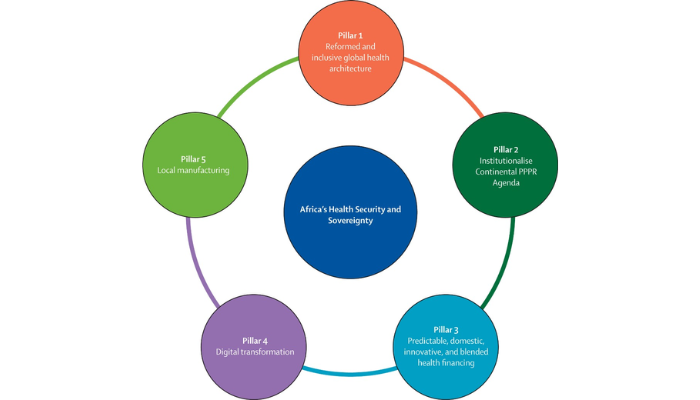
According to the report, Africa’s health sovereignty must rest on five pillars.
The first pillar calls for a reformed, more inclusive global health architecture that moves beyond the traditional donor–recipient model. This framework demands equitable distribution of decision-making, financing, and implementation power, where countries lead, regions coordinate, and the global community supports continental priorities.
The second pillar involves institutionalizing continental preparedness. This means ensuring permanent readiness, not ad-hoc responses, by unifying emergency systems under the Incident Management Support Team (IMST) and securing sustainable, flexible financing through the Africa Epidemics Fund (AfEF). The report emphasizes that preparedness is inseparable from resource ownership.
The third pillar highlights the need for predictable, domestic, innovative, and blended financing. There will be “no sovereignty without appropriate innovative domestic resources,” Kaseya explained. While aligning with the Lusaka Agenda, Africa aims to generate at least 50 percent of its health-security financing from national budgets, supported by efforts to eliminate structural inefficiencies such as procurement fraud and “ghost workers,” the report stated.
The fourth pillar focuses on digital transformation as the backbone of resilient primary health care (PHC). Through a PHC Digital Intelligence Ecosystem linked to a continental data centre, Africa is asserting data sovereignty, ensuring that “Africa does not want to lose data when a partnership ends, or to see its health data stored elsewhere,” Kaseya stated.

Finally, the fifth pillar underscores local manufacturing as the “engine of the second independence of Africa.” Leveraging tools such as the African Medicines Agency (AMA) and the African Pooled Procurement Mechanism (APPM), the continent aims to ensure that at least 60 percent of vaccines, diagnostics, and therapeutics used in Africa are locally produced by 2040.
Although challenges such as financing gaps and governance weaknesses persist, the Africa CDC is generating momentum through accountability scorecards and proactive political engagement.
Africa’s sovereignty agenda is not a retreat from global cooperation but “an invitation to a new partnership model” in which Africa leads with clarity and confidence, driving its transition “from dependency to ownership, from vulnerability to resilience, and from aspiration to action,” the report concluded.