When the Nigerian Exchange opened the first quarter of 2025 with strong trading volumes and renewed institutional interest, the familiar drivers returned to the fore. Banking stocks lifted the All-Share Index, while government securities drew defensive buyers seeking shelter from inflation and currency pressure.
Yet beneath the surface, another shift is unfolding in parts of the market that attract far less attention than equities and Treasury bills. A growing number of investors are turning to exchange-traded funds, real estate investment trusts and listed infrastructure funds.
These are not the instruments that dominate retail conversation, but they are quietly reshaping portfolio construction in a Nigerian market that has experienced repeated shocks over the past five years.
Their resurgence is not being driven by speculation or exuberance. It is a response to risk. Investors who lived through the pandemic-era volatility of 2020, the FX shortages of 2021 to 2023 and the monetary-tightening cycle of 2024 have become more cautious.

The hunt is now for instruments that offer stability, transparent pricing and long-term income, without the operational burdens of direct property ownership or the concentration risk that comes with single-stock exposure.
The shift has been gradual, but the data shows it is now gaining momentum.
ETFs quietly gain traction
Exchange-traded funds remain small compared with global standards, but their footprint on the NGX is far larger than it was five years ago.
The Exchange currently lists several index-tracking and sector products, including the Vetiva Griffin 30 ETF, the Vetiva Banking ETF and the Stanbic IBTC ETF 30. The NewGold ETF provides naira-based exposure to gold prices. According to the Nigerian Exchange’s official ETF listings, these products now trade actively across both institutional and retail platforms.

A 2025 review of NGX-listed ETFs noted that several of these funds outperformed their underlying benchmark indices in 2024, reflecting a gradual but sustained increase in secondary-market participation. The rise mirrors a broader shift toward diversified equity exposure rather than concentrated stock positions.
REITs offer property exposure without physical ownership
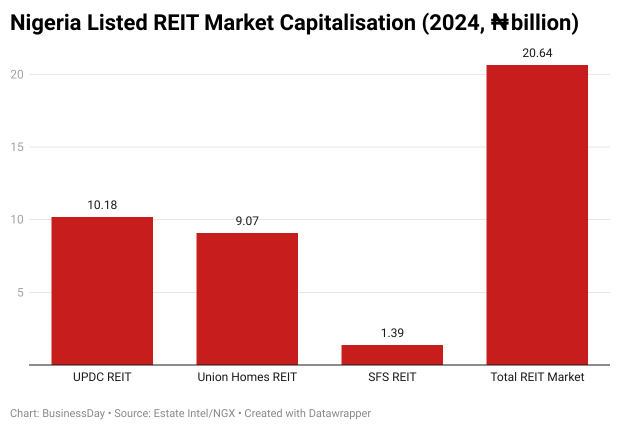
Nigeria’s listed real estate investment trusts remain modest in size, but they represent one of the few regulated channels through which investors can access income-producing property without owning buildings directly. The market currently hosts UPDC REIT, Union Homes REIT and SFS Real Estate Investment Trust.
According to market data compiled by Estate Intel and verified by NGX filings, the combined market capitalisation of listed REITs stood at roughly N20.6 billion at the end of 2024, with UPDC REIT identified as the largest by net asset value.
Their appeal lies in predictable rental income distributions, which offer a stabilising counterweight during periods of equity volatility.
| Instrument | Liquidity | Volatility | Income Stability | Policy Sensitivity |
|---|---|---|---|---|
| Equities | High | High | Low | High |
| Government Bonds | High | Medium | Medium | Very High |
| ETFs | Medium | Medium | Medium | Medium |
| REITs | Low | Low | High | Medium |
| Infrastructure Funds | Very Low | Very Low | Very High | Medium |
Infrastructure funds bring long-dated assets to public markets
The most structurally distinctive instrument in this ecosystem is the Nigeria Infrastructure Debt Fund, managed by Chapel Hill Denham and listed on both the NGX and FMDQ. It remains the first listed infrastructure debt fund in Nigeria and Sub-Saharan Africa.
In its half-year 2024 financials, the fund reported profit before tax of N8.4 billion, representing a 16 percent year-on-year increase driven by rising yields on long-dated infrastructure loans.
Recent disclosures put NIDF’s infrastructure loan book at about N93.37 billion in 2024, reflecting growth on the prior year. The portfolio spans power, transport and industrial projects, offering investors regulated access to infrastructure cash flows without operational exposure.
What unites these instruments
What binds ETFs, REITs and infrastructure funds is not sector exposure but behaviour. They tend to move more slowly than equities and respond less abruptly to interest-rate cycles than government securities. For long-term investors managing pension, insurance and endowment capital, such characteristics provide diversification in a market where shocks often travel rapidly across asset classes.
These instruments do not eliminate risk. Liquidity is thinner than in equities. REIT cash flows track commercial property demand. Infrastructure funds remain exposed to policy shifts and macro conditions. But critically, these risks are visible in public disclosures and governed under formal regulatory frameworks.
A broader, more resilient investment landscape
The large and youthful Nigerian population continues to support equity turnover, while elevated yields have kept fixed-income markets attractive. But as inflation gradually moderates, currency pressures ease and pension funds deepen their search for long-duration, stable assets, demand for listed alternatives is likely to rise.
For investors seeking exposure to Nigeria without depending solely on equity volatility or sovereign debt policy risk, this quieter corner of the capital market offers a more balanced way to participate in the country’s long-term growth story. It does not promise spectacular short-term gains, but it offers something increasingly scarce in Nigeria’s financial system: stability under transparent regulation.
In a market shaped by uncertainty, that may prove to be one of the most valuable assets of all.