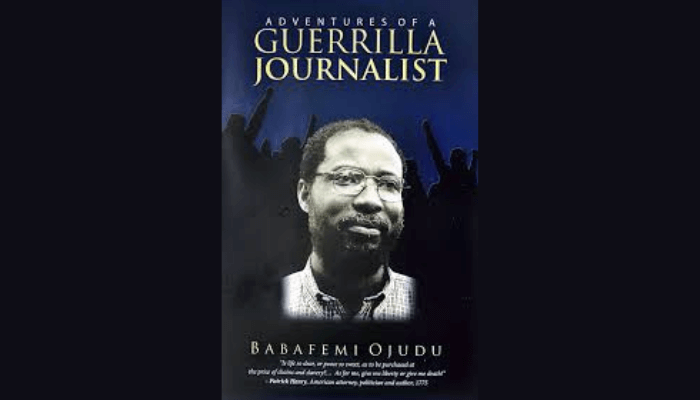
This book tells the story of a Nigerian child who grew up driven by curiosity concerning the world around him, and a passion, somehow, to capture the essence of it, and to put the information so garnered to a use which he assumed would be for the general good.
A six-year-old boy went to spend his holidays at his village in Ika in the rural depth of Ekiti with his grandmother and ended up frightening the poor woman out of her wits as he tried to penetrate the mystery around the Oro cult and the shrieking sound it emitted. In Yorubaland, when the Oro was abroad, even the most highly placed women in the land had to cower behind closed doors. The grandmother, exasperated, cut short his holiday and sent him back to his parents.
Enrolled at University of Ife to study English and Literary Studies, the author became a reporter with the student publishers of ‘The King Cobra’, the student newspaper famous for ‘bugging’ students and staff without restraint. The publication became even more famous after the Buhari-Idiagbon military coup and the promulgation of Decree 4, when a stern-faced Idiagbon specifically condemned and banned it.
The restless young man and his cohorts founded another campus newspaper named ‘The Parrot’. They got a scoop concerning an ‘assignment’ to procure ‘campus girls’ for the entertainment of National Party of Nigeria (NPN) bigwigs who were coming to Oshogbo for the commissioning of the Oshogbo Steel Rolling Mills, one of the flagship projects of President Shehu Shagari’s government. The ladies were procured by a lecturer in liaison with the popular campus female club, ‘La Cle’, and conveyed to Oshogbo by bus. Every one of them returned to campus with a stash of ‘mint’ money. ‘The Parrot’ reported the story, and published the names of everyone involved, including the lecturer. Naturally, all hell broke loose.

Employment at the Guardian Express under Nduka Irabor would provide the beginning of engagement with the outside world in the rapidly changing and frequently turbulent milieu of Nigeria.
Much of the book is taken up with events and personalities that populated the author’s life following his chance meeting with fellow journalist Bayo Onanuga. They became fast friends. The older man would draw the writer into the stable of African Concord, and into the orbit of publisher, businessman, politician and larger-than-life man of the world, Chief MKO Abiola. With a coterie of ex University of Ife-hued ‘committed’ journalists, the ‘African Concord’ increased massively in circulation, popularity and impact.
Danger would come calling, and the perpetual question of where to draw the line would rear its head. When an ex-soldier came up with the story that he was detailed to guard a house where the parcel bomb that killed Dele Giwa was assembled, the question arose – was this a scoop, or a ‘National Security’ bomb?
MKO, the Publisher, would kill the story.
His chafing hirelings, subsequently came up with another Babangida story with the banner headlines – ‘HAS IBB GIVEN UP?’

That publication would bring the military government’s hammer down on the Concord Press, and lead to the exit of its star journalists.
Something about the writer would seem to make it inevitable that in leaving a position of danger, he would be jumping straight into even greater danger.
The News magazine was born, with a promise ‘…to disrupt Nigeria’s journalistic stage’. It lived true to its promise, launching off with a piece on Professor Humphrey Nwosu, Chairman of National Electoral Commission (NEC) titled ‘Dirty Humphrey’ , and earning the magazine its first libel suit.
Things would get hotter.
Arrests and detentions by Security Agencies followed different editions.
Three years after the palace coup that toppled Muhammadu Buhari, The NEWS secured an interview with Buhari. It was a major scoop, and in anticipation of a massive national circulation, the team had printed 200,000 copies of the newsmagazine.
Just as they were rounding off the production, soldiers arrived and seized all the copies, carting them away.
The team would start a tabloid ‘TEMPO’ whose writing, production, and even circulation fully met the criteria of ‘Guerrilla Journalism’. Journalists wrote in closets and printed in disused buildings. Vendors were not spared – several were arrested and their papers seized, yet they persisted.
Nigeria itself was lurching inexorably into a deeper crisis. June 12. Interim Government. Abacha.
There are glimpses of dangerous encounters in the life of this unrepentant newshound. A bumpy road trip to Gashua with Gani Fawehinmi’s wife to try to see him in prison, while playing hide and seek with State Security agents. A journey to Shaki to try to get a photo of Gideon Orkar after the Orkar coup. Sharing in Fela Anikulapo’s remarkably sweet cake on a road journey to Abuja and back, before becoming aware it is baked with marijuana. A surreal interaction with Dr Segun Banjo, brother of Victor Banjo who featured in the civil war and was executed by Ojukwu. He had procured arms to start a guerrilla war against Abacha. A friendly encounter with the then Senator Bola Ahmed Tinubu in London, and the matter of a conversation secretly recorded on audiotape.
Fittingly, the author was in detention in Ikoyi when Sani Abacha died. He was alerted by ‘a loud chorus of Alleluia…followed by the song, God Na Helele’
He had had many run-ins with the ‘Maximum Ruler’, from doing a story on his wife’s past life, to labelling the accusations that led to the incarceration of Olusegun Obasanjo and others as a ‘phantom coup’.
Life has since taken the author into the rarified atmosphere of the National Assembly as a ‘distinguished Senator’ from Ekiti State and led him into the hallowed portals of Aso Rock as Special Assistant.
In his heart, it seems, he is still a journalist, pen poised, eager to tell a story.
Adventures of a Guerrilla Journalist is published by Ojudu, Babafemi and is available in bookshops