Global demand for natural ingredients in food, beverages, pharmaceuticals, and cosmetics, driven by health-conscious consumers, has fueled rising interest in gum arabica.
With increasing demand for gluten-free and low calorie diets by health-conscious consumers, food manufacturers are gradually replacing fats with gum arabica, accounting for about 60 percent of global usage in over 180 countries, according to Straplan Advisory’s 2022 report.
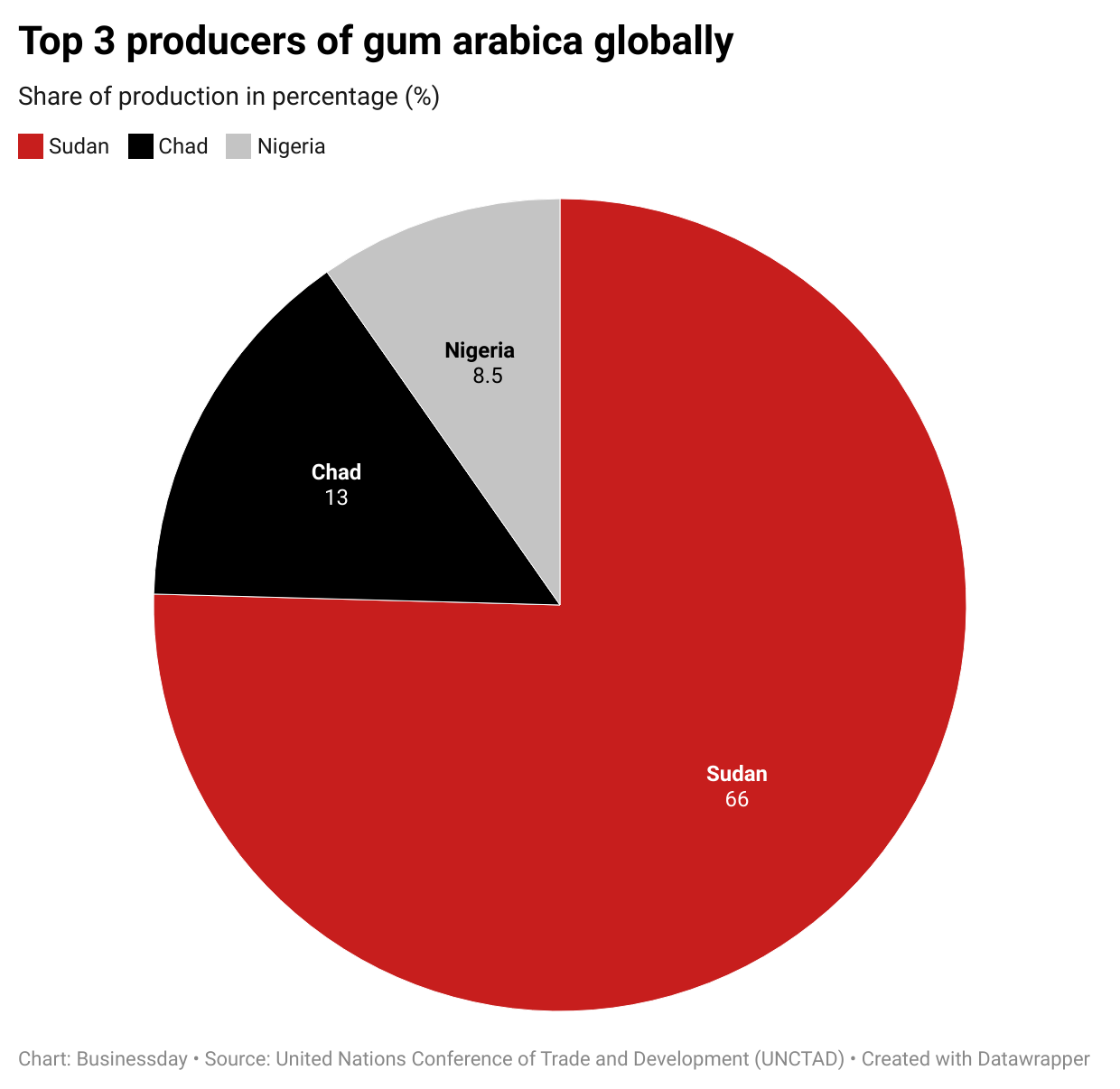
Nigeria stands as the largest producer in West Africa, producing between 20,000 and 25,000 metric tons, and accounting for roughly eight percent of global supplies, according to the United Nations Conference on Trade and Development (UNCTAD).
Read also: Naira records N215.73 gain one year after EFEMS

Gum arabica is a natural sap from Acacia trees, cultivated on about 2.5 million hectares across 11 Nigerian states. Borno, Yobe, and Jigawa alone account for 70 percent of the nation’s supply, according to a 2022 report by Straplan Advisory Ltd. Between 2003 and 2013, Nigeria earned an average $94.2 million (N13.2 billion) annually from the commodity, according to reports.
Globally, Sudan remains the top producer, accounting for about 66 percent to 70 percent of total supplies (120,000–150,000 tons). However, ongoing conflicts have disrupted supply chains, shrinking their output to just 60,000 tons in the 2022–2023 market year. As a result, attention is shifting to Chad and Nigeria, the second and third largest producers between 2014 and 2016, opening a huge opportunity for investors, experts note.
Eze Okoro, president of the National Association of Gum Arabica Producers, Processors, and Exporters of Nigeria (NAGGAPPEN), underscored the crop’s significance to Nigeria’s economy and the environment.
“Gum arabica is a remarkably profitable commodity that has the ability to attract foreign exchange, carbon credits and preserve the environment from desert encroachment,” he said.
“It also has the capacity to lift women and youths from poverty as they dominate 85 percent of the value chain.”

Kayode Ogunjobi, associate professor of Wood Utilisation and founder of Validview Network, also underscored the untapped potential in gum arabica.
“Gum arabica has great potential for profitability and we have the wide land mass, quality soil to support growth and a youthful population to leverage on,” he stated.
Leading global players such as Coca-Cola, Nutrigaard LLC (USA), and Alland & Roberts rely on gum arabica for production and processing, signifying the importance of this agro-commodity on the international market.
A few years ago, Auwal Tukur, a farmer and group managing director at Daddo Group, attempted to cultivate gum arabica in Adamawa State, despite warnings about the region’s climate suitability. He defied skepticism and successfully harvested Grade one gum arabica, a highly valuable commodity grade in the international market.
“I was discouraged by some local experts from farming gum arabica due to weather concerns, but I went ahead anyway,” Tukur recounted.
“Years later, the farm now generates high- grade gum arabica, a product type highly valuable in the international market.”
Read also: “Detty December” inflows seen boosting Naira
Profitability of gum arabica
Gum arabica is increasingly viewed as a highly profitable commodity, driven by its stable international prices, low farm maintenance costs, and broad industrial applications.
“A ton of gum arabica has not gone below $2,000–$5,000 per ton in over 20 years,” said Aliyu Hassan, a farmer from Yobe State. “Prices have been relatively stable,” he added.
IndexBox, a market intelligence platform, reports that import prices for gum arabica ranged between $2,023 and $4,978 per ton from 2013 to 2022, highlighting the commodity’s stability in prices.
Nigeria grows two key varieties – Acacia senegal and Acacia seyal – both well adapted to the country’s climate.
Although the trees typically mature within four to seven years, experts note that research institutes are developing improved varieties to shorten this window and boost yield. A kilogram of gum arabica currently sells for $1.5 to $5, depending on quality and location.
“Harvest season is usually between November and April of the following year, before the onset of the rainy season,” noted Stan Edom, chief executive of Globexia, an export hub.
Global outlook
The global market size for gum arabica is valued at $1.28 billion and is expected to reach $1.97 billion between 2025 and 2030, growing at a compound annual growth rate (CAGR) of 9.01 percent, according to Mordor intelligence.
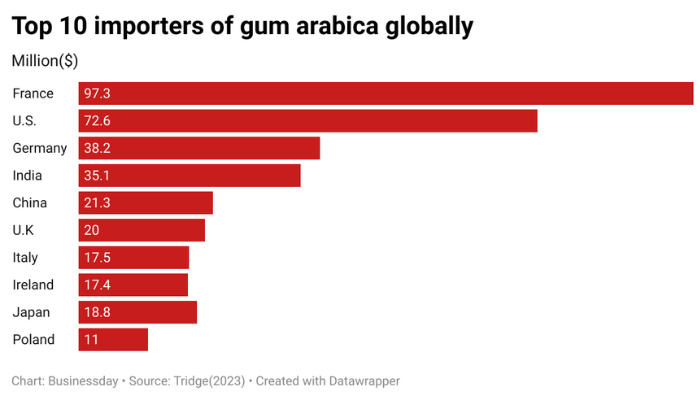
Sudan is the largest producer (120,000 to 150,000MT) globally, followed by Chad(42,000MT) and Nigeria(25,000MT). France, the United States and Germany are the top importers of gum arabica according to data by Tridge(2023).
Read also: Nigeria smartphone market rebounds 29% as Naira stabilises
Challenges, way forward
Despite its immense opportunities, the gum arabica value chain continues to be marred by insecurity in top producing states, low quality, lack of modern facilities for production and processing, and high labour costs. Addressing these challenges requires a collaborative effort between relevant institutions, as well as other private and public agencies, experts note.
“ We need the collaborative efforts of both public and private sectors in order to boost production,” Okoro, NAGAPPEN president, noted.