Nigeria’s economy expanded by 3.98 percent year on year in the third quarter of 2025, according to new data from the National Bureau of Statistics. The pace is faster than the 3.86 percent recorded in the same quarter of 2024, though slower than the 4.3 percent growth posted in Q2 2025.
In nominal terms, GDP rose to N113.59 trillion from N96.16 trillion a year earlier, an 18.12 percent increase.
The figures show an economy that continues to grow in aggregate, supported mainly by services and non-oil activity, even as household purchasing power, manufacturing output and social-sector spending remain under strain.
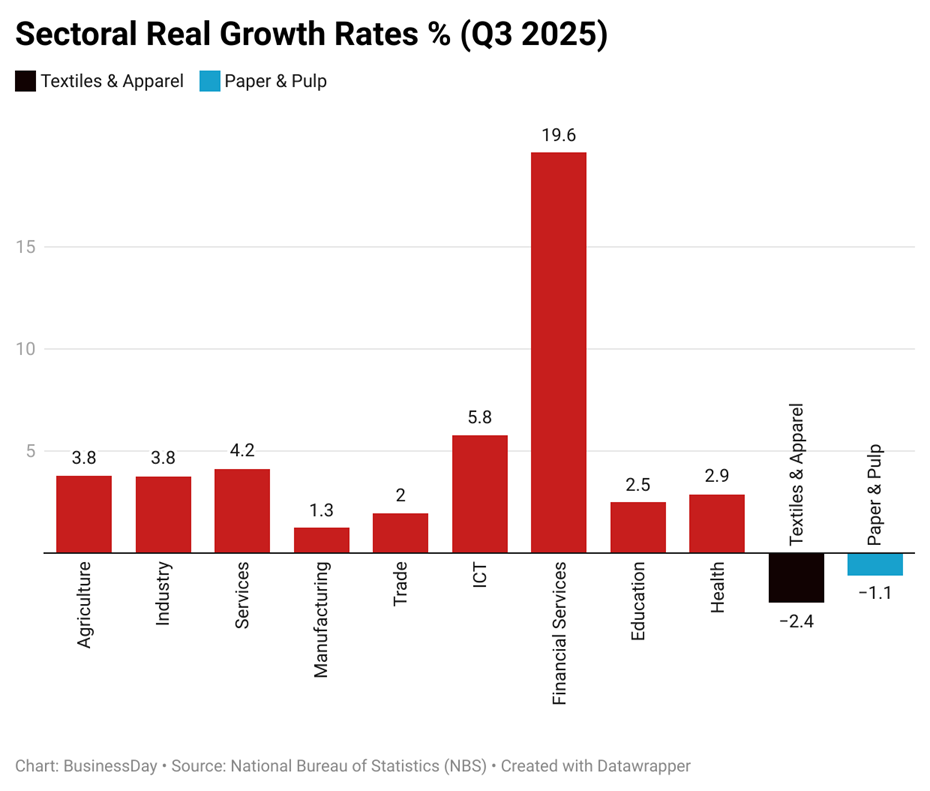
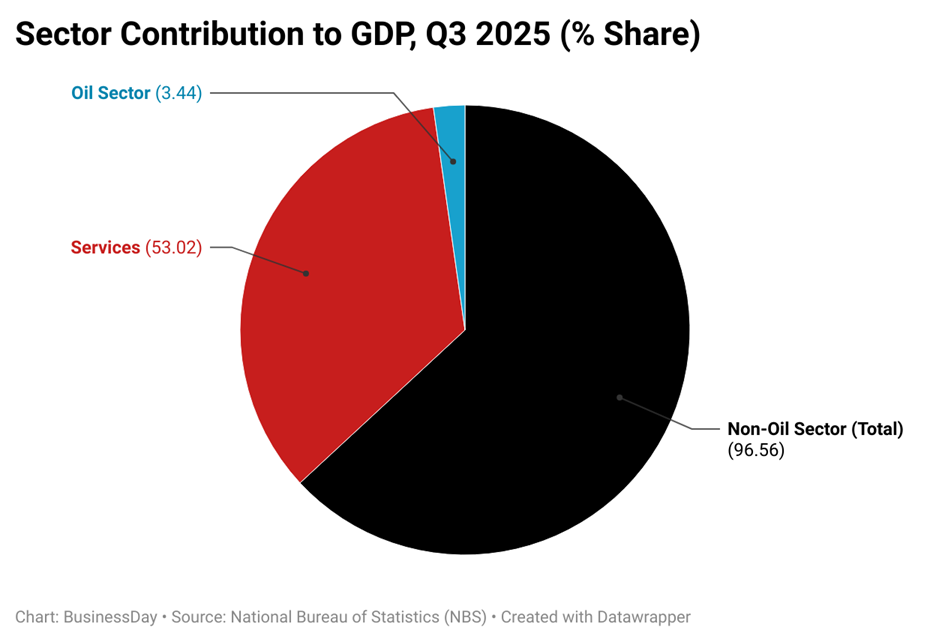
Agriculture grew 3.79 percent, industry 3.77 percent and services 4.15 percent, with the latter accounting for just over half of total output (53 percent). Oil production averaged 1.64 million barrels per day, while the non-oil sector rose 3.91 percent, contributing more than 96 percent of GDP.

Muda Yusuf, chief executive officer of the Centre for the Promotion of Private Enterprise (CPPE), said the numbers confirm that Nigeria is on a gradual recovery path. “Nigeria’s Q3 GDP performance reaffirms that the economy is on a steady recovery, supported by improved macroeconomic stability, stronger investor sentiment, and resilience across key sectors,” he said.
He added that the results reflect the positive impact of reforms in stabilising the exchange rate, moderating inflation and gradually restoring confidence.
Where Nigeria sits in the business cycle
Economic cycles typically move through contraction, trough, recovery and expansion. Between 2020 and 2023, Nigeria oscillated between contraction and a fragile recovery under the combined weight of the pandemic, FX shortages, energy-price adjustments and aggressive monetary tightening. Growth stayed positive but vulnerable, with real incomes persistently squeezed.
The 2025 data suggest the economy has entered a clearer recovery phase, though not yet a broad-based expansion. The World Bank noted recently that “Nigeria’s recent growth reflects early dividends from macroeconomic reforms, but productivity and household welfare remain constrained by inflationary pressures and structural weaknesses.”

Several indicators underline that point. Growth is positive but moderate. At just under 4 percent, output is improving but still below the pace required to absorb Nigeria’s expanding labour force or deliver meaningful employment gains.
The recovery is also narrowly led: financial services grew 19.63 percent; ICT expanded 5.78 percent and services dominated output. By contrast, manufacturing expanded only 1.25 percent, trade rose 1.98 percent, textiles and apparel contracted 2.41 percent, and paper and pulp remained in recession.
Yusuf described manufacturing as the “weakest link.” High energy and logistics costs, costly borrowing conditions and dependence on imported inputs continue to erode competitiveness and limit job creation.
Household consumption is another drag. Inflation is easing, but not fast enough to restore real wages or revive broad domestic demand, a typical feature of early recoveries.
Drivers of the rebound
Stabilisation of the foreign-exchange market has been central to the rebound. “Greater exchange-rate stability resulting from FX market reforms has reduced uncertainty, eased cost pressures and improved business planning,” Yusuf said. Disinflation is also helping, even though its impact on living standards remains muted.
The IMF, in its September 2025 Article IV consultation, observed that “macroeconomic stabilisation is underway, but the challenge is converting nominal growth into durable gains in real incomes through sustained investment and structural reform.”
Financial services benefited from improved fiscal operations, rising transaction volumes and renewed banking-sector confidence. ICT growth reflects rapid digitalisation, e-commerce expansion and enterprise technology adoption.
Construction and real estate also posted gains, supported by public-sector projects and private-sector urban investment. Agriculture showed modest improvement but continues to face insecurity, logistical bottlenecks, weak purchasing power and limited mechanisation.
The road ahead
A shift from recovery to full expansion will require stronger job creation, sustained private investment and clear improvements in household welfare. Manufacturing remains weak, credit conditions are tight and heavy dependence on imported inputs leaves firms exposed to FX volatility. Trade’s slow revival underscores how fragile consumer demand remains. Education and health critical for productivity, continue to be underfunded.
Yusuf summarised the balance: “The economy is consolidating on a recovery path, but achieving stronger and more inclusive growth will require targeted interventions to address structural bottlenecks, strengthen agriculture, and restore manufacturing competitiveness.”
Whether Nigeria moves beyond recovery will depend on the pace of structural reforms, the management of the cost-of-living crisis and the ability of policymakers to channel capital into productive sectors rather than allowing momentum to concentrate in finance and services.
For now, the Q3 numbers indicate real progress. But they also reveal the limits of the rebound and the distance Nigeria must still travel before the recovery becomes a genuinely transformative expansion.