|
Getting your Trinity Audio player ready...
|
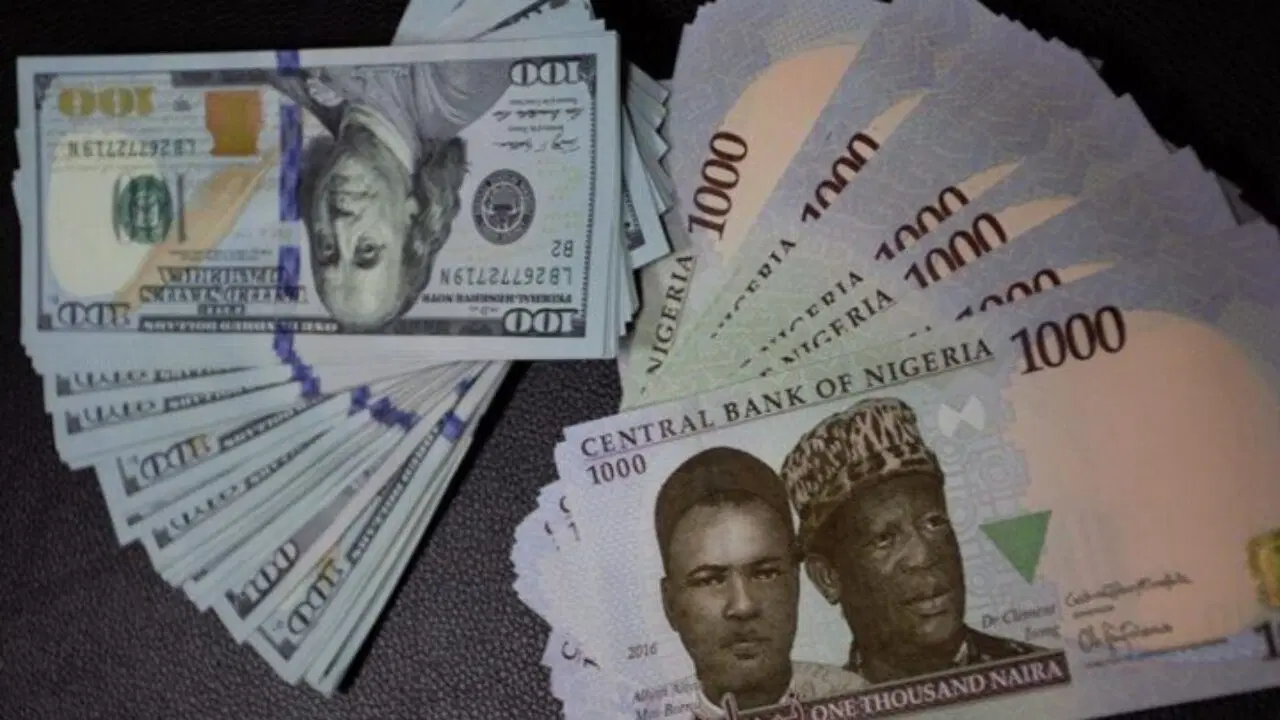
The naira has recorded a significant gain of N215.73 against the dollar in the official foreign exchange market, marking a full year since the commencement of the Electronic Foreign Exchange Management System (EFEMS).
Data published by the Central Bank of Nigeria (CBN) showed that the naira appreciated by 14.93 percent to N1,445.39 on Tuesday, December 2, 2025, compared to N1,661.12 quoted on December 2, 2024, which was the first trading day under the EFEMS framework. This improvement underscores the currency’s gradual strengthening since the revised trading architecture came into effect.
The shift toward greater transparency began on Tuesday, November 26, 2024, when the CBN issued a directive instructing all banks active in the interbank foreign exchange market to adopt the Bloomberg BMatch system. That platform, which became operational on December 2, 2024, was designed to enhance transparency and operational efficiency by ensuring that all orders were mandatorily submitted and matched electronically under real-time regulatory visibility. This development laid the foundation for the gains recorded over the past year.
Read also: Naira ends week with N7.10 gain as FPI inflows hit $21bn

On a day-to-day basis, the naira continued to strengthen, appreciating by 0.2 percent as the dollar was quoted at N1,445.39 on Tuesday compared with N1,448.43 quoted on Monday at the Nigerian Foreign Exchange Market (NFEM), according to the CBN data.
The local currency also showed notable improvement in the parallel market, commonly referred to as the black market, where it gained N47 or 3.2 percent to close at N1,468 per dollar on Tuesday, compared to N1,515 on December 2, 2024, the day EFEMS became operational. The narrowing gap between the official and parallel market rates continues to be viewed as one of the clearest indicators of restored confidence.
Nigeria’s external reserves have also maintained steady growth over the period under review, rising by $4.37 billion or 10.9 percent to $44.66 billion as of November 28, 2025, from $40.29 billion recorded on December 2, 2024, according to the CBN. This accumulation of reserves has been attributed to improved FX inflows, stronger remittances, and renewed foreign investor interest supported by the reforms in the FX market.
Olayemi Cardoso, governor of the CBN, said the introduction of the Nigerian Foreign Exchange Code has established clear rules for transparency, ethics, governance, and fair dealing among authorised dealers. He added that the deployment of the EFEMS platform, powered by Bloomberg BMatch, has “transformed FX trading through mandatory order submission, real-time regulatory visibility, and enhanced price discovery.” He explained that the transformation of the FX market has become “perhaps the most visible sign of renewed confidence in our economy,” noting that over the past year, the apex bank has sustained the unification of the multiple exchange-rate windows. Cardoso stated that the once-crippling multi-billion-dollar FX backlog had been fully cleared, restoring credibility and giving businesses the confidence to plan. He emphasised that these reforms have reduced opacity and manipulation and restored discipline to the market, allowing the naira to trade within a narrow and stable range and shrinking the gap between the official and parallel markets to under 2 percent, down from more than 60 percent previously.
Aloysius Uche Ordu, a member of the Monetary Policy Committee (MPC), said the naira appreciated month-over-month at both the official and parallel market windows, reflecting the positive effect of continued market reforms and strengthened investor sentiment. He noted that resilience in remittance inflows, capital market performance, and gradual improvement in Nigeria’s international investment position further buttressed external stability. Similarly, Emem Usoro, deputy governor of the CBN, said the convergence between the NFEM and the Bureau De Change segments has further enhanced transparency and boosted investor confidence.

EFEMS, the electronic platform introduced to curb speculation and improve transparency in Nigeria’s FX market, automatically matches buy and sell orders to promote fairness and efficiency. Financial experts have expressed optimism about its potential to address long-standing challenges affecting the naira and the country’s FX reserves.
Read also: CBN to unveil FX manual to further strengthen market participation, naira
Razia Khan, managing director and chief economist for Africa and the Middle East at Standard Chartered Bank, observed that “The introduction of EFEMS was eagerly awaited. It should allow for greater transparency and better functioning of the FX market, enabling the CBN to gauge the true extent of FX demand and formulate policies accordingly. Market participants expect that EFEMS adoption will lend itself to greater Naira stability.”
In addition, the CBN has set a minimum tradable amount of $100,000 with incremental clip sizes of $50,000. This was disclosed then by Omolara Duke, director of the bank’s Financial Markets Department, in a circular sent to banks last year, reinforcing the structured approach the regulator is taking to deepen liquidity and improve trading efficiency across the market.