|
Getting your Trinity Audio player ready...
|
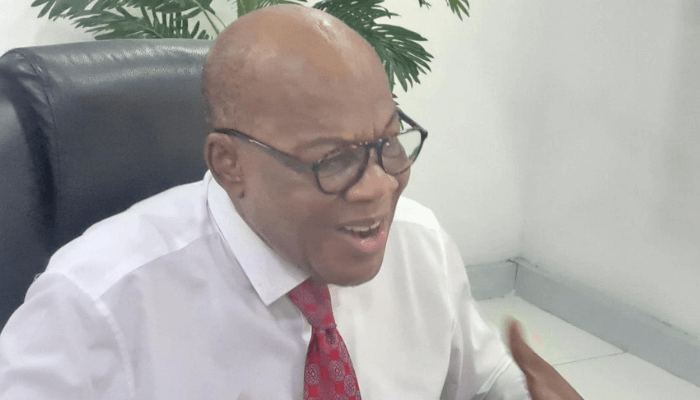
Nigeria is overlooking a massive N70 trillion annual revenue opportunity in its maritime and blue economy sector due to outdated laws, weak regulation, and abandoned transport infrastructure, Olisa Agbakoba, a prominent senior advocate of Nigeria, warned in a new policy paper and letter addressed to Adegboyega Oyetola, the minister of Marine and Blue Economy.
In the detailed letter dated November 30, 2025, the maritime law guru described the sector as “potentially Nigeria’s largest economic sector outside oil and gas,” citing projections by the Nigerian Institution of Marine Engineers and Naval Architects (NIMENA) that the industry “could contribute approximately $44 billion (N70 trillion) annually to Nigeria’s GDP with improved governance and regulation.”
Agbakoba said the country’s ability to unlock this revenue has become urgent given Nigeria’s worsening debt crisis. He warned that “total public debt at N152.40 trillion… and debt servicing projected at N15.4 trillion for 2025” means the government is “trapped in an unsustainable borrowing cycle while enormous revenue opportunities remain untapped.”
The accompanying 70-page policy document goes further, stating bluntly that “Nigeria’s maritime sector presents a N70 trillion annual opportunity… currently unrealised due to legal and regulatory gaps.” It adds that “the roadmap exists; what is needed is decisive implementation to translate policy into law and law into measurable economic outcomes.”

The documents reveal seven transformative revenue streams and a legislative overhaul needed to unlock them:
Port infrastructure (N14 trillion annually)
Nigeria loses “approximately N20 billion daily at the ports due to poor infrastructure and inefficiencies,” with most cargo diverting to Cotonou, Tema and Lomé. Agbakoba argues that enacting a Ports and Inland Waterways Development Act and amendment of NPA and NIWA laws would “modernise our ports and unlock revenues from tariffs, cargo handling fees, and special economic zones.”
Inland waterways (N10–12 trillion annually)
Nigeria’s once-functional 42 inland waterways “lie abandoned.” The document says dredging the Niger and Benue would turn them into “transformational economic corridors” where “transportation from Baro to Onitsha would take 90 minutes instead of nine hours.”

Cabotage enforcement (N8 trillion annually)
Over “25,000 foreign vessels illegally trade in Nigeria’s coastal waters,” representing huge economic leakage. Strengthening the Cabotage Act “would recapture these revenues while creating jobs for Nigerian seafarers.”
Oil rig taxation (N6 trillion annually)
The documents reveal a major revenue scandal: “tax is currently not collected from oil rigs operating in Nigerian waters,” forming what Agbakoba describes as “a cartel for tax avoidance.”
Read also: Nigeria returns to International Maritime Council after 14 years
Oil & gas maritime services (N16 trillion in annual losses)
Nigeria loses “over $1 billion worth of legal work annually” and gains no shipping, banking, or insurance revenue from offshore operations. Enforcing local content laws and creating a Maritime Development Bank would “recapture these losses.”
Maritime security & blue economy (N8–10 trillion annually)
Despite improved security under the Deep Blue Project, only a dedicated coast guard can “adequately protect and assure maritime safety and security.” Reduced piracy could cut insurance premiums by 40% and increase shipping traffic.
Emerging maritime technologies (N5–6 trillion annually)
The IMO will mandate Maritime Autonomous Surface Ships (MASS) by 2028. The paper stresses that early adoption “would position Nigeria as a regional hub for digital maritime services.”
A legislative revolution needed
The documents propose nine new laws and amendments to seven existing ones, including: Ports and Inland Waterways Development Act, Marine Spatial Planning Act, Sustainable Fisheries and Aquaculture Act, Coast Guard Establishment Act, Blue Economy Act, Amendments to the NIMASA, NIWA, NPA, Cabotage, Merchant Shipping, and Petroleum Industry Acts.
Agbakoba insists the reforms are not theoretical, saying that “The transformative element of this proposal is that the National Policy on Marine and Blue Economy (2025–2034) already contains most of the required legal and institutional reforms. The roadmap exists; what is required now is decisive implementation.”
He concluded by challenging the government to choose between stagnation and transformation: “What remains is the political will to act decisively and transform Nigeria’s maritime sector from its current state of underperformance to its rightful position as a cornerstone of our economic transformation.”