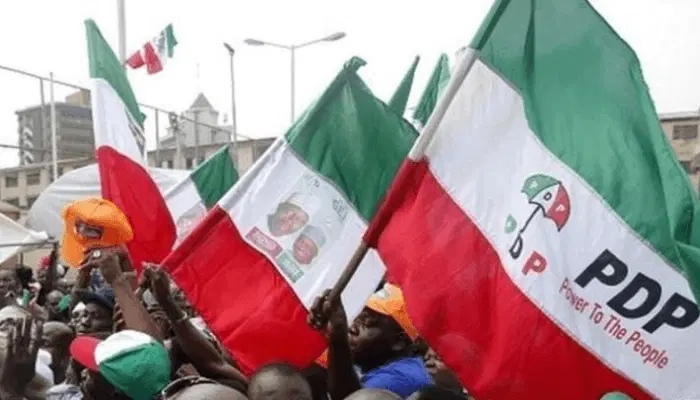
Less than 10 days to the end of the Peoples Democratic Party PDP, National Working Committee (NWC), there are fears that the party may become extinct if they allow December 10 to come without resolving the current crisis rocking the main opposition party.
BusinessDaySunday checks revealed that neither the law nor other regulatory institutions will be able to bail out the party, after the expiration of the current tenure of the NWC.
Segun Showunmi, a chieftain of the party, said “the PDP may be risking creating a political mess for the country occasioned purely by their recidivist tendencies over the years.”
The party has found itself in this quagmire, following the battle between the two main factions – one led by Nyesom Wike, the Minister of the Federal Capital Territory FCT and the other, by Umar Damagum/Kabiru Turaki.

Read also: Niger school abduction: PDP visits Bago, seeks end to politicisation of security
Both groups are battling for the soul of the party, to control power at the center, ahead of the 2027 general election.
The struggle led to security agencies sealing off the party’s National Secretariat, Wadata Plaza, Abuja.
The decision to seal the party, followed the clash by the rival groups which would have resulted to blood bath, but for the intervention of the combined security operatives.
Okechukwu Osuoha, the party’s deputy national legal adviser, while speaking with BsinessDaySunday on the issue, however, said the case before the Court of Appeal over who controls the party amongst the two groups will settle the dispute

Osuoha, who called for accelerated hearing assured, that if the court acts on time, the situation can be salvaged
“Do not worry, we hope that the matter will be resolved before the December 8, when the tenure of the NWC will expire.”
He blamed the development on the party’s refusal to follow due process and rule of law.
According to him, “this is what you get when political parties fail to follow the rule of law and respect provisions in their Constitutions.”
The ongoing crisis took a new turn last Tuesday, when the Nyesom Wike and Samuel Anyanwu faction of the party filed a fresh suit before the Federal High Court in Abuja, asking the court to bar the Independent National Electoral Commission (INEC) from recognising the national convention recently held in Ibadan, the Oyo state capital, on November 15 and 16.
The group which earlier boycotted the Ibadan Convention, anchored their decision on the grounds that the Federal High Court Abuja, had, in a judgement by James Omotosho, suspended the convention.
They also argued that the convention was illegal-based judgement delivered on October 31 in FHC/ABJ/CS/2120/2025: between Austine Nwachukwu v INEC & Ors; as well as the interim order of November 11 and judgement of November 14 in FHC/ABJ/CS/2299/2025 between Alhaji Sule Lamido v PDP & Ors.
But the faction loyal to Turaki got approval of an Ibadan High Court to conduct the convention.
Following the Ibadan judgement, the party went ahead to hold the convention on the 15 and 16 of November, taking far reaching decisions, including the expulsion of Nyesom Wike, Samuel Anyanwu, Ayo Fayose, amongst others for engaging in anti- party activities
In the suit, which is yet to be assigned to a judge, with no date fixed for the hearing, and marked FHC/ABJ/CS/25012025, the Wike group is praying the court to ” declare the convention and all decisions taken at the event as “null, void and of no effect.”
The plaintiffs, Mohammed Abdulrahman, the faction’s acting national chairman, and Samuel Anyanwu, national secretary, are also seeking an order of the court restraining security agencies and INEC from recognising the defendants — including Umar Damagum, Kabiru Turaki, new national chairman, and other prominent members — as PDP officials.
Read also: PDP: Lamido seeks dissolution of Ibadan convention, formation of caretaker committee
The plaintiffs, in their originating summons, argue that the Ibadan convention was conducted in flagrant disregard of three subsisting judgements of the federal high court.
These include the judgement delivered on October 31 in FHC/ABJ/CS/2120/2025: between Austine Nwachukwu v INEC & Ors; as well as the interim order of November 11 and judgement of November 14 in FHC/ABJ/CS/2299/2025 between Alhaji Sule Lamido v PDP & Ors.
They also cited on the judgement delivered on May 31, 2023, in FHC/ABJ/CS/139/2023: Nyesom Wike v PDP & Ors.
The plaintiffs asked the court to declare that INEC, the inspector-general of police, the FCT commissioner of police, and the DSS are constitutionally bound to enforce the above judgements and give full effect to their provisions.
They are also also asking for an order of the court restraining the defendants from recognising or giving effect to the Ibadan convention or any decisions made there, as well as an order preventing the sixth to 25th defendants from parading themselves as officials of the PDP.
They also seek the court order directing the security agencies to provide adequate protection for them and to grant them access to Wadata Plaza and Legacy House for the purpose of conducting the affairs of the party.
They said the court must also restrain INEC from accepting any change of address for the PDP other than the two existing official locations in Abuja.
Others include the court’s determination, as to whether any authority or institution can lawfully recognise the Ibadan convention in view of the subsisting judgements and the provisions of the constitution, the Electoral Act, and the PDP constitution.
They averred that various decisions had nullified the 21-day notice issued for the national convention and had expressly restrained the party from conducting the exercise.
They argued that the Turaki led group “organised themselves and their cohorts” and convened a gathering in Ibadan where they purportedly elected national officers and announced the expulsion of some prominent party members.
Anyanwu, in his affidavit, alleged that the Turaki led group, also unsuccessfully attempted to “forcibly take control” of the party’s national secretariat at Wadata Plaza and Legacy House in Abuja, on the 18th of November.
He added that instead of enforcing the subsisting court orders, the police and Department of State Services (DSS) “sealed up” the secretariat and denied the legitimate officers of the party access to the buildings.
To prevent a leadership vacuum Showunmi has recommended that the NWC acts within the next 48-72 hours, by calling for a meeting as the December 2025, expiration closes in
According to him “INEC requires: 21 days’ notice for leadership change, NEC meeting requires: 7 days’ notice,
“The PDP must act immediately (within 48–72 hours) to avoid legal paralysis.”
He declared that to prevent a leadership vacuum, the INEC must recognise and sanction leadership transition, while the party is also mandated to maintain constitutional compliance within PDP rules.
To avoid court injunctions and factions, he said the “party must create a roadmap to a national convention.
“To tackle the problems, the National Chairman must issue NEC meeting notice, TODAY to comply with the 7-day requirement.
“If Chairman refuses, Trigger ⅔ NEC members’ request in writing (same day). Force Chairman to convene within 7 days as mandated. This is the single most urgent step.
“Notify INEC of Intent to Conduct Leadership Transition (Within 48 Hours).”
He noted that either the National Chairman or the National Secretary, can send the notice to the INEC
“Even if the exact date is pending ratification by NEC, send preliminary notice to INEC expressing intent to hold elections/convention.
This protects the party from the strict 21-day rule.
“The INEC can accept preliminary notices as long as final details come later.secure Internal Unity (Within 72 Hours).”
Others will include emergency consultation to prevent factional NEC boycotts, ensure at least ⅔ representation from ⅔ of zones will attend the NEC meeting, as well as issue directive to all state chapters to avoid parallel meetings.
Within 30 days, the party must achieve, legally recognized interim or extended NWC, while the INEC-notifies and approve a compliant transition calendar.
As it is now, it is however not clear if the party will be able to agree to follow the above process was both parties are not willing to step down for each other.
According to Osuoha, only the court can help solve the current problem.