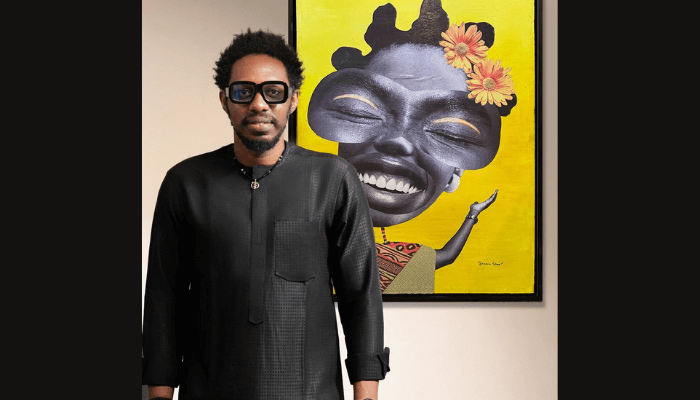
Ehinomen Okoeki is a self-taught multidisciplinary artist from Benin City, now based in Lagos. A graduate of Sikkim Manipal University, his path shifted after a 2017-internship with renowned artist, Victor Ehikhamenor, which inspired his full-time commitment to visual art. Okoeki has exhibited widely, including at Yenwa Gallery, Soto Gallery, Ecobank, the Ministry of Foreign Affairs in Abuja, and in Shanghai. He has completed residencies at the Shanghai Academy of Fine Arts (2023) and the Reimagining Hope Residency organized by Nigeria’s Ministry of Art, Culture, Tourism, and the Creative Economy (2025). In this interview with KENNETH ATHEKAME, he reflects on the evolving landscape of Nigeria’s art scene, noting that Lagos has rapidly become a cultural hub with growing global visibility. Excerpts:
You are a self-taught artist who studied Information Technology before moving into art. What drew you fully into visual arts, and how does your background in tech shape your collage practice?
I’ve always had a creative instinct, but for a long time it stayed in the background while I pursued Information Technology. Over time, art became the language I couldn’t ignore, it was how I processed memory, emotion, and history. My tech background trained me to think in layers, to problem-solve visually, and to embrace experimentation. Those skills translate directly into collage, where I move between digital and physical processes to create something whole from fragments.
How did your internship with Victor Ehikhamenor in 2017 influence your artistic direction?

That experience was pivotal. Victor taught me that art is not just about aesthetics, it’s about storytelling, identity, and resilience. He gave me permission to merge personal memory with larger cultural narratives. Watching him tell his story through an unconventional medium gave me confidence to trust my own path.
Collage is central to your work. What initially attracted you to this medium, and what does it allow you to express that other forms may not?
I began working with collage as a child. We always had magazines at home, especially Ovation and others like it, and I would cut out images to piece together my own characters. That early play stayed with me. Collage mirrors the way memory works, fragmented, layered, and never linear. I was drawn to it because it allows me to hold the past and present in one frame. Unlike painting or drawing, collage carries traces of lived reality within its source materials. It lets me build a world where humour, grief, and longing can coexist.
The exhibition focuses on departure and the emotional weight of migration, particularly the Japa phenomenon. What inspired you to frame this theme not as fleeting but as part of a longer historical narrative?
Migration is not new to Nigeria; it’s part of our history, from colonial displacement to the brain drain of the ’80s to today’s Japa movement. I grew up in Benin city where almost every family had someone abroad. Migration took away family members and close friends, leaving a distance between us that even time cannot heal. I wanted to show that what we are experiencing now is an echo of a longer story. By treating it as historical, I honour the emotions of families separated across generations, not just the current wave.

Your works often exaggerate eyes, hands, and gestures. How do these distortions help you communicate tenderness, longing, and humour within such a heavy subject?
Eyes and hands carry emotion more directly than words. By enlarging or distorting them, I can exaggerate what is often hidden, desire, fatigue, or vulnerability. The humour comes from pushing these features almost to the point of caricature, which makes the work feel a bit tender.
The Line Between Us suggests both separation and connection. How do you interpret that “line” in your own life and in Nigeria’s collective experience today?
For me personally, the line is the distance I navigate in a long-distance relationship, it’s both a space of absence and of creative closeness. Collectively, I think Nigerians live with many lines between those who leave and those who stay, between generations, between hope and despair. That line is fragile but also a reminder that connection can still exist across it.
Your collages balance fragmentation and wholeness. How do you see this reflecting the emotional state of those leaving and those staying behind?
When you migrate, you leave pieces of yourself scattered, memories, relationships, traditions. Those who stay also feel incomplete without loved ones around. My collages reflect that sense of being whole and broken at the same time, an emotional condition of migration.
You describe memory as both personal and communal. How do you balance your own private memories with the collective cultural archive in your work?
I start with my own memories, family gatherings, stories, and photographs. Then I layer them by using found images that carry a wider cultural resonance. By combining them, I move from the intimate to the communal, showing how personal experiences are part of larger narratives.
Can you walk us through your creative process from sourcing found images to digital manipulation to physical layering?
I generate my images using AI prompts, which helps me capture the exact expressions I need. From there, I digitally manipulate them in a design software, stretching, cutting, and exaggerating. Once the composition is ready, I break down each layer for print and then reassemble them physically, often on parchment-like paper, canvas, plexiglass, or any other material I choose to work with.
How do humour and playfulness function in your work alongside themes of loss, distance, and longing?
Humour is survival. Nigerians laugh even in hardship, it’s a cultural resilience. In my work, playfulness creates an entry point to capture the attention of the audience. It softens the heaviness and reminds us that joy and grief are often intertwined.
Nigeria’s art scene has gained global recognition in recent years, with Lagos fast becoming a cultural hub. From your perspective, what opportunities and challenges still exist for emerging artists here?
The opportunities are exciting, international exposure, residencies, and a growing local collector base, with more galleries available to support emerging artist. But challenges remain, limited infrastructure, no funding, and unequal access for young artists outside Lagos. There’s still a need to build sustainable systems that support artists beyond the spotlight moments.
How has your experience exhibiting internationally (Shanghai, Joburg) shaped your approach compared to showing in Nigeria?
Internationally, the infrastructure abroad creates space for artists to test new mediums and be more unconventional. That exposure has expanded my awareness of materiality and its possibilities, and I see it becoming an even more integral part of my practice in the coming years, especially in contexts outside Nigeria.
What role do you think Nigerian art can play in reframing global narratives about migration, identity, and memory?
Our art can show the nuance, the laughter, the grief, the longing, the resilience. It can push the world to see migrants not just as statistics but as people with layered stories.
As someone who works across digital and physical techniques, how do you see technology influencing the future of Nigerian art?
Technology is opening doors, from digital collaging and AI tools to NFTs and online exhibitions. For Nigerian artists, it offers ways to bypass traditional gatekeepers and reach global audiences directly. But I also think technology should enhance not replace the tactile and human quality of our art.
What themes are you interested in exploring beyond The Line Between Us?
I’m interested in exploring spirituality, intimacy, emotions, culture and humour in daily Nigerian life beyond migration. I want to look at how ordinary gestures, eating together, loving, praying, and playing carry deep meaning. Migration will always be there, but I also want to celebrate the small acts of staying connected.