
…Says AI has made creating chemical compounds easy and cheap
A professor of Chemistry and global force in chemical security group has warned Nigeria to start ahead to prepare against chemical warfare in the face of rise in terrorist activities especially by outside forces. This is as experts said Artificial Intelligence (AI) has made making of chemical weapons easier and cheaper.
Kaine Okorosaye Orubite, head of department, Pure and Industrial Chemistry, UNIPORT, reminded Nigerian authorities that the global trend is a concern and quiet preparations against chemical warfare especially by terror groups.
She made it clear that Nigeria must prepare ahead over chemical security. “It is not yet here but we must prepare. AI creates new compounds; diversion and theft rates are indicators of ulterior motives in access to chemicals.”

The professor was keynote speaker at a training on handling of chemicals which took place at the Port Harcourt Chamber of Commerce, Industry, Mines, and Agriculture (PHCCIMA) organized by the Chemicals and Allied Trade Group of the city chamber.
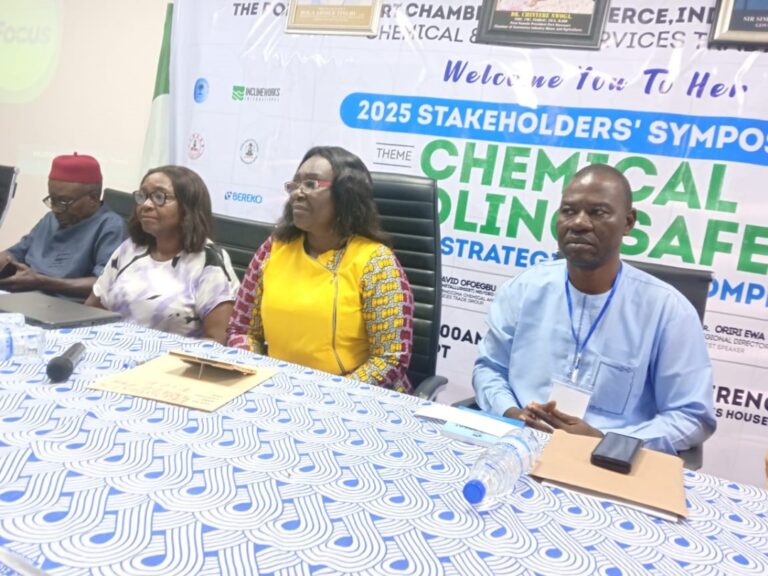
Orubite, who said she has a huge passion for Chemistry, pointed at those she called ‘duel-use chemicals’ that can be used for both good and evil purposes.
She warned that terrorists use such good chemicals for other ends such as bombs, etc. “These are substances with legitimate industrial or commercial applications that can also be diverted to produce chemical weapons, explosives, or illicit drugs.
She named such chemicals with dual purposes as petrol – used in vehicles/motors; Chlorine used for water purification, pharmaceutical production, chemical manufacturing, plastics industry; ammonium nitrate (used in Agricultural fertilizers to boost crop yield); hydrogen peroxide (used in homes as a disinfectant and for making sanitizers); sodium hydroxide (caustic soda) for industrial chemical used in soap making; phosphorus oxychloride, phosphorus trichloride, thionyl chloride, triethanolamine precursors with legitimate uses but have potential for misuse.
The professor who said she has become a globe -trotter on account of her works in chemical security named chemical waste disposal issues as another concern. She said chemical waste disposal is a growing concern worldwide and features in global meetings.

Read also: Marine engineers, naval architects, push for national pathway for blue economy
She said only the US was showing signs of managing the issue better because scientists from most other countries complain bitterly about concerns back home.
She hinted that the global trend has shifted from chemical safety (about protecting yourself) to chemical security (about protection of the chemical). “Global bodies are issuing warnings.
The keynoter also mentioned another concern, saying chemical waste disposal issues have become pronounced. He said there is a dearth of experts in the sector, saying most universities are looking for experts to dispose of their huge stocks of chemical waste and expired chemicals.
The scientist and member of a global body on Chemical Security, said the objective is trying to understand how to protect people and the environment.
She stated: “Chemical concerns everybody. People must know that chemicals are dangerous; Urea fertilizer is dangerous, though a good product. There are many workplace issues concerning chemicals.”
Taking up the issue of gatekeepers of chemicals, she mentioned importers, stockists, distributors, etc. and called for commitment in safety as key at every stage.
She thus saluted the Chemicals and Allied Trade Group of PHCCIMA for opening up their process for the world to see, saying it was the height of transparency. “Those handling chemicals must know the components of each product so they can keep to the rules of every chemical. They must embrace the National Agency for Food, Drugs Administration and Control (NAFDAC) because they are globally recognized as the regulatory agency for chemicals (and foods) in Nigeria.
The HOD also warned against prolonged exposure to chemicals. “Shops must run shifts so nobody is exposed from morning till evening every day.”
On technicalities of waste disposal, she said labelling everything in the home or shop was important because some chemicals look alike or like water. “Compliance is key in handling chemicals. Beware of illegal sources of your chemicals. Beware of incompatible chemicals. Wrong disposals will always come back to us.”
She defined chemical waste disposal as safe management of chemical wastes to protect health and environment. “Collective Responsibility required that every individual and organization handling chemicals is responsible for keeping our environment safe.
Common examples of chemical wastes include laboratory solvents and reagents; heavy metal solutions; acids and caustic bases; contaminated materials; and expired reagents.”
She went on: “Let all persons join in tackling waste disposal campaign. The Global Chemical Congress is working round the clock on this.”

Handlers training:
Thus, handlers of chemical products in most parts of the Niger Delta gathered in Port Harcourt for two days to learn more about emerging trends in safety and security.
The experts revealed that global focus has shifted from mere safety to security concerns in chemicals handling and access due to theft and misuse.
The training, organized by the ‘Chemicals & Allied Trade Group’ of PHCCIMA, targeted all those involved from importation to handling.
Explaining the essence of the training in the face of new concerns, David Ofoegbu, a chemical engineer and chairman of the Chemicals and Allied Trade Group of PHCCIMA, stated that a story he told reminds everyone that every lapse in chemical handling carries human consequences. “It is precisely to prevent such tragedies that we gather here today.”
In that case, he said: “This event is more than a meeting of minds; it is a convergence of leadership, knowledge, and duty. We are here because chemical safety is not optional; it is fundamental. It protects lives, preserves our environment, and ensures that commerce and industry thrive responsibly.
“The strategic purpose of this symposium is clear: to strengthen the culture of safety in chemical handling; to align industry practices with global standards; and to foster collaboration between regulators, academia, and the private sector.
“Our goal is to ensure that compliance is not seen as a burden but embraced as a pathway to competitiveness, sustainability, and corporate excellence. By bringing together stakeholders across commerce, industry, and science, we aim to generate actionable insights, shape policy direction, and build partnerships that safeguard our communities while advancing economic growth.”
He said the presence of regulators and government agencies (NAFDAC, SON, the Rivers State Ministry of Commerce & Industry; the Rivers State Ministry of Environment; the Rivers State Fire Service; and the Rivers State Ministry of Health represented by the Emergency Medical Service and Ambulance System), is not just symbolic; it is foundational. “It affirms that chemical safety is a matter of national priority, ensuring that the outcomes of this symposium resonate with integrity, accountability, and lasting impact.”
They showed deep appreciation of safety professionals at the event saying they would bridge the gap between theory and practice.
In her speech, Chinyere Nwoga, the president of PHCCIMA, said the city chamber operated through the trade groups that burrow into the real sectors and ferret out the challenges to be solved by the bigger house.
She spoke about the need for strong connectivity between the academia and the industry, saying the universities produce the people that would work in the companies.
The president called on regulatory agencies to rather embrace the businesses they regulate with supportive approaches because if businesses die, there would be nothing to regulate. She said it was great to realise that the Rivers State Fire Service was fully back.
Conclusion:
Agencies involved in anything chemical attended the training and delivered papers that seemed to help participants wake up and join in chemical safety and security.