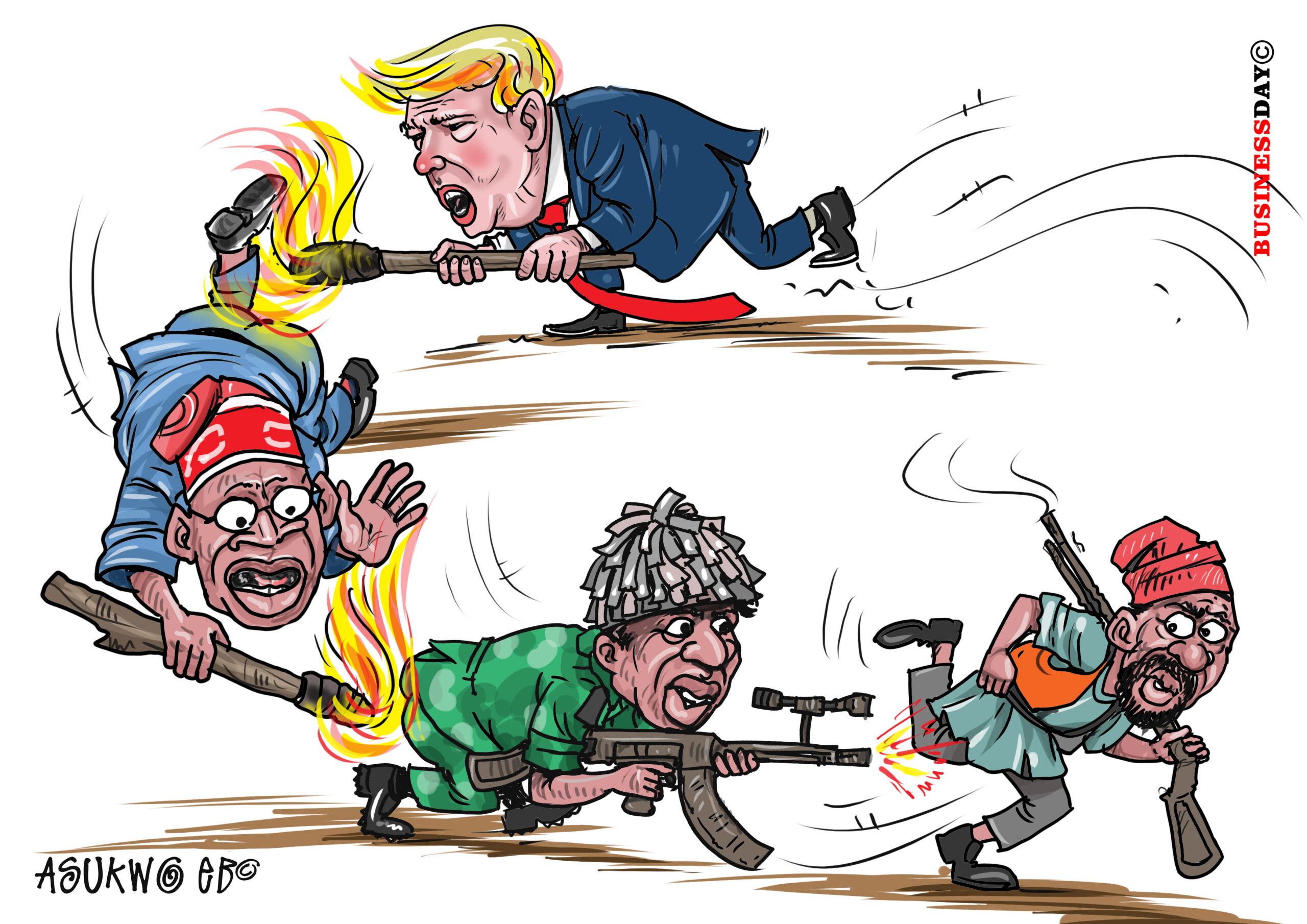
Mounting pressure from Donald Trump, United States President, appears to have forced President Bola Tinubu into taking some of the most decisive security steps of his administration, amid escalating violence across Nigeria and rising global scrutiny.
Trump in recent weeks designated Nigeria a Country of Particular Concern (CPC) for allegedly killing Christians. Within 24 hours, he threatened on Truth Social and X to invade Nigeria ‘with guns ablazing’ to eliminate terrorists he claims are targeting Christians in Africa’s most populous nation.
Read also: Terrorists’ attacks surge despite Trump threat
He followed up by appointing Tom Cole, chairman of the U.S. House Appropriations Committee, and Riley Moore of West Virginia to lead a probe into alleged Christian genocide in Nigeria.

Trump has twice described Nigeria as a ‘disgraceful country,’ including in a radio interview last weekend where he accused the government of failing to protect Christians. He has not walked back any of these remarks.
The pressure appears to have jolted President Tinubu and his cabinet members into moving ‘from sleep to sprint,’ triggering a flurry of actions aimed at projecting control and preventing further deterioration of the nation’s security landscape.
President’s steps
On Wednesday, Tinubu declared a nationwide state of emergency on insecurity – a step long demanded by security experts and civil society groups.
The decision followed a rapid sequence of directives issued over the past week, including an order to Bello Matawalle, minister of state for Defence, to relocate to Kebbi State to coordinate operations directly with service commanders after the abduction of 24 schoolgirls there.

As attacks intensified, Tinubu instructed the military and police to “dislodge criminal elements by all lawful means” and restore confidence across communities hit by banditry, kidnapping and insurgency.
In the North-West and parts of the North-Central, security forces have, in line with the President’s directive, begun cordoning off forest belts, a move aimed at flushing out armed groups that have exploited difficult terrain and intelligence gaps for years.
Senior officials involved in the operations say the mandate from the presidency is to degrade the networks, assert federal presence, and stop the spiral of attacks that have strained public trust in the government’s capacity to protect citizens.
Last week, Tinubu also dispatched a high-level delegation led by Nuhu Ribadu, national security adviser (NSA), to the United States to address allegations of Christian persecution in the country.
While Nigerian officials publicly downplay the significance of Trump’s remarks, the outreach underscores Abuja’s desire to maintain steady diplomatic channels and avoid misinterpretations at a time of domestic volatility.
In parallel, the President has ordered the accelerated recruitment of up to 50,000 police officers and 24,000 military personnel to address chronic shortages in manpower across operational theaters.
This is in addition to the personnel expected to be recovered from the withdrawal of police officers currently attached to VIPS, as recently ordered by the president.
He also cancelled planned international engagements to remain in Abuja, where he has held back-to-back security meetings with service chiefs, intelligence agencies, and key cabinet members.
Another round of consultations with state governors was scheduled Thursday as the administration seeks broader political buy-in for its response strategy.
Read also: Angry Trump insists Nigerian govt not doing enough
Are these enough?
Security analysts say the president’s flurry of activity is encouraging but warn that Nigeria’s deep-rooted instability will require more than emergency measures and muscular operations.
“The President is showing a level of urgency we haven’t seen in months, and that’s positive,” said Kabir Adamu, an Abuja-based security expert and managing director of Beacon Consulting Limited.
“But sustained improvement will depend on whether these actions translate into structural reforms, better troop welfare, and credible policing at the community level.”
Nigeria’s chronic manpower shortages remain a major constraint on its security capabilities. With a population of about 230 million people, the country has roughly 372,000 police officers — a ratio of 1:609, well below the United Nations’ recommended 1:450 benchmark.
The Army fields about 230,000 personnel, translating to roughly 1:1,000, further underscoring the magnitude of the gap confronting frontline operations.
Jacob Ioraa, a security expert and lecturer at the University of Maiduguri in Nigeria’s insurgency-scarred North-East, said low morale among troops fighting Boko Haram has compounded the difficulty of the counter-insurgency war.
He described personnel as overstretched, under-resourced and emotionally drained, arguing that motivation “matters as much as equipment.”
“Recently, I saw a soldier in tears because they had no weapons to fight their enemies,” he said. “Just two weeks ago, I was at the military barracks in Maiduguri for the burial of soldiers killed at the front.”
According to him, many young Nigerians are now avoiding recruitment, having seen “what happens to those at the battlefields.”
Ioraa pointed to poor remuneration as a major factor. “How can you pay a police officer as low as N80,000 a month and expect him to adequately care for his family?” he asked, noting that a private in the Army earns about N114,000.
He urged the government to consider substantial welfare improvements, including full scholarships for up to four children per soldier.
Tinubu, on his part, also directed a nationwide upgrade of police training facilities and authorised the use of National Youth Service Corps (NYSC) camps as temporary training depots.
Ioraa recommended that officers withdrawn from VIP protection duties undergo crash retraining before being deployed to high-risk areas.
Emmanuel Onwubiko, national coordinator of the Human Rights Writers Association of Nigeria (HURIWA), was more scathing, describing the President’s declaration of a security state of emergency as ‘verbal gymnastics’ with ‘minimal impact’ on the scale of the threat.
Read also: I never invited Donald Trump into Nigeria’s situation Obi
He agreed with Ioraa that the move “did not go far enough,” especially given the absence of a timeline for achieving measurable gains.
To Onwubiko, the announcement amounts to “a rehash of what successive governments — including this one — have done,” which explains, he said, why the war still appears unwinnable.
“How does the federal government expect to try the same solutions for over 13 years and hope for a different outcome?” he asked. Beyond recruitment plans for the police and military, “there is nothing anyone can decipher as the kernel of the emergency measures,” he said.
He called for the removal of Kayode Egbetokun, Inspector General of Police (IGP), blaming Nigeria’s prolonged insecurity partly on what he described as the ‘spectacular dysfunction’ of the police.
The resulting vacuum, he argued, has forced the military into routine law-enforcement duties at the expense of its core mandate to defend the country’s territorial integrity.
Onwubiko also faulted the emergency declaration for failing to outline steps to stop corruption within the defence sector, prosecute compromised officers, or address long-standing lapses such as the withdrawal of soldiers from a Kebbi State girls’ school shortly before a major abduction.
He criticised ongoing non-kinetic approaches, including negotiations with armed groups and the reintegration of so-called repentant terrorists, insisting that Nigeria’s counterterrorism laws do not support pardons without prosecution. “There are no repentant terrorists,” he said.
Abubakar Kari, a sociology professor at the University of Abuja, described the flurry of government actions as ‘panicky,’ questioning why officials who admit they know the locations and identities of perpetrators have struggled to dismantle the networks.
He dismissed negotiations with terrorists as futile. “You cannot negotiate from a point of weakness,” he said. “The money you give them only fuels the problem.”
Kari also wondered why past administrations repeatedly claimed Boko Haram had been “decimated or substantially degraded,” despite evidence to the contrary.
“Merely proclaiming an emergency will not produce tangible results,” he said. “People are tired of recycled policies. There is nothing novel here.”