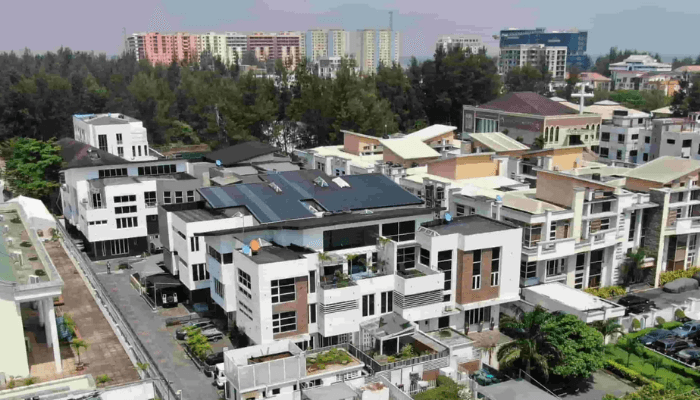
Banks and other lenders in Nigeria are increasingly classifying land and buildings as high-risk collateral for loans, as frequent demolitions and title revocations by federal and state governments continue to undermine the security of real estate assets.
What was once the most reliable form of collateral has now become vulnerable, with governments citing irregular documentation or building approval violations to dispossess owners.
This shift is disrupting both formal and informal lending, where land has traditionally been the strongest guarantee for borrowing.
Read also: Wike denies rift with military, vows relentless crackdown on Abuja land grabbers

Formal lending and borrowing have always involved fixed assets as collaterals. Real estate assets have played a key role in this space until recently, when governments started putting too much interest in land. In Lagos, for instance, land is regarded as an equivalent of oil.
Across the country, particularly in Lagos and Abuja, federal and state governments are either demolishing people’s buildings or revoking titles and repossessing people’s landed property.
Though it is not easy to get the exact number of buildings that have been demolished by the Lagos State government in the last 12 months, the state’s bulldozers have reduced over 100 buildings to rubbles.
The state government demolished, at least, 19 buildings at the Trade Fair Complex and 17 buildings at the Ikota River alignment in Lekki, while about 70 buildings were demolished in Oworonshoki area of the state recently.
Abuja faces similar instability—demolitions and, more prominently, mass land title revocations. Federal Capital Territory (FCT) minister Nyesom Wike has revoked several plots and demolished structures, leading to clashes, including a recent confrontation involving military officers over land in Wumba District allegedly belonging to former Chief of Naval Staff, Vice Admiral Awwal Gambo (rtd).

Read also: Reps to probe ₦20trn in abandoned federal land, buildings
“That singular incident and others like it explain why banks in Nigeria no longer accept land or buildings as collateral, and why so many businesses are quietly dying,” Emmanuel Oledibe, an investment analyst, told BusinessDay.
He cited the case of a business woman in Abuja, who owns a piece of land in the city. According to him, the woman built a nice plaza on the land and has tenants paying her rent every month.
“One day, the woman went to the bank to get a N200 million loan to expand her business. She submitted her land documents as collateral. The bank officer smiled and said, ‘Madam, we can’t take this land; what if government revokes it tomorrow?’
The business woman laughed, wondering how government could revoke her land when she has certificate of occupancy (C of O). But the bank officer referred her to the Wike-Naval officer incident,” Oledibe narrated, recalling that the minister drove down to revoke the land, but soldiers stood their ground to defend it.
Continuing, he said, “Imagine if that same land was already used as collateral in a bank? Tomorrow the government can wake up and say this land belongs to them or to the military, or it was wrongly allocated, or it’s under revocation?”
Read also: FCTA to begin ground rent, land fees enforcement on Nov. 26
According to him, the moment that happens, that land becomes a worthless paper, and what follows is that the bank loses, the business owner loses, and the economy loses.
Yemi Afolayan, an investment and property broker, stressed that these actions explain why some Nigerian banks have stopped accepting landed properties as collateral, especially in Abuja and Lagos.
“The risk is simply too high. Every time a government revokes land, cancels allocations, or disputes ownership, it quietly destroys business confidence, access to credit for entrepreneurs, and investor trust in real estate,” Afolayan explained to BusinessDay.