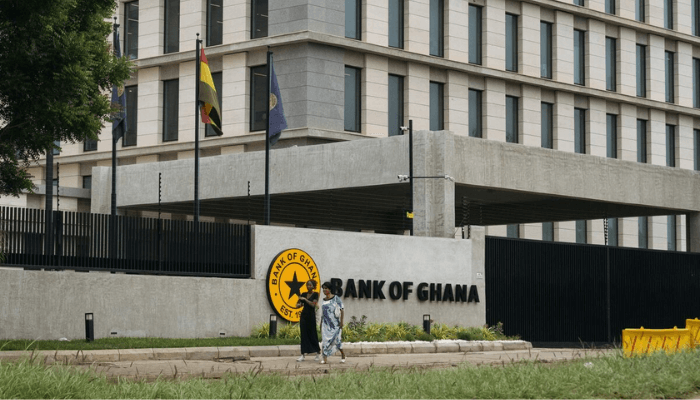
Ghana’s central bank will likely deliver a third consecutive big interest-rate cut as inflation is projected to fall below the lower end of its target range by year-end.
Governor Johnson Asiama will probably reduce the benchmark rate by 350 basis points to 18%, when he announces the monetary policy committee’s decision on Wednesday, according to majority of economists polled by Bloomberg.
Read also: Major highlights of Fidelity Bank’s 9-month results
“Real rates remain high, creating room for a carefully calibrated easing cycle,” Asiama said at the opening of the MPC on Monday. The economy “has turned a decisive corner, inflation has eased faster than we anticipated, and likely to settle between 4% and 6% by year end before stabilizing around the target band in 2026.”

Inflation fell back within the central bank’s 6% to 10% target range in September and eased to a more than four-year low of 8% last month.
Price growth now looks set to “be below the central bank’s expectations in November and remain there into 2026,” said Mark Bohlund, senior credit analyst at REDD Intelligence, who expects a 350-basis-point rate cut.
High cocoa and gold prices have handed Ghana — the world’s second-biggest grower of the beans and Africa’s top bullion producer — a windfall that’s driven the cedi up nearly a third against the dollar this year and helped cool inflation.
GCB Bank Ltd.’s Courage Boti expects the MPC to take a more cautious approach, delivering a 200-basis-point cut to “consolidate the stability.”
Finance Minister Cassiel Ato Forson, in his budget speech earlier this month, pledged to maintain fiscal restraint as Ghana prepares to exit its three-year International Monetary Fund bailout. A primary budget surplus of 1.5% of gross domestic product is projected for 2026, while the overall deficit is expected to narrow to 2.2% of GDP from a projected 2.8% in 2025.

Read also: Africa’s $100bn credit gap pushes banks, fintechs into unlikely pacts
The government forecasts economic growth of at least 4.8% in 2026, from an estimated 4% this year, with inflation seen ending next year at 8%.