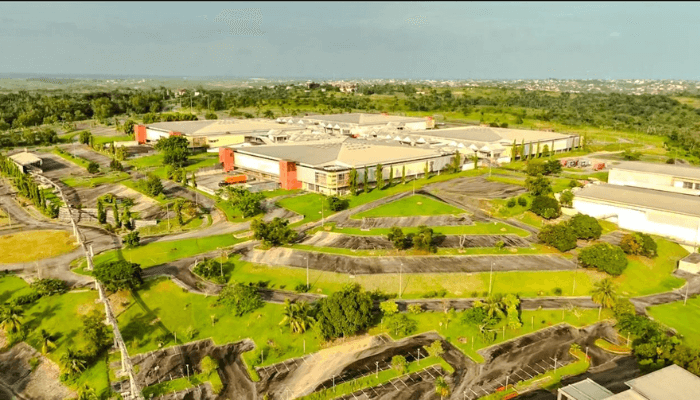
…Path ahead requires discipline, investment
For years, the Tinapa Business Resort & Free Zone vision attracted international attention.
Investors, tourists and development analysts saw the facility as a symbol of subnational ambition executed at an admirable scale.
On November 7, 2025, the Government of Cross River State announced a historic breakthrough: Tinapa had been fully repossessed from AMCON, ending years of legal ambiguity.

For many, the repossession of Tinapa represents the return of a pride symbol that once projected Cross River into global conversations. The repossession increases the state-owned infrastructure as a long-term asset, and ending legal disputes reassures local and international investors.
Read also: Hope for Tinapa as Otu breathes life into Cross River’s sleeping giant
The journey to the dark path…
Tinapa, strategically positioned near the Calabar Free Trade Zone, was intended to support duty-free shopping, large-scale trade, and international commercial traffic.
At its opening, it was easily one of the most sophisticated business and leisure estates in Nigeria. It was admired as a breakthrough. The combination of luxurious hotels, state-of-the-art retail spaces and seamless architectural design gave Cross River State an economic beacon unlike anything in the region.
The early years saw a surge of interest from businesses and tourists. Conferences were held there. Families flocked to the waterpark. Retail shops buzzed with activity. For a while, it worked.

Tinapa was alive, and Nigerians believed the promises that the state had finally found a non-oil revenue engine strong enough to rewrite the future. But despite the glamour of its launch and the massive capital investment it attracted, Tinapa began drifting toward uncertainty.
Once AMCON took over the management of the resort’s liabilities, the question of ownership entered a grey zone. Though Cross River State remained the initiator and principal stakeholder, the facility functioned under different operational and legal encumbrances that undermined the State’s direct control.
The ambiguity discouraged investors. Potential partners feared litigation. The general public viewed the once-glittering estate as a stranded asset.
Tinapa, in effect, became a majestic structure trapped in limbo, unable to operate freely, yet too valuable to abandon.
For years, successive governments attempted negotiations, renegotiations and legal reviews. But it was not until 2025 that a breakthrough finally came.
The repossession, economically necessary…
The repossession, which officials described as “decisive, strategic and economically necessary,” restored the resort as the bona fide property of the Cross River State Government.
Cross River State Governor, Bassey Otu, in his remarks at the repossession celebration, delivered a set of statements that captured both the gravity of the moment and the optimism of the State moving forward.
He said: “Today’s event has finally removed the legal lacuna on the ownership of Tinapa, which is now the bona fide property of the Cross River State Government.”
He added: “We are not only reclaiming the facility, but also increasing the stock of our enduring infrastructure.
“The return of Tinapa is not merely an event; it is a rebirth, the triumph of faith, patience,l and resilience.
“This is more than reclaiming an asset; it is the revival of a vision that once placed Cross River on the global economic map.
He reaffirmed his administration’s commitment under the “People First Agenda” to reposition Tinapa as a thriving hub for trade, tourism, and creative enterprise.
He further revealed that discussions were already ongoing with credible investors and partners to transform the facility into a dynamic centre of commerce and job creation, guided by transparency and accountability.
Otu also expressed gratitude to the Federal Government, AMCON and other relevant agencies for their cooperation throughout the transition process, commending all stakeholders who played key roles in ensuring the successful handover.
Read also: Can Tinapa’s fading glory be restored?
On his part, Mike Odere, Commissioner for Finance, Cross River State lauded the development as a symbol of renewed pride and optimism for the state.
“It means pride, it means reawakening, it means renewed hope as we are now free to attract investors and reposition the facility for maximum impact,” he said.
Also commenting, Shola Lamide, Executive Director of AMCON, noted that the corporation had acquired Tinapa in 2011 but faced challenges attracting private investment to revive it.
He described the handover as “a win for both AMCON and the people of Cross River.”
For many, the repossession was more than a bureaucratic win; it was clearly symbolic. It represented a return to clarity. A restoration of dignity. A renewed belief in the state’s ability to steward its most valuable assets.
According to investment experts, the path ahead will require discipline, investment and sustained political will. But for the first time in years, Tinapa is positioned on a runway, engines humming, ready to take off.

An ambitious developmental project…
On April 2, 2007, former Nigerian President Olusegun Obasanjo inaugurated the first phase of the Tinapa Business Resort & Free Zone in Calabar, one of the most ambitious developmental projects ever embarked upon by the Cross River State Government.
It was a vision birthed by then-Governor Donald Duke to transform the state into the economic heartbeat of West Africa.
More importantly, it was designed as a fulcrum for job creation, revenue generation, tourism resuscitation, economic emancipation and development revolution.
After the glitz and glam that heralded its inauguration, the project, in 2011, sailed into a man-made financial tempest that grounded it. When all revival efforts failed, it was subsequently taken over by the Asset Management Corporation of Nigeria (AMCON).
Nonetheless, Tinapa’s story, from its glittering conception to its paralysis, public debt and eventual repossession by the Cross River State Government in 2025, reads like an epic. It has been described in many quarters as a decisive victory that will rewrite the state’s story for future glory.
Tinapa was conceived at a time when Cross River State sought to reinvent itself as a globally competitive investment destination. As the State transitioned away from oil dependency and aggressively promoted tourism, the government envisioned a complementary commercial nerve centre, one that would blend leisure, trade and business.
The resort was designed as a mixed-use development with world-class retail facilities, wholesale emporiums, a film studio (Studio Tinapa), hotels, entertainment complexes and Africa’s largest waterpark at the time. The aspiration was not merely infrastructural; it was structural. Tinapa was intended to serve as what Governor Otu recently described as “an enabler of the socio-economic transformation of the State.”
However, Tinapa’s decline did not occur overnight. It was gradual, layered and deeply tied to regulatory constraints. The very engine that was supposed to power the resort, duty-free operations, ran into federal Customs restrictions that crippled the resort’s core business model. Goods meant to be traded freely were trapped in layers of bureaucracy.
Without free-flowing international commerce, Tinapa’s retail sector lost its competitive edge. Shops closed. Investors exited. Foot traffic dwindled. Financial pressure mounted and the State, unable to maintain the massive infrastructure without the projected revenue streams, found itself sinking into debt. The project that once symbolised progress became an emblem of stalled potential.
It was during this period of financial distress that Tinapa fell under the management and supervision of the Asset Management Corporation of Nigeria (AMCON), which had stepped in to recover debt obligations.
Read also: Otu hails return of Tinapa, says marks economic rebirth
Now that the legal knots have been unravelled, the state government is implementing the first phase of a sweeping revitalisation agenda.
The first is infrastructure rehabilitation, as some components of Tinapa require modern upgrades, ICT, water systems, lighting, hotel refurbishment and road access enhancement.
The state plans new business models by shifting Tinapa’s focus from purely retail to a diversified economic base, including: processing zones; creative industries; technology incubation; transport and logistics hubs; conference tourism and film and media production
One major growth strategy of Tinapa is the partnership-driven framework built around it. The state government says viable partners, local and global, have already expressed interest. Sectors like agro-processing and manufacturing are high on the list, promising sustainable jobs and export earnings.
To protect the gigantic project, the state government is bolstering regulation by engaging with federal agencies to ensure Tinapa enjoys smoother commercial operations, free from the regulatory chokeholds that crippled it in the past.
Governor Otu’s statements at the repossession ceremony reveal a clear philosophical direction.
Tinapa is to be reborn as a driver of statewide socio-economic transformation.
Business owners welcome the move, hoping it will catalyse wider infrastructure upgrades. Also, young people express optimism about new job opportunities.