|
Getting your Trinity Audio player ready...
|
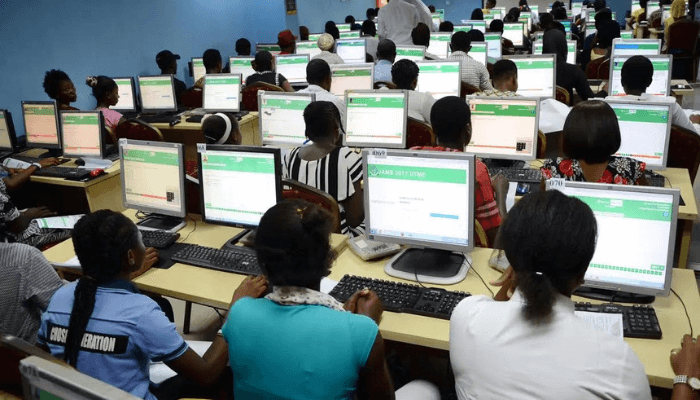
The West African Examinations Council (WAEC) has insisted the 2026 West African Senior School Certificate Examination (WASSCE) will be conducted strictly as a computer-based test, maintaining its commitment to modernising assessment across the country.
Amos Dangut, the head of the Nigeria National Office (HNO) at WAEC, disclosed this to journalists after the 63rd Nigeria National Council (NNC) meeting held in Umuahia, Abia State.
Binta Abdulkadir, the chairman of WAEC Nigeria National Committee had announced that the council will commence the conduct of CB-WASSCE from 2027.
Dangut in the media brief emphasised that only an official communication, not media reports could change the council’s plan of implementing CB-WASSCE as earlier announced.

“As we speak, we are only hearing that there is a discourse at the National Assembly. We have searched and found no formal communication.
“WAEC is a structured organisation; we act only on official directives. Whenever any directive reaches us, we will consider it and take the decision that best promotes learning and sustainable human development,” he said.
However, he promises the pilot testing of CBT-WASSCE in 2026 will go on as planned, insisting there is nothing like suspension of the examination model.
Read also: Reps ask FG to suspend computer-based WAEC examinations till 2030
Dangut emphasied that the council is yet to receive any formal directive from the National Assembly to suspend its planned migration of WASSCE to computer-based examinations (CBE).

WAEC insists that the phased transition, scheduled to commence with pilot testing in 2026, remains on course.
Dangut reiterated that the plan is to conduct pilot testing only in schools with the required ICT facilities, many of which have already volunteered.
“For schools without the necessary infrastructure, WAEC will utilise existing community-based CBE centres,” he noted.
Meanwhile, Dangut speaking on the revised basic and secondary school curricula, said that the review was a federal government initiative and that WAEC aligns its syllabuses only to reflect approved content.
However, he stressed that the two newly introduced core subjects, Citizenship and Heritage Studies, and Digital Technologies, will not be examined in 2026 and 2027 due to the ongoing development of their curricula and syllabuses.
“They are expected to be assessed from 2028, once full implementation begins. This means candidates for the 2026 and 2027 WASSCE diets will sit only three core subjects: English Language, General Mathematics, and one trade subject.
“They will then select additional subjects to reach the approved minimum of eight and maximum of nine subjects,” he said.
Furthermore, he explained that the federal government streamlined trade subjects from 26 to six, with some subjects renamed but retaining their curriculum content.
Dangut cleared the air on students being barred from registering some other subjects outside their field.
“Science students will not be barred from taking Economics as an elective,” he noted.
He encouraged journalists to help educate the public on the benefits of CBE, noting that trials conducted so far have shown improved candidate performance, reduced malpractice below international thresholds, and strong student enthusiasm in pilot centres.